Spacesheep: A New Take on 3D Games and Chip Design in the Browser
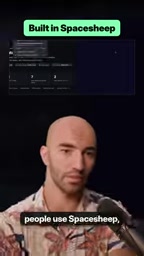
Spacesheep uses browser-based 3D creation to cover both games and chip visualization, demonstrating the cross-domain potential of a general-purpose engine.
Based on a YouTube video, the article introduces two application cases of the Spacesheep platform: a 3D game running entirely in the browser, and an interactive visualization tool for chip design. The former reflects the browser's ability to handle real-time 3D as WebGL, WebGPU and other web graphics technologies mature; the latter demonstrates the possibility of transforming highly specialized chip structures into intuitive 3D interfaces. The creator is still in the exploration stage, reflecting the early adoption state of emerging tools. The article argues that this span from entertainment to professional work hints at the versatility and flexible abstraction of the underlying engine, with low-barrier creative tools breaking down domain boundaries—though Spacesheep's technical architecture and production-grade performance remain to be seen.
From Games to Chips: Spacesheep's Cross-Domain Practice
Recently, a video on YouTube showcased the diverse application scenarios of a platform called Spacesheep (mispronounced as Spaceship in the video). The creator highlighted two impressive examples: a 3D game running directly in the browser, and an interactive visualization tool for chip design. These two cases may seem completely unrelated, yet they both point to the same trend—low-barrier, high-expressiveness creative environments are breaking down the boundaries of traditional fields.
A 3D Game in the Browser
The video first presents a 3D game running entirely in the browser. According to the creator, this game was built using Spacesheep. No client installation, no complex configuration—just open the webpage and play. What this reflects is the maturity of the web technology stack: the widespread adoption of graphics interfaces like WebGL and WebGPU has given browsers the ability to handle real-time 3D rendering. Spacesheep appears to further lower the development barrier, allowing creators to focus more on the content itself.

For indie developers and small teams, this "out-of-the-box" 3D development environment means faster prototype validation and lower trial-and-error costs. Rendering pipelines that once took weeks to set up may now require only a few lines of configuration.
WebGL and WebGPU are two generations of core interfaces for real-time 3D rendering in browsers. WebGL is based on OpenGL ES and has been supported by mainstream browsers since 2011, calling the GPU via JavaScript to complete rendering and laying the foundation for web 3D. WebGPU is its successor, mapping the design of modern graphics APIs (such as Vulkan, Metal, DirectX 12), offering lower CPU overhead, compute shaders, and finer resource control—suitable for high-performance rendering and general-purpose GPU computing. The widespread adoption of both means browsers are no longer just document viewers but runtime environments capable of hosting complex graphics applications—precisely the underlying prerequisite that enables platforms like Spacesheep to be "out-of-the-box."
Interactive Visualization for Chip Design
Another case mentioned relates to chip design. The video shows an interactive visualization interface that allows users to explore the internal structure of a chip. The creator admitted, "I don't really understand this, but someone does," which precisely illustrates the tool's universality—it can serve professional engineers while also letting laypeople glimpse the mysteries of complex systems.

Chip design has traditionally been a highly specialized field, relying on expensive EDA tools and deep hardware expertise. Presenting chip structures in interactive 3D form not only aids teaching and presentations but may also provide a new communication language for cross-team collaboration. Engineers can intuitively demonstrate design intent to non-technical decision-makers, reducing misunderstandings.

EDA (Electronic Design Automation) tools are the core software of chip design, covering the entire flow from RTL synthesis and place-and-route to physical verification. Traditional EDA tools are dominated by vendors such as Synopsys, Cadence, and Siemens EDA, with high licensing costs and highly specialized interfaces that typically require years of training to master. Visualizing chip structures in interactive 3D does not replace EDA's simulation and verification functions but supplements the "understanding" step: it transforms layouts, module hierarchies, and signal paths into rotatable, zoomable spatial models, reducing the cognitive cost of cross-role communication—especially valuable in teaching, design reviews, and cross-team collaboration.
The Creator's Self-Exploration
In the latter half of the video, the creator shares their experience with Spacesheep: "I'm still exploring, still learning how to really use it and what I can do with it." This candid statement reflects the typical adoption curve of new tools—early users are often drawn in by their potential but need time to figure out best practices. Spacesheep's positioning seems not limited to a single scenario but rather offers a general-purpose creative canvas; what you draw depends on your imagination.
Industry Signals from Low-Barrier Creative Tools
Spacesheep's case is not an isolated one. In recent years, from Figma to Canva, from Unity to Godot, the common evolution direction of creative tools has been to reduce cognitive load and improve collaboration efficiency. Spacesheep's distinguishing feature lies in deeply integrating 3D content creation with the browser environment while covering two extreme scenarios—entertainment (games) and professional (chip design).
This span—"games on one end, chips on the other"—suggests the versatility of the underlying engine. If the same set of tools can simultaneously satisfy real-time rendering and complex data visualization, then its abstraction layer design must be quite flexible. For developers, this means learning one skill set may yield transferable cross-domain capabilities.
Of course, publicly available information is still limited. Spacesheep's specific technical architecture, performance, and ecosystem support remain to be seen. The cases in the video are more like proof-of-concept demonstrations than tests in large-scale production environments. But at least it gives us a starting point for reflection: as creative tools become increasingly "transparent," the barrier to innovation will only get lower.
"Abstraction layer" refers to the intermediate representation that tools establish between underlying hardware and upper-layer content. The more flexible the abstraction layer, the better the same engine can adapt to vastly different scenarios: games require low-latency real-time rendering and input response, while chip visualization emphasizes hierarchical organization and precise picking of large-scale data. Shared underlying capabilities include scene graph management, material and lighting systems, camera control, and event handling. When these capabilities are encapsulated as general-purpose primitives, creators need not worry about GPU instructions or data structure details—they simply describe "what to present," and the tool handles "how to present it." This is precisely the technical logic by which low-barrier tools achieve cross-domain transfer.
Conclusion
Spacesheep's appearance in the YouTube video demonstrates another possibility for browser-based 3D creation. Whether for games or chip design, the ultimate value of a tool lies in unleashing creativity. For tech professionals, paying attention to emerging platforms like this may lead to more efficient ways of expression in the next project.
Related articles

9 AI Subscription Plans Compared: The Real Cost Per 100M Tokens Revealed
Bilibili creator tests 9 AI subscription plans from Volcano, Alibaba, Tencent, Baidu, Zhipu, Xiaomi, MiniMax and more, converting them all to real cost per 100M tokens, breaking down fixed-quota vs. three-tier coefficient billing and how caching, time-of-day discounts, and window limits affect actual quota.

Vibe Coding for Beginners: Expressing Intent Instead of Handwriting Code
What is Vibe Coding? A 137-episode Bilibili course defines it: the core is expressing intent, not writing code. This article analyzes Vibe Coding's productivity logic, target audience, and entry expectations to help beginners decide if it's worth learning.

LangChain Beginner's Guide: An Agent Development Roadmap from LangGraph to Deep Agents
Clarify the encapsulation relationship among LangChain, LangGraph, and Deep Agents, and master the learning path and selection logic for agent development frameworks—suitable for beginners in large model development.