SpaceX and Tesla Merging? Look at the Risks First

Behind the SpaceX-Tesla merger rumors, SpaceX's credit risk rises due to $40B chip borrowing.
The article discusses rumors that SpaceX and Tesla have formed a special committee to evaluate a merger, noting that the market overlooks SpaceX's rising credit risk—it plans to borrow another $40 billion to buy NVIDIA chips. Supporters value the Musk ecosystem integration story, while opponents worry about high debt and capital expenditures dragging down finances. The article analyzes the computing power race and debt risk behind chip procurement, explains the special committee's role and regulatory complexity, and suggests tracking three signals: committee progress, debt financing terms, and Tesla's AI computing investment disclosures.
Title
SpaceX and Tesla Merging? Look at the Risks First
Meta Description
SpaceX and Tesla are reportedly forming a special committee to discuss a merger, but SpaceX faces elevated credit risk due to borrowing $40 billion to buy NVIDIA chips. This article analyzes the potential motives, financial risks, and regulatory hurdles of the merger to help you clarify the key signals behind this deal.
Article Content
Recent reports indicate that SpaceX and Tesla have formed a special committee to discuss the possibility of a merger between the two companies. This news has sparked heated discussion in the tech community, but much of the discussion overlooks a key background: SpaceX's credit risk is rising because it is about to borrow another $40 billion to purchase NVIDIA chips.
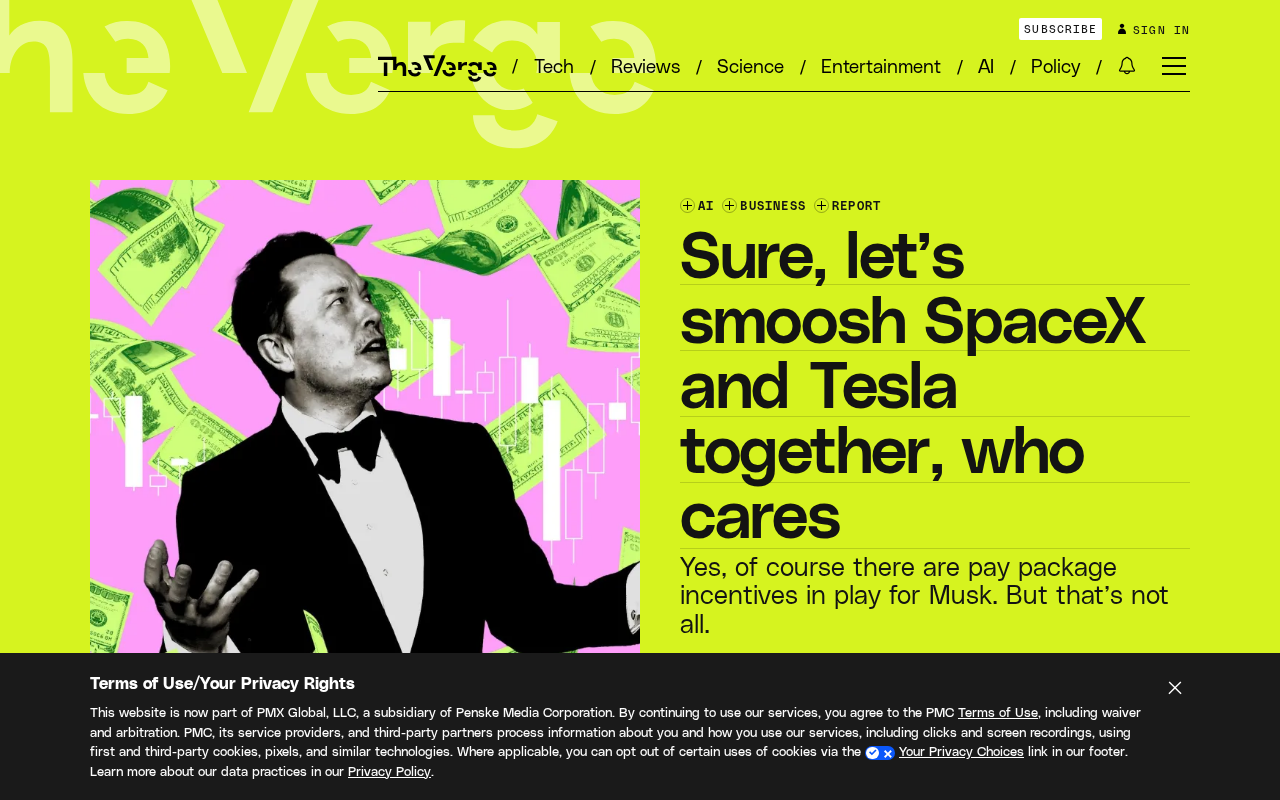
The Contradiction Between Merger Rumors and Credit Risk
According to an RSS source report, discussions about a SpaceX-Tesla merger have reached the special committee stage. On the surface, this seems like a big move in Musk's empire to integrate resources—rockets, electric vehicles, AI chips, tunnel transportation—the imagination space is enormous.
But the report also points out that SpaceX's credit risk is "quite high" because it plans to borrow another $40 billion to procure NVIDIA chips. If this massive debt is compounded by the financial complexity brought by the merger, the balance sheet of the new entity could become even more fragile.
Why This Merger Is So Contentious
The original author used a half-joking tone: "How attractive you find this merger probably depends on how much you..." (the rest is cut off). This phrasing implies that there are clear differences of opinion on the merger.
From an optimistic perspective, the merger could connect Tesla's AI computing needs with SpaceX's satellite network and launch capabilities, forming a closed loop from ground to space. From a cautious perspective, SpaceX's high debt and capital expenditures on chip procurement could drag down Tesla's originally relatively stable financial performance.
Credit Risk in financial markets refers to the possibility that a borrower cannot repay debt principal and interest on time. Rating agencies and bond investors typically assess credit risk based on a company's debt level, cash flow stability, industry cyclicality, and other factors. As a private company, SpaceX's credit status is mainly reflected through spreads in the private debt market and private assessments by institutional investors. When the report says its credit risk is "quite high," it means the market is concerned about its ability to repay new debt, which could lead to higher future financing costs and thus compress profit margins. For an entity planning to merge, the compounding effect of credit risk is particularly critical—the two companies' debt structures, cash flow characteristics, and risk exposures need to be considered comprehensively, not simply added together.
The Computing Power Race Behind Chip Procurement
$40 billion for purchasing NVIDIA chips—this figure itself speaks volumes. SpaceX's Starlink and Starship projects both require massive computing power support—from satellite network optimization to flight simulation, and even future space data center concepts.
But borrowing money to buy chips is a high-risk strategy. Chips depreciate quickly, while debt is rigid. If the merged company cannot quickly convert computing power into revenue, financial pressure will quickly become apparent.
NVIDIA chips play a core role in the current AI computing power race. Its GPUs (such as the H100 and B200 series) are mainstream hardware for training large models and running high-performance computing. However, these chips are updated very quickly, typically with a new generation every 1-2 years, causing the market value of older models to decline rapidly. For companies borrowing money to buy chips, this constitutes a special asset depreciation risk: debt is a fixed amount and must be repaid on schedule, while the chips serving as collateral are rapidly depreciating. In addition, NVIDIA chip supply is affected by export control policies, with high uncertainty in procurement cycles and deliveries. If SpaceX uses the chips for Starlink network optimization and Starship flight simulation, it needs to ensure that computing power investment can be converted into quantifiable operational efficiency improvements or revenue growth; otherwise, debt pressure will be difficult to offset.
What the Special Committee Means
Forming a special committee to discuss a merger usually means the transaction has entered a substantive evaluation stage, rather than being a simple rumor. The committee needs to assess valuation, share exchange ratio, regulatory hurdles, and post-merger governance structure.
Considering that both companies involve national security and export controls (rocket technology, satellite communications), regulatory review will be lengthy and complex. This is also one reason why the market is cautious about the merger.
Special Committee in corporate governance usually refers to a temporary body composed of independent directors of the board, specifically responsible for evaluating major transactions (such as mergers, acquisitions, or privatization) to avoid conflicts of interest and ensure decision-making independence. For companies closely associated with Musk personally, such as SpaceX and Tesla, the role of the special committee is particularly sensitive—it needs to independently assess whether the transaction is fair to minority shareholders, including valuation methods, the reasonableness of the share exchange ratio, and post-merger governance arrangements. The establishment of a special committee does not guarantee that the transaction will necessarily proceed, but it indicates that both parties have entered a substantive stage of due diligence and term negotiation. Its final recommendations will directly affect the voting results of the board and shareholders' meeting, so the market is closely watching its composition, the financial advisors it hires, and interim announcements.
Export controls and national security review are key regulatory hurdles facing such a merger. SpaceX involves rocket launch technology, satellite communications (Starlink), and other areas strictly controlled by the U.S. International Traffic in Arms Regulations (ITAR) and Export Administration Regulations (EAR), while Tesla involves intelligent driving data and AI algorithms. After the merger, any technology transfer, data sharing, or equity structure change could trigger review by the Committee on Foreign Investment in the United States (CFIUS), especially if the merger involves foreign shareholders. In addition, qualifications such as satellite communication spectrum licenses and launch permits need to be reconfirmed or transferred after the merger, and the regulatory process could take months or even years. These reviews not only increase transaction costs but may also impose conditions such as business divestitures or data localization, thereby weakening the synergies of the merger.
My Judgment
The appeal of this merger largely depends on whether you value the "story" or the "numbers." From the story perspective, the integration of Musk's ecosystem is indeed exciting; from the numbers perspective, SpaceX's debt pressure and chip procurement capital expenditures are hard constraints that cannot be avoided.
For readers following this company, I recommend focusing on three signals: progress announcements from the special committee, the terms of SpaceX's new round of debt financing, and disclosures about AI computing power investment in Tesla's next quarterly earnings report.
The original information is limited and carries an obvious ironic tone. The above analysis is based on currently available public information and does not constitute investment advice.
One-line Summary
Behind the SpaceX-Tesla merger rumors, SpaceX's credit risk is rising due to borrowing $40 billion to buy chips.
Paragraph Summary
The article discusses rumors that SpaceX and Tesla have formed a special committee to evaluate a merger, pointing out that the market overlooks a key background: SpaceX's rising credit risk—it plans to borrow another $40 billion to buy NVIDIA chips. Supporters of the merger value the story of Musk ecosystem integration, while opponents worry that high debt and capital expenditures will drag down finances. The article analyzes the computing power race and debt risk behind chip procurement, explains the meaning of the special committee and the complexity of regulatory review, and recommends tracking three signals: committee progress, debt financing terms, and Tesla's AI computing power investment disclosures.
Related articles

LLaMA-Factory in Practice: A Complete No-Code Guide to Fine-Tuning Large Models
An introduction to LLaMA-Factory, the open-source fine-tuning tool: its 60.1K-star background, supported models and algorithms, local vs. cloud deployment, and CUDA setup steps.

Zeng Ming's Deep Retrospective: Why OpenAI May Not Be the Ultimate Winner — and Why the Corporate System Will Disappear
Zeng Ming's deep retrospective on the AI endgame: model companies are just infrastructure, OpenAI and Anthropic won't be the final winners; the next battle is the Agent entry point standard; the corporate system will disappear as AI restructures collaboration, and only mission-driven companies can survive the cycle.

OpenHands v1.28.0: OpenCode and PI Added as Built-in Agents, API Keys Requestable In-Conversation
OpenHands ships 5 releases in 21 days: v1.27.0 adds OpenCode and PI as built-in agents, v1.28.0 enables in-chat key requests. ACP integration, credential reuse, model list changes, and upgrade advice.