SpaceX Reportedly in Talks to Acquire Boost Mobile — Is Starlink Becoming a Carrier?

SpaceX and Boost Mobile are discussing an acquisition or network access deal to advance Starlink's mobile carrier plans.
According to The Washington Post, SpaceX has held discussions with Boost Mobile about a deal that could involve directly acquiring the value-focused prepaid carrier or accessing its network as an MVNO. Either way, the goal is to upgrade Starlink from a satellite broadband provider to a mainstream mobile carrier. Boost Mobile's appeal lies in its ready-made operations system, spectrum licenses, and regulatory qualifications, which could dramatically shorten the time SpaceX would need to build a network from scratch. The article notes the deal is still in discussion, with regulatory approval and deal structure as the main variables; if it moves forward, it would further blur the boundary between satellite communications and terrestrial carriers, and the mobile market could see a new competitor.
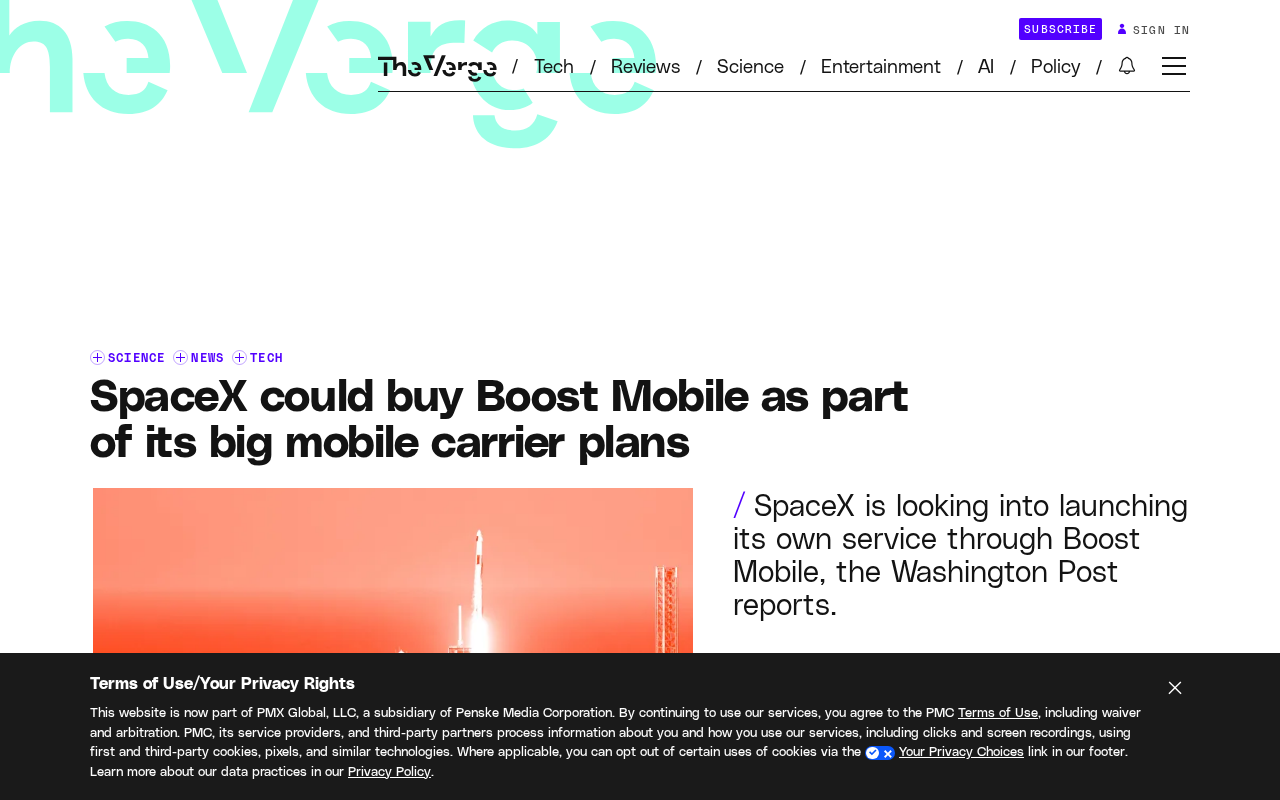
According to The Washington Post, SpaceX has held discussions with Boost Mobile about a deal to launch its own mobile service through the value-focused carrier. The transaction could take the form of a direct acquisition of Boost Mobile or an arrangement to gain access to its network. The move is directly tied to SpaceX's goal of turning Starlink into a "mainstream" mobile carrier.
Deal Outline: Acquisition or Network Access — Two Paths
Information disclosed so far is limited, but the core logic is clear: SpaceX needs the licenses, spectrum, and subscriber operations capabilities of a terrestrial mobile network, and Boost Mobile can provide at least some of these.
The report says the discussions involve two directions — a full acquisition of Boost Mobile, or some form of access to its network. The former would give SpaceX a ready-made carrier entity outright, while the latter looks more like an MVNO (mobile virtual network operator) model, delivering service atop existing network infrastructure.
Either way, the signal points to the same thing: Musk isn't satisfied with Starlink being just satellite broadband — he wants it to secure a place in the mobile communications market.
How MVNOs (Mobile Virtual Network Operators) Work
An MVNO is a carrier that doesn't own physical network assets such as wireless spectrum or base stations. Instead, it buys wholesale voice, data, and SMS capacity in bulk from an MNO (a mobile network operator that owns the network infrastructure) and resells services to consumers under its own brand. Typical examples include Mint Mobile and Google Fi in the U.S., as well as part of Boost Mobile's business model mentioned in this article. The advantage of an MVNO is low capital expenditure and fast market entry; the downside is a lack of control over network quality, coverage, and wholesale pricing costs — wholesale rates directly determine its profit margins. For SpaceX, the MVNO path would let it test the mobile market using the Starlink brand and satellite backhaul capabilities without shouldering the massive investment of building a nationwide terrestrial network. But if it relies on a partner's network long term, it will struggle to build differentiated competitiveness.
Why Boost Mobile
Boost Mobile is positioned in the U.S. market as a prepaid, low-cost mobile brand with a price-sensitive user base. For SpaceX, which wants to quickly break into the carrier space, the value of such an asset isn't its high-end users but its ready-made operations system, spectrum resources, and regulatory qualifications.
Applying for a carrier license from scratch and building a terrestrial network takes a long time, whereas acquiring or accessing a mature brand can dramatically shorten that process. This also explains why the report emphasizes Boost Mobile's "value" positioning — there's potential alignment with the remote areas and price-sensitive user groups Starlink aims to cover.
Why Spectrum and Carrier Licenses Are Scarce Resources
In the U.S., mobile carriers need FCC-issued spectrum licenses to offer commercial services and must meet regulatory obligations on network coverage and public safety. Low-band spectrum (such as 600MHz and 700MHz) has strong penetration and wide coverage, making it suitable for wide-area and remote network deployment, but very little of it exists and auction prices are high; mid-band (such as 2.5GHz) balances capacity and coverage and is the mainstay of 5G deployment; high-band (millimeter wave) offers large capacity but short coverage distance. Spectrum licenses are typically issued by region and by term, and transfers and acquisitions require FCC approval. For SpaceX, which has never held terrestrial mobile spectrum, directly acquiring a carrier with ready-made spectrum and licenses is far faster than participating in auctions or applying from scratch — and this is one of the core sources of Boost Mobile's asset value.
What Starlink's Carrier Ambitions Mean
SpaceX's goal of making Starlink a "mainstream" mobile carrier is worth noting in itself. Starlink's core business today is satellite broadband, while consumer-facing mobile communications service is a different game entirely: it involves spectrum allocation, coordination with terrestrial base stations, device compatibility, and regulatory compliance.
If SpaceX does launch mobile service, possible directions include using the satellite network to provide supplemental connectivity in areas with weak terrestrial coverage, or bundling satellite and terrestrial networks into integrated plans. But the report doesn't disclose specific technical solutions or business model details — for now, only the negotiation-level developments can be confirmed.
Background on Direct-to-Cell Technology
One of the technical foundations for Starlink's mobile service push is direct-to-cell, which lets ordinary smartphones establish a link directly with low-Earth-orbit satellites without going through terrestrial base stations. This approach faces engineering challenges such as tight link budgets, Doppler shift, and low antenna gain on both satellites and phones. It typically requires terrestrial spectrum held by carriers (such as PCS bands) as the satellite downlink/uplink frequencies, and spectrum sharing with terrestrial networks to avoid interference. SpaceX has already partnered with T-Mobile on such services and launched satellites supporting direct-to-cell. If it acquires or gains access to Boost Mobile, SpaceX could obtain its spectrum resources and operating qualifications, expanding direct-to-cell from a partnership pilot into a commercial service under its own brand — and this is the key technical context for understanding the motivation behind this deal.
Uncertainties and Factors to Watch
The deal is still in the discussion stage and far from settled. The Washington Post report uses the phrase "have discussed," indicating the two sides have been in contact, but whether a deal can be reached and in what form remain variable.
Regulatory approval is another key variable. SpaceX acquiring a U.S. mobile carrier would inevitably involve antitrust and telecommunications regulatory review. In addition, Boost Mobile's parent company background and asset structure will also affect the complexity of the transaction.
For the industry, if the deal moves forward, it will be a signal: the boundary between satellite communications companies and terrestrial carriers is blurring, and the competitive landscape of the mobile communications market may see a new entrant. But until official news lands, all of this remains reasonable inference based on reporting.
One-line Summary
SpaceX is discussing an acquisition or network access deal with Boost Mobile to advance its Starlink mobile carrier plans.
Paragraph Summary
According to The Washington Post, SpaceX has held discussions with Boost Mobile about a deal that could involve directly acquiring the value-focused prepaid carrier or accessing its network as an MVNO. Either way, the goal is to upgrade Starlink from a satellite broadband provider to a mainstream mobile carrier. Boost Mobile's appeal lies in its ready-made operations system, spectrum licenses, and regulatory qualifications, which could dramatically shorten the time SpaceX would need to build a network from scratch. The article notes that the deal is still in discussion, with regulatory approval and deal structure as the main variables; if it moves forward, it would mark a further blurring of the boundary between satellite communications and terrestrial carriers, and the mobile communications market could see a new competitor.
Related articles

9 AI Subscription Plans Compared: The Real Cost Per 100M Tokens Revealed
Bilibili creator tests 9 AI subscription plans from Volcano, Alibaba, Tencent, Baidu, Zhipu, Xiaomi, MiniMax and more, converting them all to real cost per 100M tokens, breaking down fixed-quota vs. three-tier coefficient billing and how caching, time-of-day discounts, and window limits affect actual quota.

Vibe Coding for Beginners: Expressing Intent Instead of Handwriting Code
What is Vibe Coding? A 137-episode Bilibili course defines it: the core is expressing intent, not writing code. This article analyzes Vibe Coding's productivity logic, target audience, and entry expectations to help beginners decide if it's worth learning.

LangChain Beginner's Guide: An Agent Development Roadmap from LangGraph to Deep Agents
Clarify the encapsulation relationship among LangChain, LangGraph, and Deep Agents, and master the learning path and selection logic for agent development frameworks—suitable for beginners in large model development.