SpaceX Starlink Deployed 1,589 Satellites in H1 2026, Setting a New Record Pace

SpaceX launched 1,589 Starlink satellites in H1 2026, beating last year's record-setting pace.
SpaceX deployed 1,589 Starlink satellites in the first half of 2026, surpassing the 1,489 launched in the same period of 2025. The acceleration is driven by Falcon 9's high reusability, optimized satellite packing, and a maturing mass-production pipeline. With Starship on the horizon, annual deployment rates could multiply further, widening SpaceX's already substantial lead over rivals like Amazon Kuiper and China's Qianfan.
SpaceX Starlink Maintains Strong Deployment Momentum
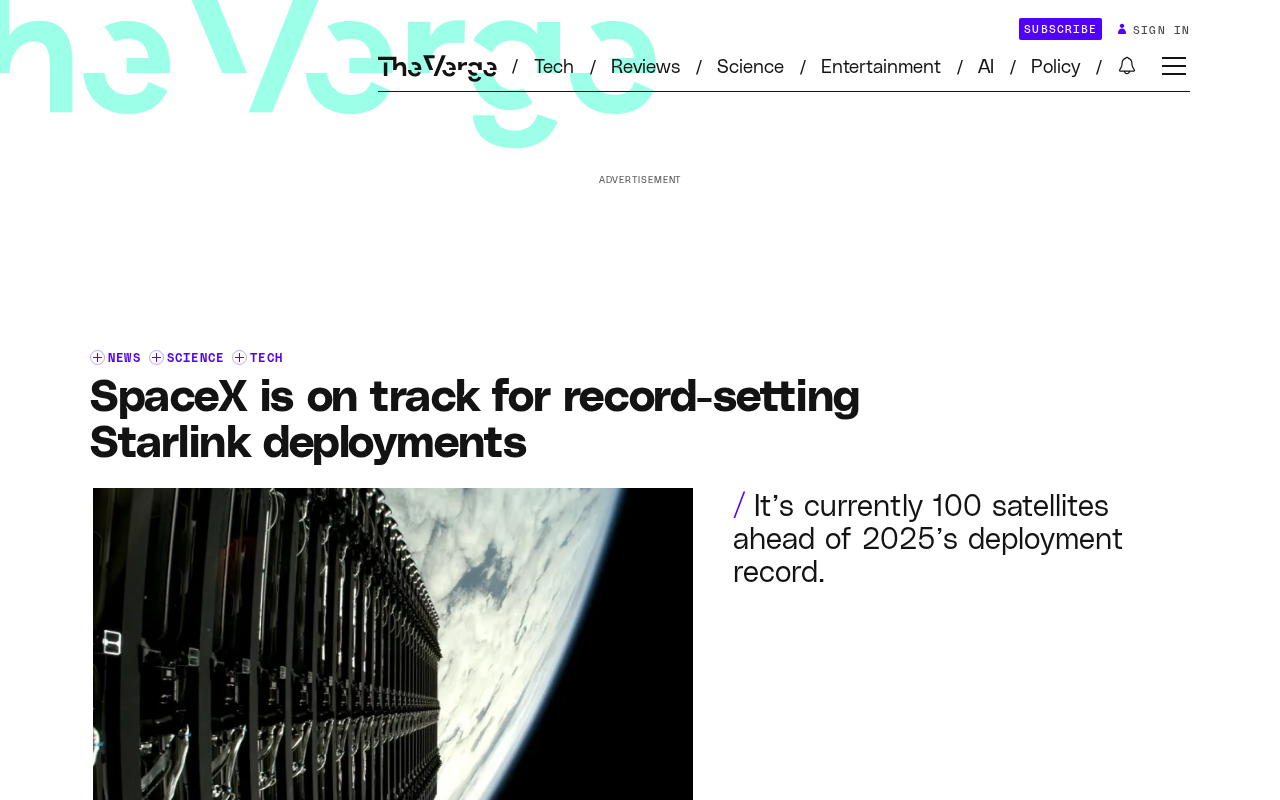
SpaceX continues to expand its Starlink satellite constellation at a pace that outstrips last year's. According to satellite tracking data compiled by astronomer Jonathan McDowell, SpaceX launched 1,589 Starlink satellites into low Earth orbit during the first half of 2026, up from 1,489 during the same period in 2025.
2025 was already a record-breaking year for Starlink deployments, and the latest first-half figures have already surpassed that benchmark — a clear sign that SpaceX's satellite internet constellation is expanding at an unprecedented rate. This momentum reflects SpaceX's technical edge in rocket reusability and launch cadence, as well as robust global demand for Starlink services.
The Logic Behind Accelerating Deployments
Going from 1,489 to 1,589 satellites — an increase of roughly 100 — may not sound dramatic, but in the context of aerospace engineering, it represents higher launch frequency, improved booster reusability, and a more mature satellite mass-production pipeline.
SpaceX primarily relies on the Falcon 9 for its intensive Starlink launch cadence. The Falcon 9's high-frequency launch capability is rooted in its pioneering first-stage recovery and reuse technology — using grid fins for attitude control, engine retroburns for deceleration, and landing legs for cushioning, the first stage can be precisely recovered on drone ships or land-based landing zones and then refurbished for reuse. As of 2026, some Falcon 9 boosters have flown more than 20 missions, dramatically reducing the cost per launch. For Starlink missions specifically, SpaceX has also optimized satellite packing density, with each mission carrying approximately 20–23 V2 Mini Starlink satellites, enabling annual deployment numbers to keep breaking records.
As Starship gradually enters commercial operations, this dynamic could undergo a fundamental shift. Starship is SpaceX's fully reusable super-heavy-lift launch vehicle system, consisting of the Super Heavy booster and the Starship upper stage, with a design target of over 100 metric tons to low Earth orbit — roughly six times the capacity of Falcon 9. For Starlink deployment, Starship's key value lies in its ability to carry hundreds of satellites per mission, theoretically multiplying the current annual deployment rate several times over. Once Starship reaches mature commercial operations, it will fundamentally reshape Starlink's expansion speed and cost curve, accelerating the deployment trajectory even further.
What Starlink's Scale Actually Means
Starlink's core goal is to deliver global high-speed internet coverage via a low-orbit satellite constellation, with a particular focus on remote areas, maritime, and aviation environments where traditional ground-based networks fall short. To appreciate this, it helps to understand the technical advantages of LEO satellites: low Earth orbit satellites typically operate at altitudes between 160 and 2,000 km. Compared to traditional geostationary orbit (GEO) satellites at roughly 35,786 km, LEO satellites reduce signal propagation latency to just 20–40 milliseconds — approaching the experience of terrestrial fiber networks. However, a single LEO satellite covers a far smaller area than a GEO satellite, which is why hundreds or thousands of satellites are needed to form a constellation capable of seamless global coverage through overlapping orbital planes. Starlink's current operational satellites are primarily distributed across orbital shells at 540 to 570 km altitude, and SpaceX has received FCC approval to deploy next-generation satellites at a lower 340 km orbit to reduce latency further.
The steady growth in on-orbit satellite count directly drives three critical metrics: network capacity, coverage density, and service quality. As the constellation scales up, Starlink can serve more users with lower latency and higher bandwidth. For sectors such as aviation, maritime, emergency communications, and defense, a denser satellite deployment also means stronger service continuity and redundancy.
Competitive Landscape and Industry Impact
SpaceX's lead in deployment cadence is raising the competitive bar for the entire satellite internet industry. Amazon's Kuiper project plans to deploy approximately 3,236 LEO satellites, also targeting global broadband internet service. Unlike SpaceX, Amazon must rely on third-party launch vehicles — including its own Blue Origin New Glenn, United Launch Alliance's Vulcan, and Europe's Ariane 6 — leaving it at a notable disadvantage in launch cost and frequency. Additionally, Europe's OneWeb (now part of Eutelsat) has around 600 satellites in orbit, and China is advancing national-level LEO constellation programs such as Qianfan. Measured by on-orbit scale, user base, and technological maturity combined, SpaceX's lead remains difficult to close in the near term.
That said, Starlink's rapid expansion has also sparked discussions about occupation of low Earth orbit resources, space traffic management, and interference with astronomical observations. Underlying these concerns is a scientific risk that cannot be ignored — the "Kessler Syndrome": in 1978, NASA scientist Donald Kessler proposed that if orbital debris density exceeds a critical threshold, collisions would generate cascading debris, ultimately rendering certain orbital altitudes unusable. The U.S. Space Surveillance Network currently tracks more than 27,000 on-orbit objects, while the estimated number of millimeter-scale debris fragments runs into the millions. SpaceX has addressed this by equipping Starlink satellites with autonomous collision avoidance systems and committing to deorbit them within five years of end-of-life. Nevertheless, as on-orbit satellites surpass thousands and even tens of thousands, with multiple commercial constellations from various countries expanding in parallel, how the international community can establish effective orbital traffic rules and debris mitigation standards has become an urgent global governance issue. Striking a balance between commercial expansion and the long-term sustainability of space will be a core challenge SpaceX and the broader industry must navigate for years to come.
Outlook: More Records Ahead
At the current deployment pace, 2026 is very likely to become yet another record year for Starlink. SpaceX continues to consolidate its dominant position in the global satellite internet sector, backed by a highly mature launch infrastructure and vertically integrated manufacturing capability.
For users, a larger constellation means a better service experience. For the industry, every record SpaceX sets redefines what is possible in commercial spaceflight. As Starship's payload capacity comes online, Starlink's deployment curve may be on the verge of another historic leap — at which point, deploying thousands of satellites per year will no longer be a theoretical projection, but an entirely foreseeable engineering reality.
Key Takeaways
Related articles

Apple HomeView Hands-On Review: Is the $300 Smart Home Hub Worth It?
Apple HomeView hands-on: a $300 smart home hub with facial recognition for quick account switching, but no App Store or voice recognition. Is the wall-mounted version worth it? Should you buy the first generation?

Meta Muse Wonder Launch: What It Means for Meta's Return to the Frontier AI Race
Meta releases Muse Wonder and WonderFull, benchmarks reach the frontier, community feedback is polarized. An in-depth look at Meta's return to the frontier AI race, its personal agent strategy, and Zuckerberg's different path.

Apple Home Smart Home Lineup Leaked: LG and Schneider Team Up, UWB Door Lock on Board
Apple Home ecosystem gains new LG and Schneider devices: UWB smart lock with proximity unlock, 2.5K dual-camera doorbell, privacy indoor camera, and AirPods-like seamless pairing.