SpaceX to Attempt Full Recovery of Starship and Booster for the First Time

Musk says SpaceX will attempt to catch both Starship and its booster next month for the first full orbital launch system recovery.
SpaceX plans to attempt catching both the Starship spacecraft and Super Heavy booster next month for the first time. If successful, it would be the first complete recovery of all major components of an orbital-class launch vehicle. Boosters have been caught before, but spacecraft recovery remains unproven. The spacecraft faces extreme re-entry heat and must precisely align with the capture mechanism, making it far harder than booster capture. Musk's timelines are historically optimistic, and complete recovery is one of the toughest milestones. Success would further lower orbital costs and affect satellite deployment and lunar missions, but refurbishment cost and turnaround time will determine whether the reuse economy truly works.
One Recovery, Rewriting Spaceflight History
SpaceX CEO Elon Musk recently stated that the company will attempt to simultaneously catch the Starship spacecraft and the Super Heavy booster next month, aiming to achieve the first complete recovery of an entire orbital launch system. If successful, this would be the first time in human history that all major components of an orbital-class launch vehicle are brought back from the edge of space and reused.
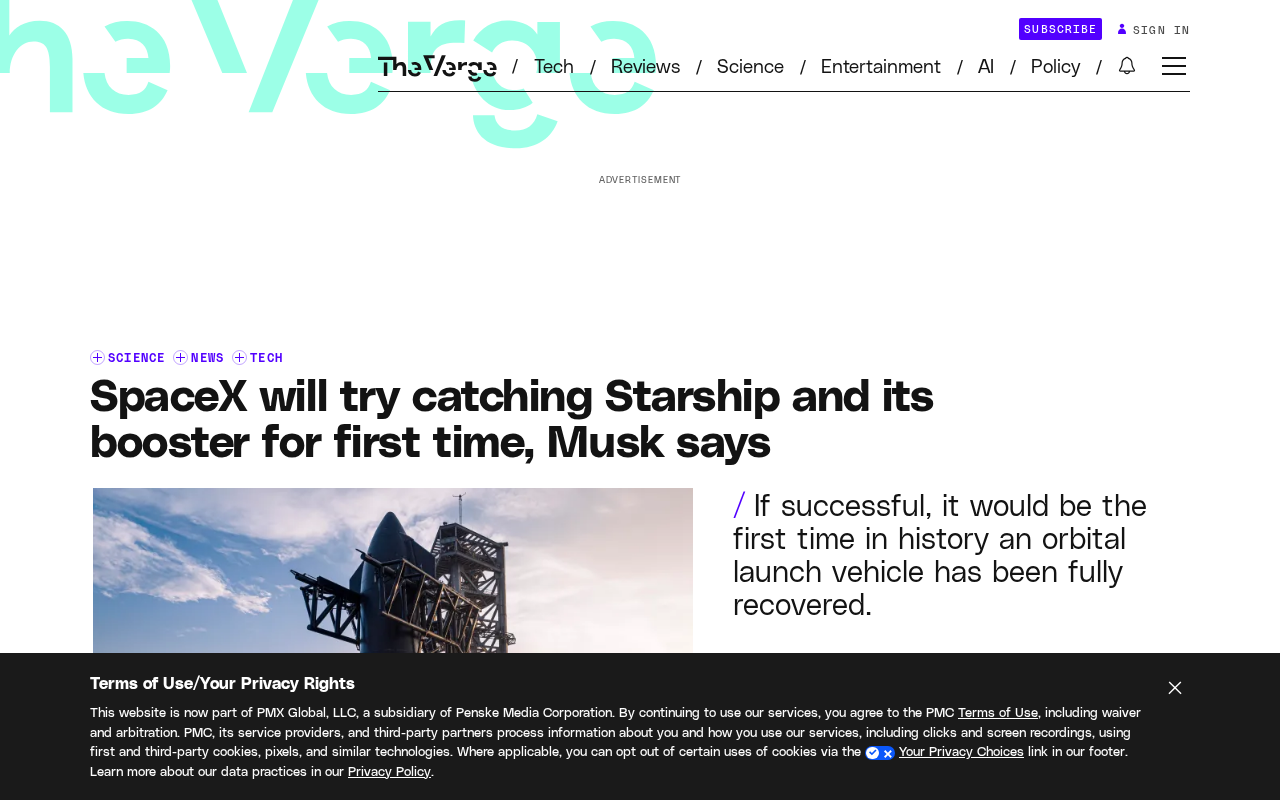
This statement came from Musk's public comments on the progress of the Starship program. SpaceX has already successfully caught returning boosters multiple times using the launch tower's "chopstick" robotic arms, but recovery of the spacecraft itself has always been the missing piece. What Musk means by "complete recovery" is that both the booster and the spacecraft must return and be captured after launch, rather than letting the spacecraft re-enter the atmosphere and splash down in the ocean as in the past.
Why This Attempt Deserves Attention
From "Partial Reuse" to "Full Reuse"
Reusability is the core logic behind SpaceX's efforts to lower launch costs. Falcon 9 has already proven the feasibility of booster reuse, but Starship is more ambitious: it aims to reuse not only the booster but also the spacecraft itself. The spacecraft is the largest, most structurally complex part of the system, and it faces the harshest re-entry thermal environment. Bringing the spacecraft back intact would turn the entire launch system into a recyclable asset rather than a single-use consumable.
From an engineering perspective, catching the spacecraft is far more difficult than catching the booster. After separation, the booster has lower velocity and a relatively controllable trajectory; the spacecraft, by contrast, must re-enter from orbital velocity, withstand temperatures of over a thousand degrees Celsius, and precisely align with the launch tower's capture mechanism in the final phase. Any significant deviation in any step means failure.
The "orbital-class" nature of the Starship system is key to understanding its recovery difficulty. An orbital-class launch vehicle refers to a rocket capable of delivering payloads to Earth orbit or higher-energy trajectories, with flight speeds and altitudes far exceeding those of suborbital tests. After completing an orbital mission, the Starship spacecraft re-enters the atmosphere at a speed close to the first cosmic velocity (about 7.9 km/s), generating extremely intense aerodynamic heating; the Super Heavy booster, after separation, has lower velocity and does not undergo a full orbital re-entry. This fundamental difference means that spacecraft recovery has far higher technical thresholds in thermal protection, attitude control, and terminal guidance than booster capture.
The "chopstick" robotic arm capture is an unconventional recovery method designed by SpaceX for the Starship system. It uses giant robotic arms on the launch tower to directly grab the returning rocket stage, eliminating landing legs and thereby reducing dead weight. During booster capture, the return velocity is relatively controllable, and the landing point can be precisely adjusted through engine retro-thrust. Spacecraft capture, however, requires the spacecraft to perform a landing burn after re-entry, hover beside the launch tower at extremely low speed and with extremely high precision, and be grasped by the robotic arms. This process imposes even stricter requirements on navigation, control, and structural strength.
Musk's Timelines Are Always Aggressive
It is worth noting calmly that the "next month" timeline given by Musk has historically been overly optimistic. The Starship program has repeatedly seen test delays and flight results falling short of expectations. Complete recovery is one of the most technically difficult milestones; even if this attempt does not succeed, it will provide critical data for subsequent iterations.
Based on public information, SpaceX's recent flight tests have been gradually validating key technologies such as re-entry control and landing burn. The precision required to capture the spacecraft is higher than that of any previous test, which is why observers remain cautious about the timeline.
What It Means for the Space Industry
If complete recovery becomes a reality, Starship's cost per kilogram to orbit will drop further, with cascading effects on satellite deployment, deep space exploration, and even crewed lunar landing plans. Low-cost, high-frequency orbital transport capability is one of the key prerequisites for NASA's Artemis program choosing Starship as its lunar lander.
At the same time, this technical approach puts pressure on other space agencies and companies. Complete recovery is not the only path, but it is currently the most aggressive cost-reduction solution. Whether it can be delivered will directly affect the competitive landscape of the heavy-lift launch market over the next decade.
The Artemis program is NASA's flagship crewed return-to-the-Moon initiative, and Starship has been selected as its Human Landing System (HLS). The program relies on Starship to transport astronauts from lunar orbit to the lunar surface and back. If Starship achieves complete recovery and rapid reuse, it will significantly reduce the cost of delivering supplies and personnel to lunar orbit—this is one of the core reasons NASA chose Starship as its lander. Therefore, the maturity of Starship recovery technology is directly tied to the timeline and feasibility of the Artemis program.
A Rational View of the "Historic First"
In Musk's phrasing, "first complete recovery of an orbital launch system" is the core selling point. Technically speaking, if both the booster and the spacecraft are successfully captured, the claim holds. But recovery is only the first step; post-recovery inspection, refurbishment, and re-flight are the real test of the reuse economy. Falcon 9's reuse experience shows that refurbishment cost and turnaround time determine whether reuse can deliver substantial savings.
Therefore, even if next month's attempt succeeds, Starship will still be far from its goal of "frequent takeoffs and landings like an airplane." The real watershed is not the moment of capture, but whether it can be launched again quickly afterward. This is more worth tracking continuously than the result of any single test.
Related articles

ChatGPT Codex Can Clone Any Software? Testing the Risks and the Truth
YouTube shorts claim ChatGPT Codex or Claude Code can clone Adobe, Excel, and Figma for lifelong free use. We break down the feasibility, legal risks, and DM-funnel tactics—and explain what AI coding tools are truly good for.

Kilo Code Is Free to Install but Charges for API: Cost Estimation and Configuration Guide
Kilo Code is free to install, but connected AI models are billed per token. This guide covers VS Code extension and CLI setup and shows how to estimate API costs.

8 Free Claude Code Skills That Make AI Coding Tools More Usable
Open Steps releases 8 free AI coding skills compatible with Claude Code, Cursor, Codex, and Gemini. Done or Not verifies task completion with evidence, Check Work independently reviews AI work for gaps, and Step-by-Step simplifies technical instructions.