Spark Structured Streaming Native Lakebase Postgres Sink Now GA

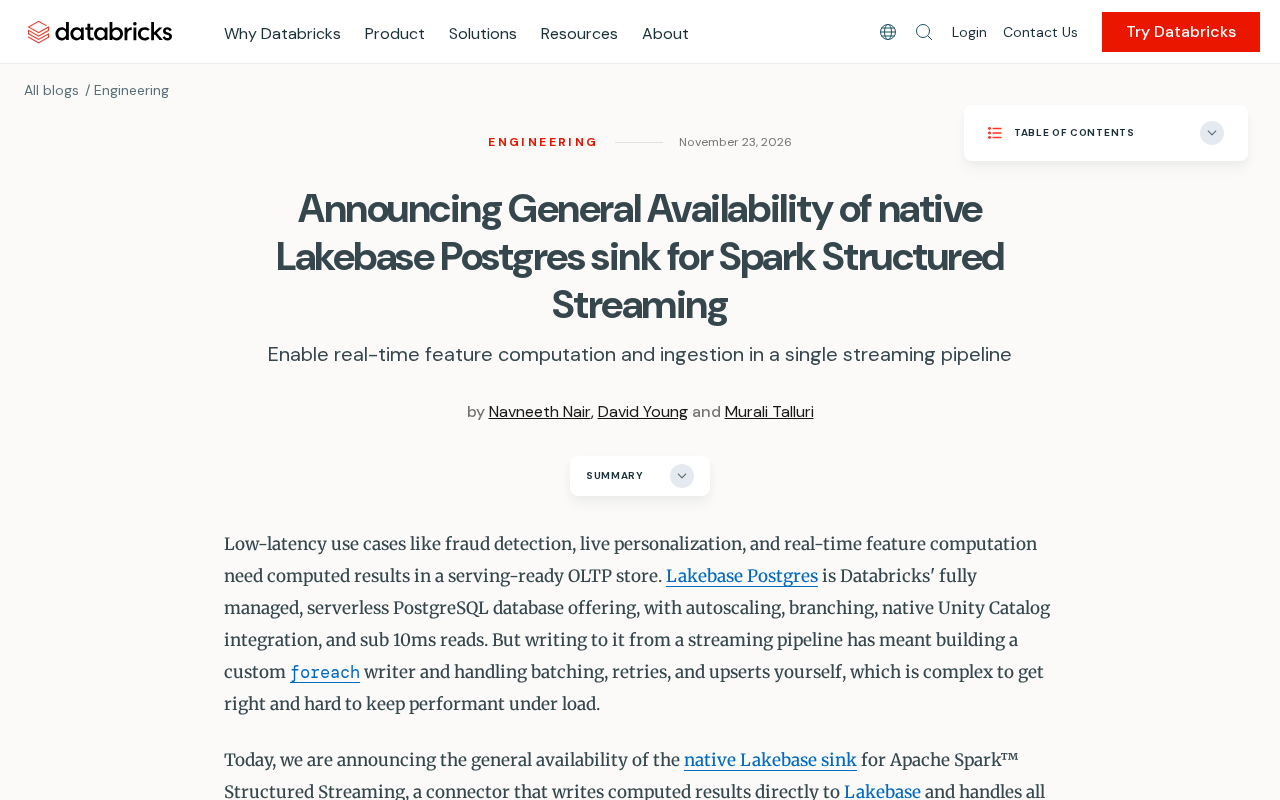
Databricks Lakebase Postgres native Sink is now GA, completing the official path for streaming writes to transactional databases.
Databricks has announced the GA of the native Sink for Lakebase Postgres, providing an official path for Spark Structured Streaming to write to transactional databases. Previously users needed custom connectors or external components to handle connection management, batch commits, and failure retries; now these capabilities are built into the framework and deeply integrated with Spark's checkpointing and micro-batch scheduling. The Sink targets low-latency scenarios such as fraud detection, real-time personalization, and real-time features, enabling lakehouse analytics and online serving to share the same streaming computation results. The announcement does not disclose specific throughput and latency figures; actual performance depends on cluster specifications, write patterns, and target table structure. GA also does not mean out-of-the-box readiness—index design, primary key conflict strategies, and micro-batch sizes still need tuning, and the Sink targets Lakebase rather than general-purpose PostgreSQL.
A New Piece in the Low-Latency Streaming Puzzle
Low-latency scenarios such as real-time fraud detection, online personalization, and real-time feature engineering place demanding requirements on every link in the data pipeline. Spark Structured Streaming has long performed reliably on the compute side, but writing results efficiently into transactional databases like PostgreSQL often required going through external connectors or custom code. Databricks has announced the General Availability (GA) of the native Sink for Lakebase Postgres, meaning this "last mile" has been officially completed.
Lakebase is a Postgres-compatible database service launched by Databricks, positioned to provide low-latency transactional capabilities on top of the lakehouse. Previously, users who wanted to land streaming results into Lakebase had to handle connection management, batch commits, failure retries, and other details themselves. The GA of the native Sink absorbs these concerns into the framework, so developers only need to specify the target in writeStream.
Spark Structured Streaming is a streaming engine provided by Spark based on a micro-batch execution model. It abstracts streaming data as an unbounded table that is continuously appended to, thereby reusing Spark SQL's optimizer and DataFrame API. Its core mechanism is checkpointing: the engine periodically persists metadata such as offsets of processed data and aggregation state to reliable storage, and combined with write-ahead-log-style idempotent or transactional writes, achieves end-to-end exactly-once semantics. It is precisely this mechanism that makes it possible to replay failed writes to external systems without duplicating data, and it also forms the prerequisite for the native Sink's deep integration with the framework. In contrast, early users building their own connectors often had to solve offset alignment and transaction boundary issues themselves, and a single misstep could lead to duplicate or lost data during failure recovery.
Why the Native Sink Matters
Reducing Glue Code and Operational Burden
The difficulty of streaming writes to a database lies not in "writing" but in "writing reliably." Connection pool exhaustion, transaction commit timing, backpressure propagation, and idempotent retries after write failures—each of these can turn into a production incident. The native Sink is maintained by Databricks and deeply integrated with Spark's checkpoint mechanism and micro-batch scheduling, so users no longer need to maintain their own connector.
Backpressure is an adaptive regulation mechanism in streaming pipelines when downstream processing cannot keep up with upstream production rates. Structured Streaming naturally has some backpressure capability through micro-batch scheduling: if a batch takes too long to write, the next batch trigger is delayed, thereby limiting the overall ingestion rate. But when the target is a relational database, backpressure propagation becomes more sensitive—database connection pools getting exhausted, slow queries piling up, and lock waits all slow down micro-batch commits in turn, and in severe cases cause batch accumulation. One of the values of the native Sink is that it brings connection acquisition, batch commits, and retry policies into the framework's unified scheduling rhythm, preventing self-built connectors from overwhelming the database by ignoring backpressure signals. In actual deployments, micro-batch intervals and the number of rows written per batch remain two knobs that require close monitoring.
Engineering Trade-offs for Low-Latency Scenarios
The announcement lists fraud detection, real-time personalization, and real-time features as typical use cases. What these scenarios share is that computation results need to be visible to online requests as quickly as possible, rather than waiting for minute-level batch processing windows. Lakebase itself is designed for low-latency access, and the native Sink ensures that the output end of the streaming pipeline does not become a bottleneck. The announcement does not provide specific throughput and latency figures; actual performance still depends on cluster specifications, write patterns, and target table structure.
The lakehouse is the architectural paradigm championed by Databricks, referring to layering table formats (such as Delta Lake) and a transactional metadata layer on top of low-cost object storage, giving the data lake ACID, schema evolution, and time travel capabilities. But the lakehouse's strengths lie in large-scale analytics and long-term retention; millisecond-level point lookups for online applications are not its design goal. Lakebase's positioning is precisely to fill this layer: it provides low-latency transactional access through a Postgres-compatible interface, allowing the application layer to read directly using familiar SQL and drivers. Once streaming results are written to Lakebase, online services no longer need to go through analytical storage as an intermediary, shortening the path from computation to serving—this is the context behind the announcement's emphasis on "providing low-latency transactional capabilities on top of the lakehouse."
Completing the Ecosystem Niche
Databricks' streaming outputs previously targeted mainly analytical or messaging destinations such as Delta Lake and Kafka. With the introduction of the Postgres Sink, the boundary between the lakehouse and the online serving layer becomes further blurred—the same stream of data can first land in the lake for long-term analytics, and can also be synchronously written to Lakebase for direct querying by the application layer. This "one computation, two consumptions" pattern offers greater value for architectural simplification than raw performance numbers alone.
Points to Note in Practice
GA does not mean out-of-the-box readiness. When streaming writes to a relational database, target table index design, primary key conflict strategies, and matching micro-batch sizes with database connection counts still need to be tuned according to business load. Additionally, while the announcement title emphasizes "native," it does not elaborate on the scope of compatibility with community-edition Spark; if your cluster is not hosted on Databricks, you should first confirm availability.
For teams already using Structured Streaming, the biggest significance of this GA is that it reduces a long-standing integration cost; for teams still stitching together real-time requirements with batch processing, it provides a reason to reevaluate their streaming architecture.
Idempotent retries are a key means of ensuring correctness when streaming writes to a database. Since micro-batches may be replayed due to failures, the Sink needs to ensure that resubmitting the same batch of data does not produce duplicate rows. Common approaches include primary-key-based upserts (such as Postgres's INSERT ... ON CONFLICT) or relying on transaction rollback. Therefore, the target table's primary key design and conflict strategy must match the Sink's write pattern; otherwise, primary key conflict errors or silent overwrites may occur. In addition, too many secondary indexes on the target table will significantly increase the cost of each write; in low-latency scenarios they should be minimized, and indexes needed for complex queries should be considered separately from the write path. These details are not elaborated one by one in the announcement, but they are unavoidable parts of production tuning.
FAQ
Q: Can this Sink only write to Lakebase? A: Based on the announcement, it is a native Sink for Lakebase Postgres, targeting Databricks' own Postgres-compatible service, not a general-purpose PostgreSQL connector.
Q: Will the API still change after GA? A: GA typically means the API has entered a stable phase, but specific behavior is still subject to the official documentation.
Q: Is it suitable for replacing existing JDBC write solutions? A: If the target is Lakebase and you are running on Databricks, the native Sink has advantages in integration and maintenance cost; other combinations still need evaluation.
Related articles

Aphasia Discourse Analysis: Language Metric Differences Across Tasks
A study of 61 adults with aphasia found that narrative, descriptive, and procedural discourse tasks yield non-interchangeable language metrics. Total words and lexical diversity show a gradient; disfluency is higher in narrative tasks. Each metric must be labeled by task type and compared only within the same task.
Must-Read for Quality Engineers: A Practical Guide to Structured Data Extraction with Generative AI
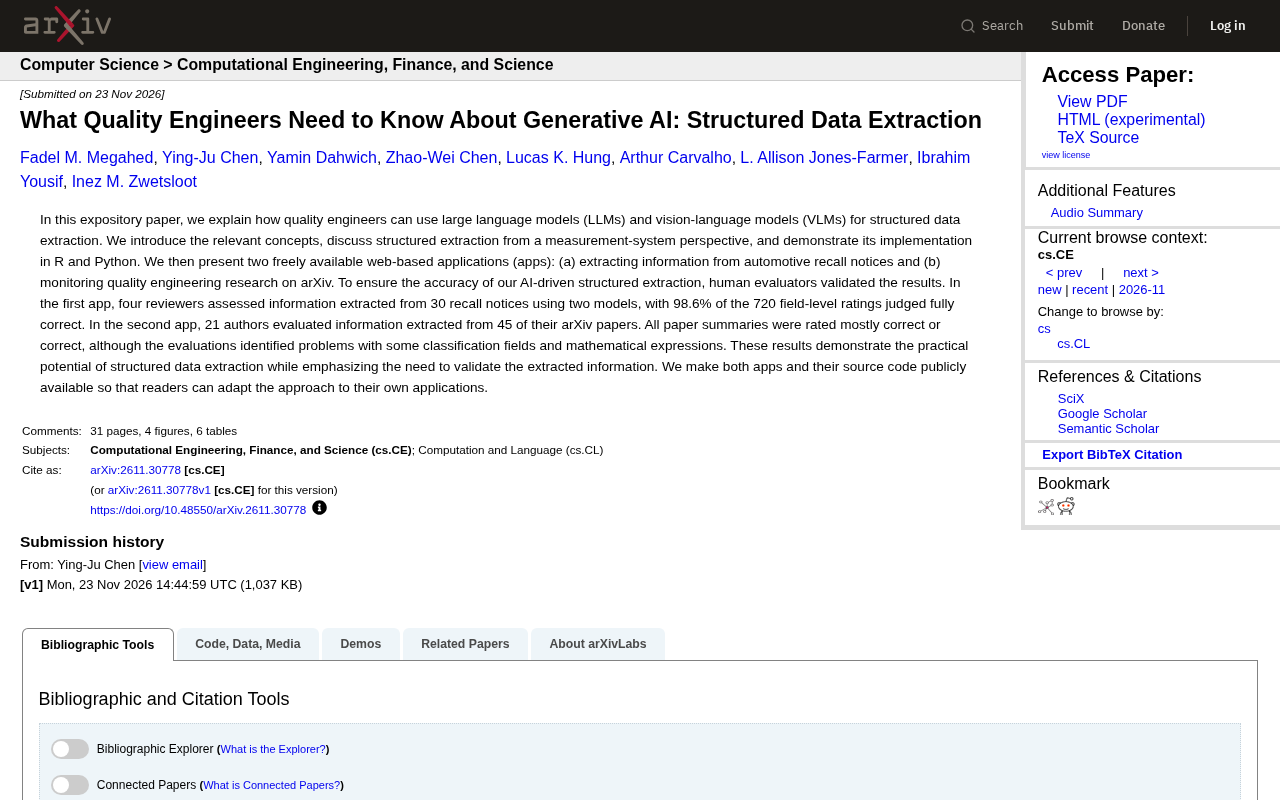
A paper shows how quality engineers use LLMs and VLMs for structured data extraction, validated through two web apps, with R and Python implementations.

CocoonBench: Can Multilingual Search Agents Break Out of the Language Information Cocoon?
CocoonBench evaluates whether multilingual search agents can escape the language information cocoon. Tests show 10 advanced models range from 33.8% to 69.7% accuracy, with the strongest system still below 70%, revealing key challenges in connecting cross-lingual evidence.