Specreel: Auto-Updating Product Demos That Never Go Stale
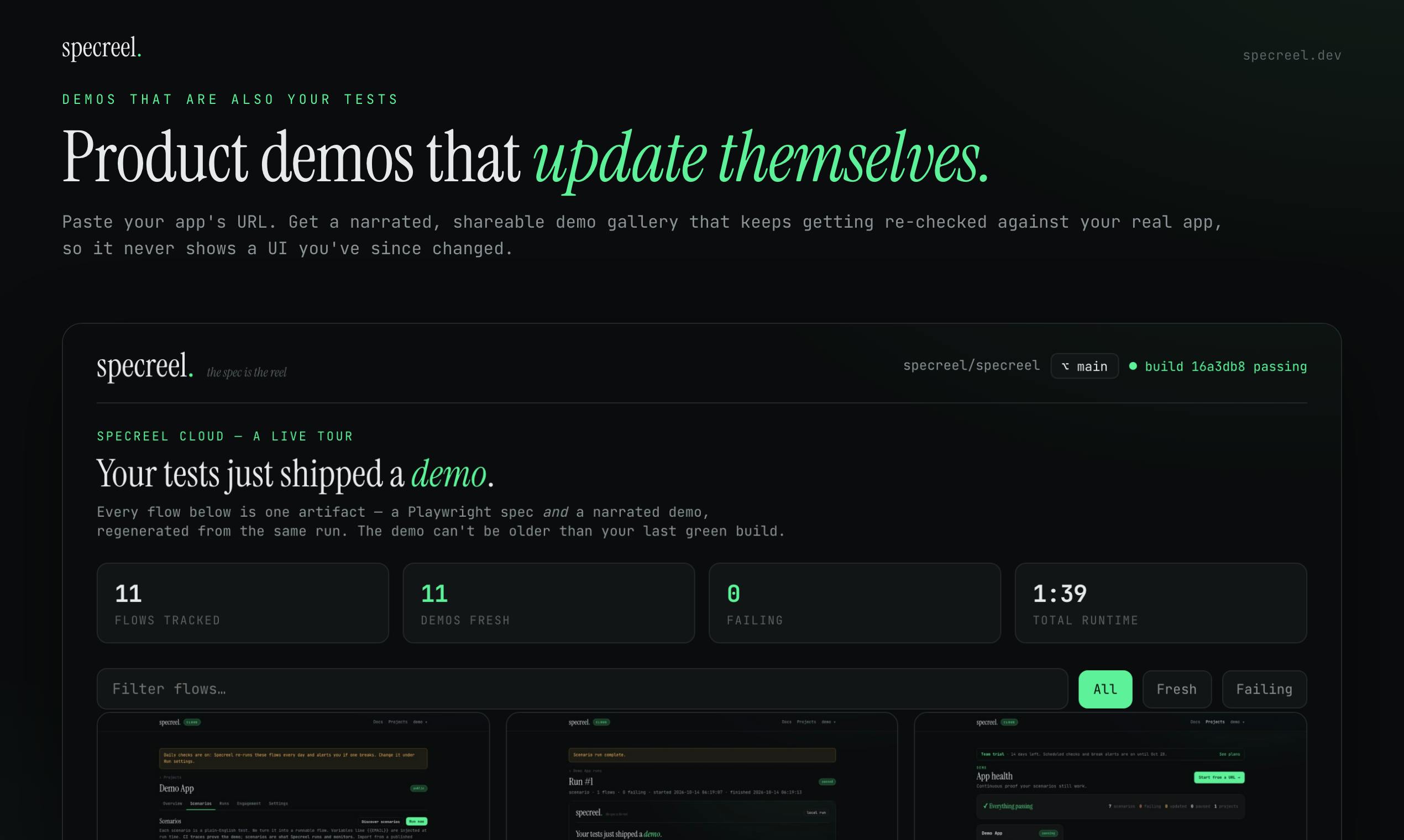
Specreel uses test traces to auto-generate product demos, keeping them fresh through the CI pipeline.
Specreel is an open-source CLI plus cloud-hosted service whose core idea is to make product demos auto-update like a CI pipeline. It offers two paths: paste an app URL to have the tool traverse it in a real browser and generate narrated demos, or render videos directly from Playwright test traces so every green build produces the latest demo. Its insight is that testing and demos share the same origin — reusing E2E testing investment makes demos a byproduct of builds rather than independently maintained assets. The article analyzes the structural causes of demo staleness, the applicable scenarios for URL mode and Trace mode, the business logic of open source plus cloud service, and notes that such tools reflect the trend of developer tools expanding from assisting coding to assisting communication.
Specreel: Auto-Updating Product Demos That Never Go Stale
Product demo videos are common material in SaaS marketing and developer relations, but they have an almost unavoidable pain point: once the product UI updates, the recorded video goes stale. Re-recording means going through the whole process of recording, editing, and voice-over again — costly and easily procrastinated on by teams. A new tool ranked #10 on Product Hunt, Specreel, attempts to solve this problem at its root — the core idea is straightforward: product demos should update automatically like a CI pipeline.
What Is Specreel?
Specreel is an open-source command-line tool plus a cloud-hosted service, positioned as "Product demos that update themselves." It works through two paths:
First, paste your app URL. Specreel walks through your application in a real browser and automatically turns key user flows into shareable demos with voice-over narration. Second, if you're already using Playwright for end-to-end testing, Specreel can render demo videos directly from test traces — automatically generated after every green build, fundamentally eliminating the possibility of demos going stale.
The core insight behind this design is that testing and demos are essentially two expressions of the same thing. Development teams already invest significant effort in maintaining E2E tests to ensure every critical flow works. Specreel reuses that investment, transforming test execution into demo material for customers and stakeholders.
Playwright is Microsoft's open-source browser automation framework, supporting three major engines — Chromium, Firefox, and WebKit — primarily used for end-to-end (E2E) testing and web scraping. It offers both synchronous and asynchronous APIs, with built-in auto-waiting, network interception, multi-tab and multi-context isolation, significantly reducing script fragility.
Trace is a debugging artifact of Playwright: when trace recording is enabled, the framework serializes and saves all operations during a test — including clicks, inputs, navigation, DOM snapshots, network requests, console logs, and screenshots at each step. Developers can review the test process step by step like a "time replay" through the Trace Viewer. It's precisely because it fully records "interface changes from the user's perspective" that it has the potential to be re-rendered as a demo video — Specreel is essentially reading this structured log, driving a headless browser to replay it with added narration.
Why Do Product Demos Always Go Stale?
Traditional demo production follows a linear process: product team prepares a demo script → records the screen → post-production editing → voice-over → publish. This chain has multiple breaking points. A single small UI change can make the footage diverge from the current product; after team members change, no one knows how to re-record; teams with fast release cadences don't even have time to update demos before new features ship.
The deeper problem is that demo videos, as an "artifact," are completely disconnected from the codebase. Code has version control, has CI/CD, but demos remain in the era of manual maintenance. Specreel attempts to bring demos into the engineering workflow — using test traces as the single source of truth, making demos a natural extension of build artifacts rather than an independently maintained burden.
CI/CD (Continuous Integration / Continuous Delivery) is a set of engineering practices that automatically build, test, and deploy code changes. In this system, any artifact should be reproducibly generated from a specific build, rather than relying on manual operations. Single Source of Truth is a key principle: the same data has only one authoritative definition, and all other locations should derive from it to avoid version drift. Specreel treating test traces as the single source of truth for demos is precisely reconstructing "demos" from an independently maintained asset into an artifact that can be deterministically derived by the pipeline — consistent with the philosophy of Infrastructure as Code (IaC) and Configuration as Code.
Specreel's Two Usage Modes
URL Mode: Zero-Config Quick Start
For teams without E2E testing infrastructure, Specreel offers the lowest-barrier entry point. Simply paste your app URL, and the tool traverses your application in a real browser, identifies key flows, and generates demos with narration. This approach suits teams in early product stages that need to quickly produce demo material.
Playwright Trace Mode: An Engineered Demo Pipeline
For teams that already have Playwright tests, Specreel's value is even more significant. It renders demos from test traces, meaning every CI green build automatically produces the latest demo video. Demos are no longer assets that need separate maintenance, but byproducts of the build process. In this mode, demo freshness is synchronized with code — as long as tests pass, the demo is up to date.
Green build refers to a build status in which all steps of the CI pipeline pass, as opposed to a "red build" (failure). In mature teams, only green builds are allowed to merge to main or deploy to production. Hooking demo video generation to green builds means the demo's "freshness" is bound to the code's "releasability": when tests fail, no misleading demo is produced; when tests pass, the demo necessarily reflects the true behavior of the current version. This also brings traceability — every demo can be traced back to a specific commit and build number for later verification.
The Combination of Open-Source CLI and Cloud-Hosted Service
Specreel adopts a business model of open-source CLI plus managed cloud service, a mature path in the developer tools space. Open-sourcing the CLI lowers the adoption barrier, allowing teams to self-host and audit; the cloud service provides convenience, suitable for teams that don't want to maintain infrastructure. The product received 71 upvotes and 3 comments on Product Hunt, with categories covering open source, marketing, developer tools, GitHub, and Google Cloud Run, indicating its target users span three roles: developer relations, product marketing, and engineering efficiency.
Open Core + Commercial Cloud is one of the most common business models in the developer tools space, with typical examples including GitLab, Sentry, and Supabase. The logic is: open-source the core functionality that runs locally to lower adoption barriers and build community trust; charge for value-added capabilities like hosting, collaboration, and scalability in the cloud. For teams, this means they can self-host and validate early on, then migrate to cloud services as they scale; for product companies, it builds sustainable revenue without sacrificing open-source reputation. Specreel open-sourcing the CLI and delegating rendering and hosting to the cloud is precisely following this repeatedly validated path.
Significance for the Developer Tools Ecosystem
Specreel represents a larger trend: developer tools are expanding from "assisting coding" to "assisting communication." Testing tools are not only used to ensure quality, but can also produce material for non-technical audiences; CI/CD doesn't just build software, it can generate marketing assets. This blurring of tool boundaries reflects engineering teams taking on more and more external communication responsibilities within their organizations.
Another noteworthy point is the "verifiability" of demos. Manually recorded demos cannot guarantee consistency with actual product behavior, while demos generated from test traces are inherently authentic — they show exactly the flows that have been verified through testing. For developer tool companies that prioritize trust-building, this authenticity itself is a marketing advantage.
Who Should Use Specreel?
Specreel's typical users include: developer relations teams that need to frequently update product demos; engineering teams that already have Playwright tests and want to maximize the return on their testing investment; and product marketers — who can directly reuse the engineering team's testing process without relying on manual screen recording. For teams with incomplete testing infrastructure, URL mode provides a gradual entry point.
One-line Summary
Specreel automatically generates product demos from test traces, keeping demos fresh through the CI pipeline.
Paragraph Summary
Specreel is an open-source CLI plus cloud-hosted service whose core idea is to make product demos auto-update like a CI pipeline. It offers two paths: paste an app URL and the tool traverses it in a real browser to generate narrated demos, or render videos directly from Playwright test traces, producing the latest demo with every green build. Its insight is that testing and demos share the same origin — reusing the investment in E2E testing makes demos a byproduct of builds rather than independently maintained assets. The article analyzes the structural reasons for demo staleness, the applicable scenarios for URL mode and Trace mode, the business logic of open source plus cloud service, and points out that such tools reflect the trend of developer tools expanding from assisting coding to assisting communication.
Related articles

Cursor AI Programming in Practice: Build a Student Management System from Scratch in 30 Minutes
A Bilibili creator demonstrates Cursor AI programming: generating a student management system in 30 minutes with natural language. Details on Agent mode, Claude selection, prompt techniques, and thresholds.

Top 20 AI Coding Tools Ranking: From Rock-Solid to Lackluster, a Scored Matrix
Bilibili creator releases top 20 AI coding tools ranking, tiered T0–T4 from rock-solid to lackluster, with Claude Code and Codex tied at T0. This article details the scoring dimensions (capability, reliability, robustness, durability, cost, domestic availability) and tool performances to help developers choose the right AI coding assistant.

Vibe Coding Systematic Tutorial: Master AI-Assisted Programming from Zero
A three-month Vibe Coding tutorial from a Bilibili creator covering Codex, ClaudeCode, and Cursor, from core logic to commercial project practice for beginners.