Spectral Feedback: Teaching Protein Diffusion Models to Self-Correct

Spectral Feedback lets protein diffusion models iteratively self-correct, boosting stable protein generation by up to 32.3%.
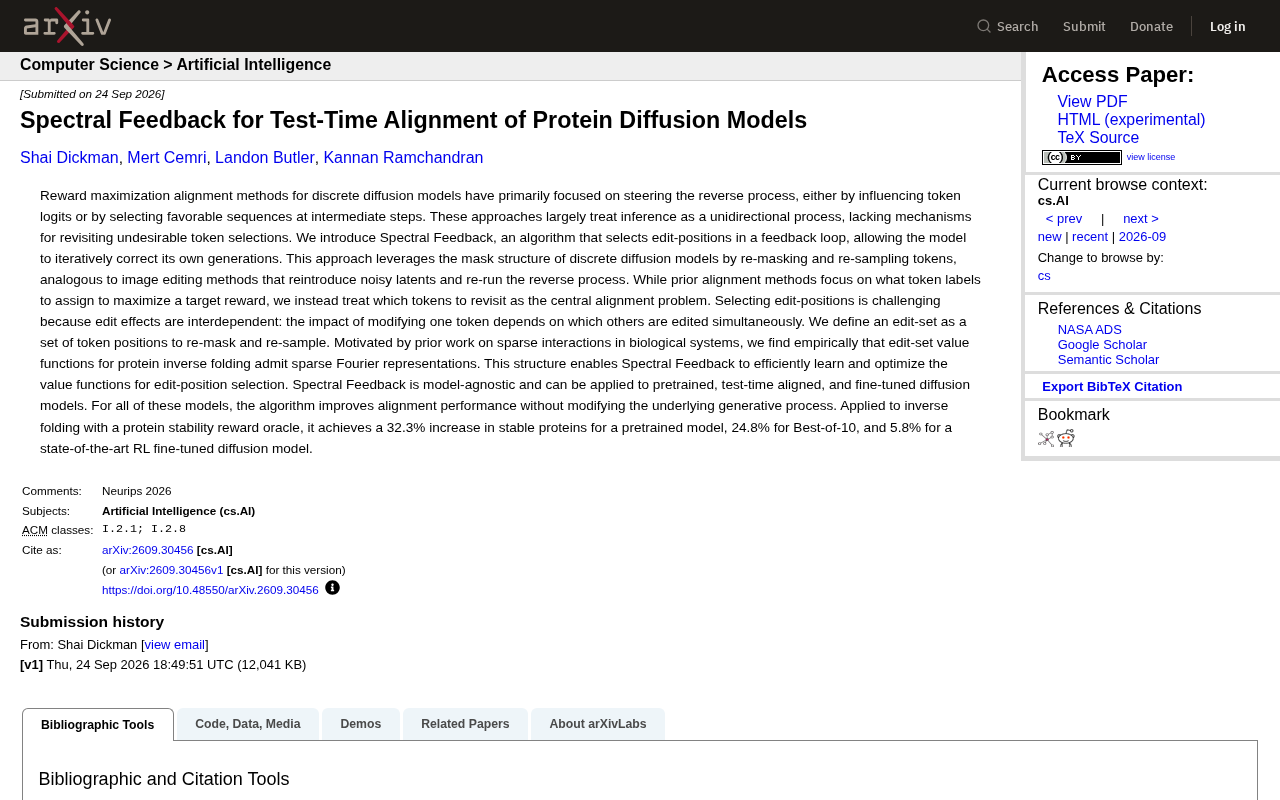
Spectral Feedback is a novel alignment method for discrete diffusion models that shifts focus from "what label to assign" to "which positions to revisit." Unlike traditional one-pass inference, it leverages the masking mechanism of discrete diffusion models to iteratively select and re-sample specific positions in a feedback loop. A key finding is that edit-set value functions exhibit sparse Fourier structure in protein inverse folding tasks, making the otherwise intractable combinatorial search efficiently solvable. Model-agnostic and applicable to pretrained, test-time aligned, and RL fine-tuned models, it achieves gains of 32.3%, 24.8%, and 5.8% respectively on protein stability tasks.
In the field of protein design and generation, diffusion models are becoming central tools. However, existing alignment methods share a common limitation: they treat the inference process as a one-way street — once the model picks the wrong amino acid token, there's no opportunity to go back and fix it. A new study called Spectral Feedback aims to break this unidirectional constraint, enabling models to repeatedly review and correct their own generated outputs.
The Blind Spot in Traditional Alignment Methods
Reward-maximizing alignment for discrete diffusion models has traditionally focused on "guiding the reverse process" — either by influencing token logits or by selecting better sequences at intermediate steps. The shared assumption underlying these approaches is that inference is unidirectional: once a token is sampled and committed, it is never reconsidered.
In other words, prior work has focused on "what label to assign to a given position to maximize reward," while lacking any mechanism for the model to "revisit already-committed choices." When a token selection turns out to be detrimental to the final objective, traditional pipelines have no way to actively backtrack and correct it. This is precisely the core problem that Spectral Feedback sets out to solve.
Discrete diffusion models are a branch of diffusion models specifically designed for discrete data (such as amino acid sequences, DNA sequences, or text). Unlike continuous diffusion models used in image generation, discrete diffusion models typically employ a "masking" mechanism in their forward process: certain positions in a sequence are replaced with a special [MASK] token, and the model then gradually predicts and restores these masked positions during the reverse process. Protein generation models such as ESM3 and MDLM fall into this category. "Alignment" in this context means making generated outputs satisfy specific functional objectives — such as improving a protein's thermostability or binding affinity — rather than simply producing structurally plausible sequences. Existing alignment methods typically use a reward function to evaluate generation quality and maximize it through guided sampling or reinforcement learning fine-tuning, but these operations all occur within a single reverse inference pass from noise to sequence.
Reframing Alignment Around "Where to Edit"
The key shift introduced by Spectral Feedback is this: rather than focusing on "what label to assign," it places "which tokens to revisit" at the center of the alignment problem.
The algorithm leverages the mask structure inherent in discrete diffusion models, performing re-masking and re-sampling of already-generated tokens within a feedback loop to iteratively select positions for editing — allowing the model to correct its own generations. This idea echoes image editing methods that reintroduce noisy latent variables and re-run the reverse process to achieve local modifications.
The Challenge of Selecting Edit Positions
Choosing which positions to edit is far more complex than it might appear. The research identifies that editing effects are interdependent: the impact of modifying one token depends on which other tokens are being edited simultaneously. This means individual positions cannot be evaluated in isolation — one must consider the entire edit-set, i.e., the collection of token positions to be re-masked and re-sampled together.
Faced with the combinatorial explosion of possible edit-sets, the research team drew inspiration from prior work on "sparse interactions" in biological systems.
Protein inverse folding is the task of designing amino acid sequences that fold into a given three-dimensional protein backbone structure. The inverse of forward folding (sequence → structure), inverse folding is a core challenge in protein engineering — a single structure can correspond to an enormous number of possible sequences, and finding those with high thermostability and functional activity is a central goal of computational protein design. ProteinMPNN and ESM-IF are representative tools for this task. Spectral Feedback uses inverse folding as its primary validation setting, with a stability reward oracle (typically a structure prediction model like ESMFold paired with a stability scoring function) as the optimization target, measuring whether generated sequences fold into the target structure with good thermodynamic stability.
Efficiency Gains from Sparse Fourier Structure
A key empirical finding of the research is that in protein inverse folding tasks, the value function over edit-sets exhibits a sparse Fourier representation.
This structural property is critical. It means that despite the vast space of edit combinations, the effective components determining their value are sparse — and therefore Spectral Feedback can efficiently learn and optimize the value function used for edit position selection, without exhaustively enumerating all possible combinations. This modeling approach, grounded in the sparse interaction characteristics of biological systems, transforms what would otherwise be an intractable combinatorial optimization problem into an efficiently solvable one.
Sparse Fourier representation is a concept from signal processing and combinatorial optimization. Fourier analysis decomposes a function into a sum of sinusoidal components at different frequencies; if a function defined over a discrete set can be accurately (or approximately) represented using only a small number of Fourier components, it is said to have sparse Fourier structure. For value functions defined over binary vector spaces (where each token is either masked or not), the Fourier basis corresponds to the Walsh-Hadamard transform basis. Sparsity means the function's main structure can be recovered from far fewer than 2^n samples, reducing an exponential combinatorial search to polynomial complexity. In biological systems, amino acid interactions tend to be local and sparse (with weak long-range coupling), providing a physical basis for this assumption to hold in protein settings. The research team empirically validated this property in the inverse folding task, making it feasible to estimate edit-set value with relatively few model calls.
Model-Agnostic with Significant Performance Gains
Another advantage of Spectral Feedback is that it is model-agnostic. It can be applied to pretrained models, test-time aligned models, and fine-tuned diffusion models alike, improving alignment performance without modifying the underlying generation process.
In inverse folding experiments targeting a protein stability reward oracle, the results are compelling:
- For pretrained models, the number of stabilized proteins increased by 32.3%;
- For the Best-of-10 sampling strategy, the improvement was 24.8%;
- For state-of-the-art RL fine-tuned diffusion models, there was still a 5.8% gain.
This data shows that even top-performing models already fine-tuned with reinforcement learning can be further improved by Spectral Feedback — demonstrating that the ability to "go back and correct" provides genuine value that traditional unidirectional alignment cannot cover.
Significance and Outlook
The core contribution of Spectral Feedback lies not in designing a more complex generative model, but in reframing the alignment problem itself: from "what to generate" to "what to correct." This perspective — treating test-time alignment as an iterative self-correction process — opens a new path toward controllable generation with discrete diffusion models.
For protein design, objectives like stability are often difficult to achieve in a single generation pass. A mechanism that allows the model to "reconsider and revise" is a natural fit for tasks requiring this kind of fine-grained optimization. And its model-agnostic nature means it can potentially serve as a general-purpose enhancement module, layered on top of a wide range of existing diffusion models. As more discrete diffusion applications emerge beyond protein design, this feedback-loop-based paradigm for edit position optimization may prove to have broad transferability.
Related articles

Penguin Moves Up Publication of 'Smarter Than Us': An AI Risk Guide for General Readers
Penguin moves up publication of 'Smarter Than Us,' an AI guide co-written with Patchen Barss that explains how AI works and lays out its many risks for non-technical readers.

From Photons to Production: An Open-Source Computer Vision Engineering Reading Path
Reddit user open-sources a computer vision engineering reading path with 16 chapters from image formation to production deployment, emphasizing primary sources, dependency order, and reproducible benchmarks to help engineers understand why models fail and build reliable vision systems.

Prompt Failures? The Truth About Why AI Agents Struggle in Production—and How to Fix It
A Reddit developer built Agents with Copilot and Gemini but faced unstable behavior. This article analyzes three gaps in prompt engineering for Agent scenarios and offers three practical paths to reliable Agent deployment, including structured prompts, workflow-first approaches, and building an evaluation loop.