SponsorPulse: A Local-First AI Agent for Quantifying and Negotiating Brand Deals

SponsorPulse uses TabPFN for pricing, Gemma for wording, and a numerical firewall to bring brand quotes back to rational negotiation.
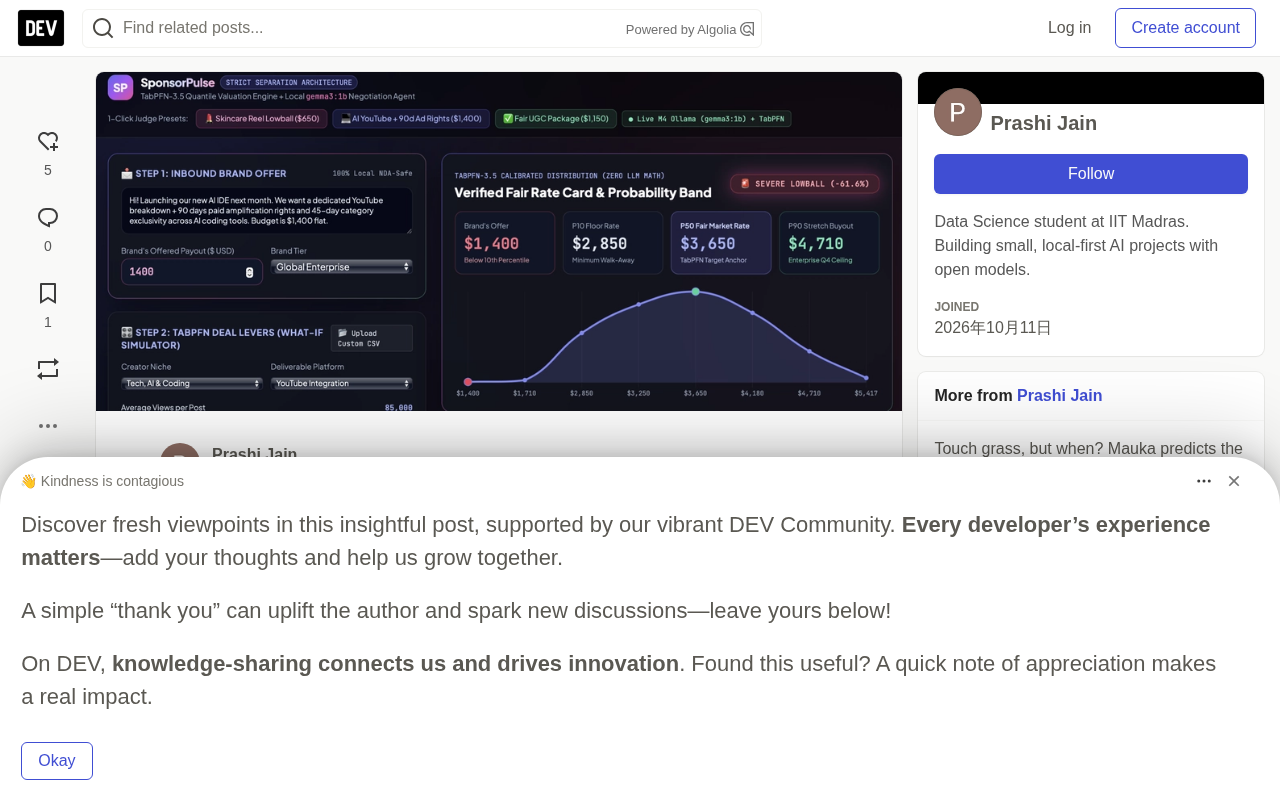
SponsorPulse is a local-first AI agent for quantifying and negotiating brand deal quotes, originating from the Hacktoberfest side-hustle theme and targeting creators, UGC authors, and newsletter writers. It acknowledges the inherent mathematical weaknesses of small-parameter LLMs, so it completely separates "computing" from "writing": the TabPFN-3.5 quantile engine outputs P10/P50/P90 probabilistic quote ranges based on historical collaboration logs, the Prior Labs counterfactual loop runs 5 parallel What-If queries to quantify the cash impact of term changes, and local Gemma 3:1b generates negotiation wording. A numerical firewall sits between them, using an AST/Regex validation layer to intercept and replace model-fabricated numbers in real time. Local inference balances speed (120+ tokens/sec) with privacy, avoiding uploading negotiation cards to the cloud. The project demonstrates a transferable LLM reliability engineering paradigm: "specialized model computation + small model expression + deterministic validation."
SponsorPulse: A Local-First AI Agent for Quantifying and Negotiating Brand Deals
When creators receive brand collaboration offers, they often face an awkward reality: the quote letter specifies 30-day paid ad whitelisting rights and a 15-day category exclusivity clause, but there's no way to tell what those terms are actually worth. SponsorPulse attempts to bring this asymmetric information game back into rational territory with a combination of a "quantification engine + local small model + numerical firewall."
The project originated from Hacktoberfest's second-week "side hustle" theme, targeting creators, UGC authors, and newsletter writers, with its core positioning as a local-first intelligent quoting desk.
Why Small Models Can't Do the Math Themselves
The project author's judgment is quite clear: small-parameter LLMs perform poorly on mathematical tasks. If you let a language model price brand deals directly, it will fabricate random numbers out of thin air.
This isn't a flaw of any particular model — it's a fundamental characteristic of autoregressive language models. They excel at generating text that "looks reasonable," not at performing precise probabilistic computation. SponsorPulse's strategy is to completely separate "computing" from "writing": computation goes to a specialized tabular foundation model, wording goes to local Gemma, and a mandatory validation layer sits between them.
Breaking Down the Deterministic Neuro-Symbolic Pipeline
SponsorPulse's architecture can be summarized in four layers, which the author calls a "deterministic neuro-symbolic pipeline."
The TabPFN Quantile Engine: Computing Price Ranges, Not Single-Point Quotes
TabPFN-3.5 takes in historical collaboration logs, with input dimensions including view counts, engagement rates, asset usage rights, whitelisting authorization, exclusivity clauses, and more. It outputs probabilistic valuation ranges — P10 represents the "walk-away floor," P50 is the median target price, and P90 is the enterprise-level ceiling. Using ranges instead of single numbers is itself an honest response to negotiation uncertainty.
TabPFN (Tabular Prior-Data Fitted Network) is a "foundation model" designed specifically for tabular data. Its approach is similar to GPT-style text foundation models, but both input and output are structured tables. Through meta-learning on a large number of synthetic tabular tasks, it pre-trains the ability to "perform classification or regression on small-sample tables" into the network weights. As a result, it can perform inference directly without retraining for each new dataset, and often outperforms traditional methods like gradient-boosted trees when sample sizes are small (tens to hundreds of rows). TabPFN-3.5 is its newer version, supporting regression tasks and uncertainty estimation — exactly what SponsorPulse needs: not a point estimate, but a predictive distribution. Quantiles (P10/P50/P90) are the position points cut from that distribution: P10 means there's only a 10% probability of falling below this value, which can be viewed as the acceptance floor; P90 means there's only a 10% probability of exceeding this value, representing the upper bound the brand side might offer. Expressing quotes as quantile ranges essentially transforms "pricing" from a single-point guess into a probabilistic statement with confidence levels.
The Prior Labs Counterfactual Loop: Translating Term Changes into Money
The system runs 5 sets of "what if..." queries in parallel, directly telling creators how much cash each contract term adjustment can unlock. For example, reducing exclusivity days or limiting whitelisting scope each corresponds to a specific quote difference. This turns abstract contract negotiation into a visualized numerical trade-off.
Counterfactual inference originates from the field of causal reasoning. It refers to asking, beyond the "already observed reality," "if a certain condition were changed, what would the outcome be?" In the context of contract negotiation, the reality is the original term combination offered by the brand, and the counterfactual is "if category exclusivity were shortened from 15 days to 7 days, what should the quote become?" Technically, the system takes each modified term as a new input vector and sends it back to the TabPFN quantile engine for inference, thereby obtaining the probability distribution under that hypothetical scenario. The reason for "running 5 sets in parallel" is that contract levers are often coupled: exclusivity days, whitelisting scope, and secondary asset usage rights each affect different dimensions of value. Only by quantifying them one by one can creators see the marginal price of each concession, and thereby prioritize holding the most expensive terms in negotiation.
Local Gemma 3:1b: Running at 120+ Tokens/Second on Apple Silicon
Running Gemma 3:1b locally via Ollama achieves speeds of 120+ tokens per second. The significance of local deployment isn't just speed — brand collaboration emails often contain quotes, audience data, and contract terms. If this content were uploaded to cloud APIs, creators would essentially be handing over their negotiation cards to a third party. Local inference provides greater privacy peace of mind.
Gemma is a family of open-weight models released by Google, named after the Latin word for "gem." It offers multiple parameter scales including 2B, 7B, 9B, and 27B, sharing origins with the closed-source Gemini series but deployable locally. 3:1b refers to the 1-billion-parameter version in the third generation of that series, small enough to run on consumer-grade hardware. Ollama is an open-source local LLM running and distribution tool that packages model weights, quantization formats, and inference backends (such as llama.cpp and Metal) into a service that starts with a single command and exposes a locally available OpenAI-compatible API. Apple Silicon refers to Apple's custom-designed M-series chips, whose unified memory architecture lets the CPU and GPU share the same memory block, avoiding data copy overhead — which is why small-model inference can reach over a hundred tokens per second. For a 1B-class model, 120+ tokens/second means generating a two-hundred-word negotiation passage takes only about two seconds, approaching real-time interactive experience.
The Numerical Firewall: Physically Intercepting Hallucinated Numbers
This is the most noteworthy design in the entire architecture. An AST/Regex validation layer scans Gemma's output in real time. As soon as it detects that the model has "fabricated" a number, it immediately intercepts and forcibly replaces it with the exact value verified by TabPFN.
This approach pushes "preventing LLM hallucination" down from the prompt engineering level to the deterministic code validation level.
AST (Abstract Syntax Tree) here refers to a means of structurally parsing the model's output text: first splitting Gemma's generated sentences and identifying the numbers, units, and comparison relationships within them, forming a traversable syntax tree, then comparing node by node against TabPFN's verified results. Regex (regular expressions) are used for lighter-weight pattern matching, such as quickly capturing numeric tokens near units like "$", "%", "days", or "ten thousand." The emphasis on "physical interception" is because it differs fundamentally from prompt-level constraints: prompts merely "request" that the model not make mistakes, and the model may still violate them; the AST/Regex validation layer, however, sits after model output and before presentation to the user — it's a deterministic code gate that doesn't depend on whether the model complies. Once a number is not in the verified set, the system directly discards and replaces it. The model has no discretionary authority over numbers whatsoever — this is the key step that transforms "hallucination prevention" from a probabilistic measure into an engineering guarantee.
Feature Highlights
Brand Invitation Audit: Paste any brand email, and SponsorPulse instantly scans it for predatory terms and calculates the underpayment difference.
Interactive Negotiation Levers: Adjust sliders for view counts, engagement rates, and ad usage rights in real time, with the probability curve updating synchronously.
Sentry Agent Tracing: OpenTelemetry-based span waterfall charts covering latency across the full chain of TabPFN inference, counterfactual changes, and Gemma synthesis.
One-Click Review Sandbox: A browser-based fallback engine is deployed, so you can test the sliders and probability curves directly even without Ollama installed.
An Engineering Approach Worth Noting
SponsorPulse's real value isn't in "using AI to help creators quote prices" — it's in demonstrating a pattern for handling LLM reliability issues: acknowledge the domains where language models are weak, fill the gap with specialized models, then hold the final line with a deterministic validation layer.
This combination of "specialized model computation + small model expression + numerical firewall" has transferable value in scenarios beyond quote negotiation — such as financial analysis, medical data summarization, and legal clause interpretation.
The project is open-sourced, with a GitHub repository and an online demo available.
Related articles

AI Compute Is the New Oil, But the Market Mechanism Has Yet to Take Shape
Hacker News compares AI compute to the new oil, noting the lack of price discovery, concentrated supply, and no hedging tools. The article analyzes structural issues in compute trading and explores a possible three-tier market of spot, contracts, and derivatives, plus the real impact on AI practitioners' cost management.

Running Full iOS 16.5 Firmware on Android Devices: Technical Demo or Marketing Gimmick?
A Hacker News post claims full iOS 16.5 firmware can run on Android, with 315 upvotes. This analysis argues it is more likely a web UI simulation than a true firmware port, and explores the value and risks of such projects.

Etsy Cracks Down on AI Slop: Addressing Buyer and Seller Anxieties
Etsy introduces stricter rules limiting AI-generated content in listings, addressing buyer confusion over AI products and seller fears of original work being diluted by AI slop.