Spring AI 2.0 Deep Dive: A Java Developer's Guide to LLM Application Development

Spring AI 2.0 lets Java developers build LLM apps using familiar Spring patterns and abstractions.
Spring AI 2.0 is Spring's official AI framework that bridges the Spring ecosystem with large language models through unified, provider-agnostic APIs, auto-configuration, and full RAG pipeline support. Java developers can integrate models from OpenAI, Claude, Gemini, and more with minimal code changes, while leveraging familiar Spring Boot components for production-grade AI applications.
What Is Spring AI 2.0
Spring AI is an AI engineering framework officially released by the Spring team. Its core positioning is deep integration with the Spring ecosystem, making model integration remarkably straightforward. For Java developers already familiar with Spring, it's the smoothest on-ramp to building large model applications.
The central goal of Spring AI 2.0 is to bring Spring's battle-tested design principles — portability, modularity, POJO (Plain Old Java Object), and auto-configuration — into the AI domain.
What POJO and Auto-Configuration Mean in the AI Context
POJO (Plain Old Java Object) represents one of Java's most fundamental design philosophies: ordinary Java objects that carry no dependency on specific frameworks or inheritance hierarchies. Spring has centered around POJOs since its inception, using dependency injection and aspect-oriented programming to keep business logic clean. Extending this philosophy to AI means developers can define prompt templates and receive model outputs using plain Java classes, without learning an entirely new programming paradigm. Auto-configuration is a cornerstone capability of Spring Boot — through convention over configuration, the framework automatically detects classpath dependencies and registers beans, dramatically reducing boilerplate code. In AI scenarios, simply adding an API key to
application.propertiesis enough for Spring AI to automatically initialize the client. This is especially valuable for fast delivery in enterprise projects.
Developers can build AI-native applications using the tools and patterns they already know, without abandoning their existing Spring foundation.
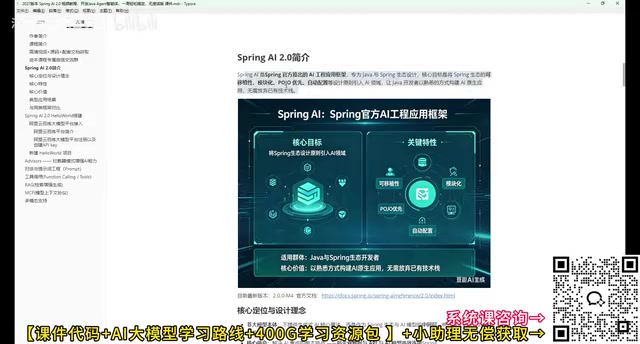
It's important to be clear: Spring AI is not a large model itself. It does not provide core generative AI algorithms. Instead, it acts as middleware between the Spring ecosystem and AI models, responsible for standardizing integration. Its mission is to solve the most fundamental challenges in AI integration: prompt management, model connectivity, enterprise data connectivity, and other tedious plumbing.
Core Design Philosophy and Value of Spring AI
Before mature frameworks existed, developers integrating large models had to manually handle prompt construction, API difference adaptation, data mapping, and a long list of other concerns — tedious work that was hard to reuse. Spring AI's core value lies in efficiently connecting enterprise data and APIs, abstracting away this complexity through a unified framework.
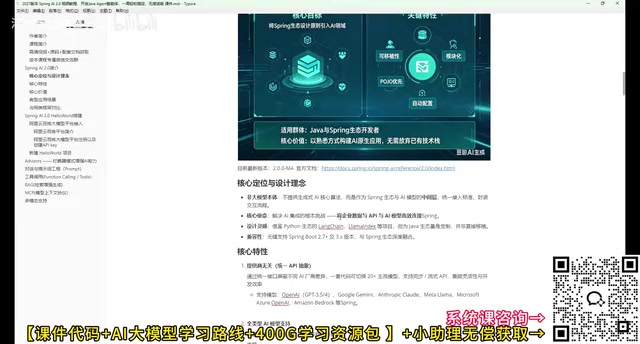
Spring AI draws inspiration from mature Python ecosystem frameworks like LangChain and LlamaIndex, but it is purpose-built for the Java ecosystem.
The Design Lineage of LangChain and LlamaIndex
LangChain was launched in late 2022 by Harrison Chase and quickly became the de facto standard framework for building LLM applications in the Python ecosystem. Its core contribution was abstracting common AI application patterns — Chain, Agent, Memory, and Tool invocation — into composable modules. LlamaIndex (originally GPT Index) focuses on data indexing and retrieval, providing finer-grained document processing capabilities for RAG scenarios, including node parsing, multi-level indexing, and query engines. Spring AI drew on the core abstractions of both frameworks, but made important adjustments for the Java ecosystem: a strong type system in place of Python's dynamic nature, Spring Bean lifecycle management instead of manual object creation, and native integration with enterprise-grade components like Spring Security and Spring Data. This "translated adaptation" rather than direct copy strategy allows Spring AI to preserve core design wisdom while genuinely fitting the way Java engineers think.
The most prominent advantage is deep integration with the Spring ecosystem — all Spring Boot components and auto-configuration capabilities can be reused seamlessly.
The framework's core value can be summarized as follows:
- Lower barrier to entry: Java developers can get started quickly without diving deep into AI internals
- High portability: Switching model providers requires minimal code changes
- End-to-end abstraction: Common AI capabilities unified under a single standard API
- Enterprise-grade capabilities: Production-ready deployment, observability, and security controls
Provider-Agnostic Unified API Abstraction
One of Spring AI's most important features is its provider-agnostic unified API design. With so many large model providers on the market, rewriting code for each new integration would be prohibitively expensive to maintain.
Spring AI abstracts away the differences between providers so developers can switch models through configuration alone, with almost no changes to business code. This is essentially the interface-oriented programming philosophy applied to the AI domain — a completely natural approach for experienced engineers.
How Provider-Agnostic Design Works Under the Hood
The provider-agnostic design relies on Java's interface abstraction mechanism. Spring AI defines unified core interfaces such as
ChatModelandEmbeddingModel, and all provider implementations — OpenAI, Anthropic Claude, Google Gemini, Alibaba Qwen, and others — must conform to the same method signatures. Under Spring Boot's dependency injection system, swapping the starter dependency and updating model parameters in the configuration file is all it takes; the framework automatically injects the corresponding implementation, and business code calling theChatModelinterface is completely unaffected. This is essentially a combination of the Strategy Pattern and Factory Pattern from software design. For enterprise applications, this design delivers value beyond technical flexibility — it also provides negotiating leverage by avoiding vendor lock-in with a single cloud provider. The ability to quickly switch providers when model performance, pricing, or compliance requirements change is an increasingly important consideration in enterprise AI infrastructure planning.

In terms of model capability coverage, Spring AI supports a broad range:
Supported Model Types
- Chat Completion: Conversational Q&A and text generation
- Embedding Models: Text vectorization
- Text-to-Image: Multimodal content generation
- Speech-to-Text (ASR) and Text-to-Speech (TTS)
- Content Moderation: Compliance checking
- Structured Output: Return structured data via POJO mapping, significantly improving developer efficiency
Structured Output is particularly developer-friendly for Java engineers — model responses can be mapped directly to Java objects, eliminating the need for tedious manual parsing.
RAG (Retrieval-Augmented Generation) and Vector Database Integration
In real enterprise applications, RAG (Retrieval-Augmented Generation) is one of the most frequently used technical approaches. Spring AI provides complete support for it, covering text vectorization, vector database integration (including local model runners like Ollama), and other key capabilities.

How RAG Works and Why It Addresses Hallucination
Large language models have a fundamental limitation: their training data has a cutoff date, and they cannot directly access enterprise private knowledge bases. When a model encounters questions beyond its training knowledge, it often generates content that sounds plausible but is factually incorrect — a phenomenon known as "hallucination." RAG is currently the most widely adopted mitigation approach in the industry. Its workflow has two phases: the offline indexing phase, where enterprise documents are split into semantic chunks, converted into high-dimensional vectors via an embedding model, and stored in a vector database (such as Pinecone, Milvus, or PgVector); and the online inference phase, where the user's question is also vectorized and used for similarity search in the database (typically using cosine similarity or approximate nearest neighbor algorithms), with the retrieved relevant document fragments inserted into the prompt context to guide the model toward answers grounded in real data. Spring AI provides standardized abstractions for each stage of the RAG pipeline, including
DocumentReader(supporting multiple data sources such as PDF, Word, and web pages),TextSplitter(document chunking strategies),VectorStore(vector storage interface), andQuestionAnswerAdvisor(Q&A enhancement component). Developers can assemble a production-ready RAG system like building with blocks.
By vectorizing documents and storing them in a vector database, then retrieving relevant context at inference time to inject into the prompt, RAG effectively mitigates hallucination and fills in private knowledge gaps. The seamless integration with the Spring ecosystem dramatically reduces the complexity of building a RAG pipeline.
Typical Use Cases for Spring AI
From a practical implementation perspective, the most common use cases for Spring AI include:
- RAG-powered Q&A: Combined with private knowledge bases — the most frequently used pattern
- Intelligent customer service: Rapidly building enterprise knowledge-based chatbots
- Automated content generation: Bulk production of marketing copy, reports, and more
- Multimodal AI processing: Image recognition, voice interaction, and similar scenarios
- Enterprise-grade AI applications: Complete solutions designed for production environments
Spring AI vs. LangChain4j
Any discussion of Spring AI inevitably leads to comparisons with similar Java frameworks like LangChain4j. Spring AI's core advantage is its deep integration with the Spring ecosystem — for teams already using the Spring stack, adoption is essentially zero-cost.
Technical Selection Details: LangChain4j vs. Spring AI
LangChain4j was initiated by Dmytro Liubarskyi in 2023, with the goal of fully porting LangChain's core concepts to the Java ecosystem. Its design stays closer to the original LangChain, offering a richer Agent framework, tool invocation mechanisms, and finer-grained flow control. In terms of feature coverage, LangChain4j often supports niche model providers and advanced Agent patterns ahead of Spring AI, thanks to its more flexible community contribution model. Spring AI's differentiating advantage lies in engineering integration depth: connecting with Spring Security's authentication system, exposing AI call observability metrics via Spring Actuator, caching model responses with Spring Cache, and combining with Spring Batch for bulk AI processing tasks. From a team decision-making perspective: if a project already runs deep on the Spring stack, the learning curve for Spring AI is nearly zero; if the team needs finer-grained Agent orchestration or the project isn't Spring-based, LangChain4j is the better fit. The two are not mutually exclusive — some teams even use both frameworks in the same project depending on module requirements.
LangChain4j is more comprehensive in certain feature dimensions and maintains a highly active community. Both frameworks are evolving rapidly, and neither holds an absolute advantage right now. The most pragmatic advice: both are worth understanding, with the final choice depending on your team's tech stack and specific project needs.
Summary
Spring AI 2.0 opens a convenient gateway for Java developers into large model application development. Rather than reinventing the wheel, it serves as middleware connecting the Spring ecosystem with AI models — significantly lowering the development barrier through unified abstractions, auto-configuration, and end-to-end encapsulation. For Java engineers looking to move into the large model space, starting from the familiar Spring ecosystem is both a smooth and highly efficient path forward.
Key Takeaways
Related articles
Jev Ultrafast: A Browser Agent with Dynamic Indexed Action Space
Jev Ultrafast is a browser agent built around a dynamic indexed action space, optimizing element targeting for ultra-fast browser automation. A deep-dive into its design.
Can Free AI Coding Models Handle Industrial-Grade Code? A Realistic Look at Your Options
Can free AI models generate commercial-grade, production-ready code? This article examines rate limits, cooldown windows, and practical strategies like multi-provider rotation and local model deployment.
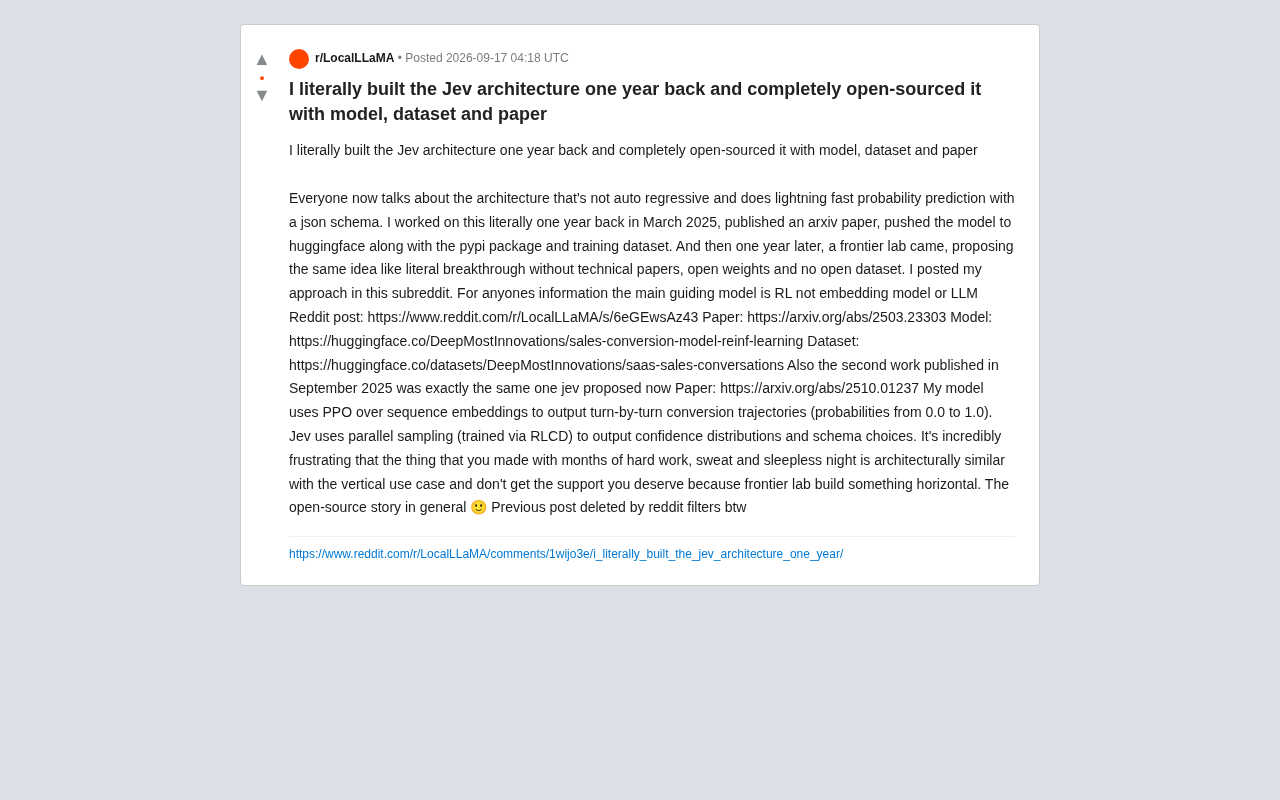
The Open Source Dilemma: A Non-Autoregressive Architecture Pioneer Overshadowed by Frontier Labs
An indie developer claims a frontier lab repackaged his year-old open-source non-autoregressive RL architecture as a breakthrough. We compare PPO sequence embeddings vs. RLCD parallel sampling and examine open source attribution gaps.