Spring AI Crash Course for Beginners: Java Enterprise AI in Practice

Spring AI is an AI framework in the Java ecosystem comparable to LangChain, with core capabilities including Tool Calling, MCP, RAG, and Chat Memory.
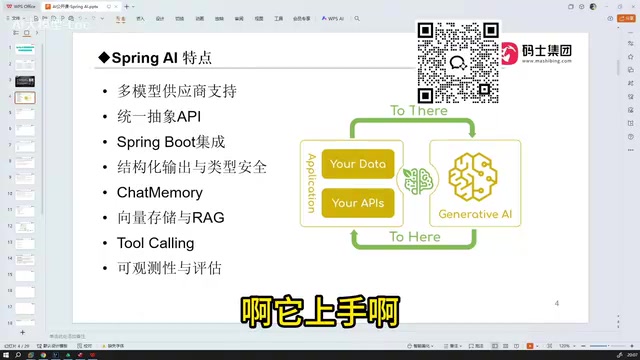
Spring AI is an artificial intelligence framework in the Java field that benchmarks against LangChain and is fully integrated into the Spring ecosystem, inheriting dependency injection, modularity, and configurability to lower the entry barrier for Spring developers. It supports multiple model providers such as Anthropic, OpenAI, and DeepSeek, but support varies across modules. Its six core features include multi-model support, a unified abstract API, seamless Spring Boot integration, structured output, multi-level Chat Memory, and vector storage and RAG. The most closely watched are Tool Calling, MCP, RAG, and Chat Memory. Among them, Tool Calling and MCP have similar encapsulation logic, making migration almost seamless. Spring AI also provides observability and evaluation mechanisms, making it suitable for enterprise-level applications. Overall, it reuses Spring's engineering capabilities, but there is a certain barrier for Java developers without a Spring background.
In the Python world, LangChain has become the mainstream framework for developers interacting with large language models. So is there a similar tool in the Java ecosystem? The answer is Spring AI. It is positioned as the artificial intelligence module within the Spring ecosystem, with the goal of letting Java developers access large model capabilities in a familiar way.
What Is Spring AI? Similarities and Differences with LangChain
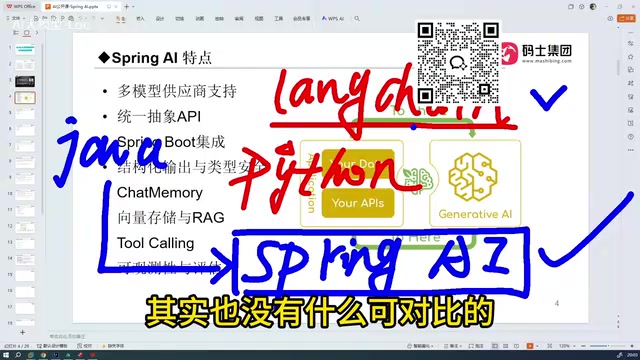
Spring AI is essentially an artificial intelligence framework for Java developers. According to the explanation in the tutorial by the Bilibili creator, it can be compared to LangChain in the Java world—interacting with large models through a unified API and covering multimodal capabilities such as text Q&A, image processing, and Embedding.
The main difference between the two lies in their language ecosystems: LangChain is rooted in Python, while Spring AI is fully integrated into the Spring ecosystem. Because of this, Spring AI inherits Spring's core design principles, including dependency injection, modularity, and configurability. For developers familiar with Spring Boot, the learning cost is significantly lower; but if you have never worked with SSM or Spring Boot, it may initially feel less intuitive than LangChain.
LangChain Introduction: LangChain is an open-source framework for building large language model (LLM) applications. It was initially implemented in Python and later expanded to JavaScript/TypeScript. It provides modular components such as model I/O, prompt templates, chains, memory, retrieval-augmented generation (RAG), and agents, helping developers integrate LLMs with external data sources and tools. The core value of LangChain lies in abstracting the common patterns of LLM applications, enabling developers to quickly build complex workflows without reinventing the wheel. Its ecosystem also includes LangSmith for debugging and evaluation, and LangServe for deployment. In its design, Spring AI draws on LangChain's modular approach, but places more emphasis on deep integration with the Spring ecosystem rather than providing a cross-language general abstraction.
Breakdown of Six Core Features
1. Multi-Model Provider Support
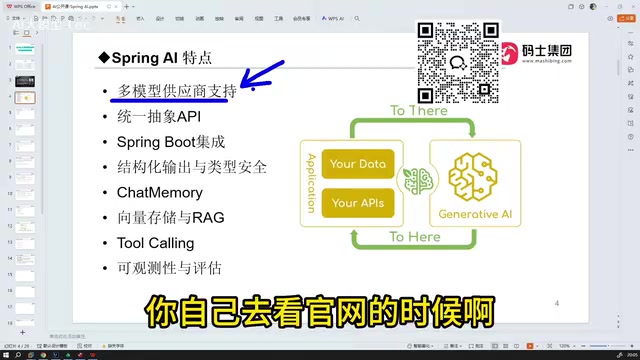
Spring AI integrates mainstream large model providers such as Anthropic, OpenAI, Microsoft, Amazon, Google, as well as domestic providers like DeepSeekAd and Zhipu AI. But one practical issue needs attention: the level of support varies across modules. The chat module supports relatively many models, while modules such as speech-to-text and text-to-speech have a relatively limited range of options.
2. Unified Abstract API
Whether it is Chat Client, Embedding Model, or Image Model, the upper-layer calling code remains consistent across different models. When switching models, only the underlying configuration needs to be modified, and business code barely needs to change. This abstraction design reduces the risk of vendor lock-in.
Dependency Injection and Aspect-Oriented Programming: The core of the Spring framework is Inversion of Control (IoC) and Dependency Injection (DI), managing object lifecycles and dependencies through the container. In Spring AI, components such as ChatClient and EmbeddingModel are registered as Beans, and developers can use them directly through constructor injection or @Autowired without manual instantiation. This design means that replacing the underlying model implementation (such as switching from OpenAI to DeepSeek) only requires modifying configuration or replacing Beans, without affecting business code. At the same time, Spring Boot's auto-configuration mechanism further simplifies integration: simply add the starter dependency and a small amount of configuration properties to automatically assemble the required model client. This engineering capability is an important feature that distinguishes Spring AI from LangChain, and it is also the key to lowering the entry barrier for Java developers.
3. Seamless Spring Boot Integration
Developers can directly introduce dependencies and configuration in a Spring Boot project to use Spring AI, without needing to build an additional independent service architecture.
4. Structured Output and Type Safety
The JSON structure returned by the model can be mapped to Java POJO objects, making data processing more type-safe and reducing manual parsing work.
5. Multi-Level Chat Memory
It supports a memory mechanism for multi-turn conversations, and the memory can be stored in memory or persisted to various databases. The creator pointed out that this part has complete implementation cases in the course for reference.
6. Vector Storage and RAG
Vectorize and store local knowledge base content, then retrieve relevant content during conversations to enhance the accuracy of model responses. This actually expands the boundaries of large model capabilities, and it was also one of the key topics explained in the tutorial that evening.
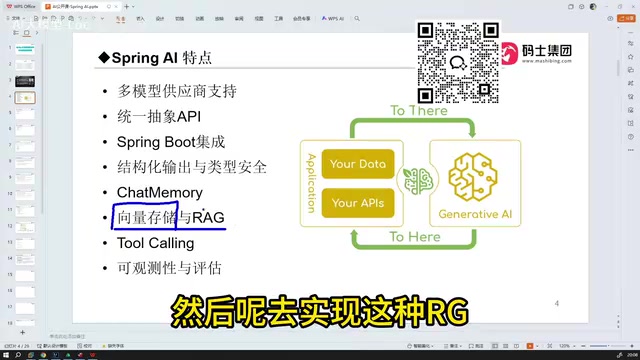
RAG (Retrieval-Augmented Generation): RAG is a technique that combines information retrieval with large model generation. Its process usually includes: splitting documents, vectorizing them, and storing them in a vector database; when a user asks a question, vectorizing the question and retrieving the most similar document fragments; concatenating the retrieval results as context into the prompt, and then handing it to the large model to generate an answer. RAG can effectively alleviate the hallucination problem of large models and ground their answers in the latest or private knowledge. Spring AI provides the VectorStore abstraction and EmbeddingModel interface, supports multiple vector databases (such as PGVector, Redis, Milvus, etc.), and includes built-in modules for document reading, splitting, and retrieval, simplifying the development of RAG applications. For Java developers, this means they can build knowledge base question-answering systems without diving deep into the Python ecosystem.
Tool Calling and MCP: The Capabilities Most Worth Watching
In the creator's view, the most core parts of Spring AI are Tool Calling (function calling), MCP (Model Context Protocol), RAG, and Chat Memory.
Tool Calling allows the model to call external tools to complete tasks. As a relatively new protocol, MCP has an API design similar to Tool Calling. The creator mentioned that when implementing Tool Calling, Spring AI has already borrowed some encapsulation logic, so migrating to the MCP protocol is very smooth and can be almost seamless.
This means developers who have already mastered Tool Calling will not encounter major learning obstacles when transitioning to MCP.
MCP (Model Context Protocol): MCP is an open protocol proposed by Anthropic in 2024, aimed at standardizing how large models interact with external tools and data sources. It defines a client-server architecture, where the model acts as a client and accesses resources such as files, databases, and APIs through MCP servers. Compared with traditional Tool Calling (function calling), MCP places more emphasis on decoupling and reusability at the protocol level: tool providers only need to implement an MCP server once, and it can be called by multiple models or applications that support MCP. When implementing Tool Calling, Spring AI has already adopted encapsulation logic similar to MCP (such as function descriptions, parameter schemas, and call result handling), so when developers migrate from Tool Calling to MCP, they only need to adjust the communication layer, and the core business logic hardly needs to be rewritten. This provides a smooth transition for Java developers to access the increasingly rich MCP ecosystem.
Observability and Evaluation
Spring AI also supports configuring logging, monitoring, and evaluation mechanisms for model calls, helping developers track model performance in production environments. For enterprise-level applications, this capability is quite practical when troubleshooting issues and optimizing results.
Getting Started Advice
This tutorial is aimed at zero-foundation learners and emphasizes practical implementation combined with business scenarios. The creator's view is that Spring AI itself is not too difficult; the key is to combine it with specific business needs. For Java developers, if you are looking for a path into AI application development, Spring AI provides a route that connects relatively naturally with your existing technology stack.
From the perspective of technology selection, Spring AI's advantage lies in reusing the engineering capabilities of the Spring ecosystem, while its disadvantage is that it has a certain barrier for Java developers without a Spring background. Whether to choose it depends on the current state of the team's technology stack and the complexity requirements of the AI application.
One-line Summary
Spring AI is an AI framework in the Java ecosystem comparable to LangChain, with core capabilities including Tool Calling, MCP, RAG, and Chat Memory.
Paragraph Summary
Spring AI is an artificial intelligence framework in the Java field that benchmarks against LangChain. It is fully integrated into the Spring ecosystem, inherits dependency injection, modularity, and configurability, and lowers the entry barrier for Spring developers. It supports multiple model providers such as Anthropic, OpenAI, and DeepSeek, but the level of support varies across modules. Its six core features include multi-model support, a unified abstract API, seamless Spring Boot integration, structured output, multi-level Chat Memory, and vector storage and RAG. The most closely watched are Tool Calling, MCP, RAG, and Chat Memory. Among them, Tool Calling and MCP have similar encapsulation logic, making migration almost seamless. Spring AI also provides observability and evaluation mechanisms, making it suitable for enterprise-level applications. Overall, it reuses Spring's engineering capabilities, but there is a certain barrier for Java developers without a Spring background.
Related articles

How Big Can Stars Really Get? The Physical Limits of the Largest Stars
Red supergiants are the largest stars by volume, with radii up to 2,000 times the Sun, engulfing the inner solar system. But there is no precise upper limit on stellar size—models predict up to 15,000 solar radii. The most massive blue stars are far smaller than red supergiants—biggest and heaviest are two different things.

Apple HomeView Smart Display Full Feature Breakdown: Wall-Mount or Desktop, $299
Apple launches HomeView, a $299 smart display with wall-mount and desktop options, 12MP camera for facial recognition, smart home control, music playback, and recipe step-by-step cooking. Full breakdown of watch faces, apps, privacy, and cooking integration.

Where Did the Promised New Studio Go? Craft Computing Answers After Five Years
Craft Computing's host responds to viewer questions: the new studio promised five years ago was shelved as construction costs soared from $30,000 to $75,000, and was replaced by a 168-square-foot garage conversion.