Spring AI in Action: A Complete Guide to LLM Integration for Java Developers

Spring AI brings LangChain-like LLM development capabilities to the Java and Spring Boot ecosystem.
Spring AI is a Spring-native framework for integrating large language models into Java applications. It features a unified API across major LLM providers, automatic structured output mapping, multi-turn Chat Memory, RAG with vector store support, and Tool Calling via the MCP protocol — all with Spring Boot's familiar auto-configuration model. Requires Spring Boot 3.x, JDK 17+, and Maven 3.9+.
What Is Spring AI? The LangChain of the Java Ecosystem
In the AI application development space, Python has long dominated thanks to mature frameworks like LangChain. Released by Harrison Chase in late 2022, LangChain quickly became the de facto standard for building LLM applications in the Python ecosystem — abstracting complex model interactions into composable modules via Chains, Agents, and Memory management, and establishing a Python-centric paradigm for AI app development. But Java developers have their own elegant solution for interacting with large language models: Spring AI.
Spring AI was introduced in 2023 by the Spring team at VMware (now Broadcom) and officially reached its 1.0 milestone in 2024. Its goal is to bring a LangChain-like developer experience to the Java ecosystem. One-line positioning: Spring AI is to Java what LangChain is to Python. It's a framework purpose-built for Java code to interact with large language models (LLMs), supporting multimodal capabilities including conversation, image recognition, speech processing, and text-to-speech.
More importantly, Spring AI fully inherits the design philosophy of the Spring ecosystem: auto-configuration, dependency injection, and externalized configuration — all present and accounted for. If you're already familiar with Spring Boot, picking up Spring AI comes with virtually no additional learning curve.
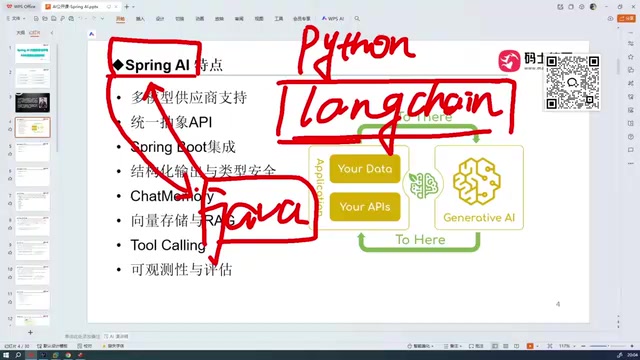
Deep Dive: Six Core Features of Spring AI
Spring AI's foothold in enterprise Java development comes from a set of capabilities deeply aligned with the Spring ecosystem. Let's break them down one by one.
Unified Abstract API and Multi-Model Support
Spring AI supports today's mainstream LLM providers, covering both conversational and multimodal models. While it doesn't support as many models as LangChain, all major vendors are covered.
It exposes a unified abstract API layer that hides the implementation differences between providers. Developers program against a single interface without worrying about vendor-specific details, making migration extremely low-cost. This design philosophy is consistent with Spring's longstanding "program to interfaces" approach — similar to how JDBC unifies access across different database drivers.
Structured Output and Type Safety
This is one of Spring AI's most practical features. When interacting with an LLM, responses can not only be returned as JSON but also automatically mapped to Java objects. Internally, Spring AI leverages modern Java language features introduced in JDK 17 — such as Records and Text Blocks — combined with Jackson or Gson for automatic JSON-to-POJO deserialization. No manual text parsing required; you get type-safe, structured results directly, significantly reducing development complexity.
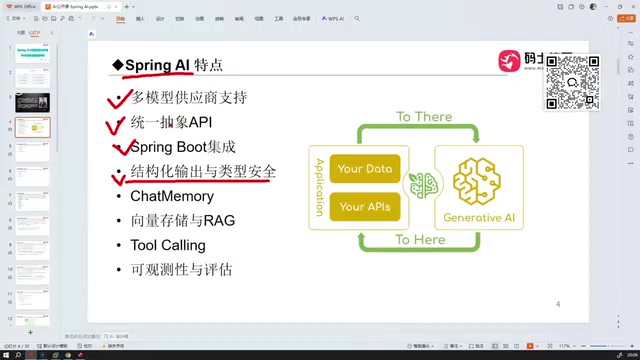
Chat Memory: Multi-Turn Conversation State Management
Spring AI's conversation memory feature is disabled by default and must be enabled manually. Once enabled, chat history is stored in memory by default; for persistence, Chat Memory can write conversation history to a database, providing full support for stateful, multi-turn conversational applications. This design addresses LLMs' inherent statelessness — each API call is a fresh conversation from the model's perspective. Chat Memory simulates "memory" at the application layer by automatically injecting historical context into each request.
Vector Store and RAG (Retrieval-Augmented Generation)
When building RAG applications, Spring AI supports data retrieval and extraction from vector databases, handling key steps like text vectorization and similarity search. This is one of the most frequently used capabilities in enterprise knowledge base and intelligent Q&A scenarios.
RAG (Retrieval-Augmented Generation) was formally introduced by Meta AI Research in a 2020 paper. The core idea is to retrieve relevant documents from an external knowledge base before generating an answer, then pass both the retrieved content and the user's question to the LLM — breaking through the model's training data cutoff and significantly reducing hallucinations. Vectorization is a key step: an Embedding model converts text into high-dimensional float vectors stored in a vector database (such as Pinecone, Weaviate, or pgvector), and at retrieval time, cosine similarity or inner product operations quickly find the most semantically relevant document chunks. Spring AI provides out-of-the-box adapters for major vector databases, so developers don't need to manually manage the low-level details of the vectorization pipeline.
Tool Calling and the MCP Protocol: Spring AI's Differentiating Advantage
Another capability worth highlighting in Spring AI is Tool Calling, which brings us to the MCP protocol.
Why Does LLM Tool Calling Need MCP?
Each LLM (such as DeepSeek, Claude, or ChatGPT) implements tool calling with its own incompatible proprietary API, making migration and integration costly. MCP (Model Context Protocol), open-sourced by Anthropic in November 2024, is a standardization protocol designed to unify this fragmented landscape. MCP uses a Client-Server architecture and defines standardized interfaces for Resources, Tools, and Prompts, allowing a single MCP Server to be reused by any model client that supports the protocol — similar to how USB unified the standard for peripheral connections. Developers implement a tool once and reuse it seamlessly across multiple models.
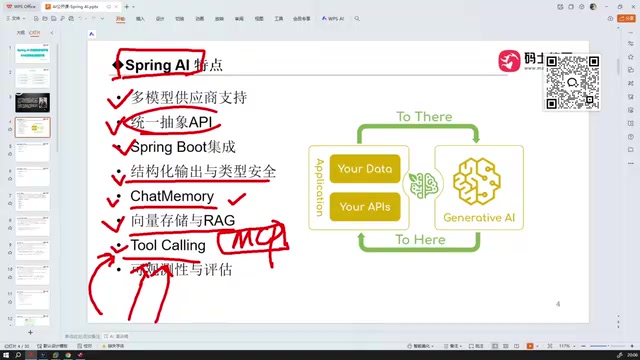
The Natural Fit Between Spring AI and MCP
Spring AI's design philosophy aligns closely with MCP. Since it's already built on a unified abstract API for calling various LLMs, the underlying implementation is inherently well-structured. When implementing Tool Calling, switching between models requires almost no code changes — just swap the model configuration. This makes integrating Spring AI into the MCP ecosystem exceptionally smooth.
Observability and Production Evaluation
As an enterprise-grade framework, Spring AI provides robust observability support, including model call count metrics and call logging. It integrates deeply with Spring Boot Actuator and the Micrometer monitoring stack, making key metrics like token consumption, latency distribution, and error rates visible — meeting the operational requirements of production environments.
Environment Setup and Version Requirements
Before writing any code, confirm your development environment meets these requirements. Based on practical experience, all of the following are non-negotiable:
- Spring Boot: Must be 3.x or higher — earlier versions will throw errors directly;
- JDK: Must be 17 or higher — the commonly used JDK 8 in enterprises won't work;
- Maven: Requires 3.9 or higher — otherwise you may encounter dependency resolution failures.
Spring Boot 3.x is required because Spring Boot 3.0 completed a full migration from the javax namespace to the jakarta namespace (corresponding to Jakarta EE 9+ spec), a change that is bytecode-incompatible with older versions. Additionally, Spring AI makes heavy use of JDK 17 features such as Records for structured output mapping and Sealed Classes for type constraints. For enterprise teams still on JDK 8, the overall upgrade cost should be assessed before migration — but strictly following the version requirements above will prevent the vast majority of environment-level issues.

Is It Worth Learning Spring AI as a Java Developer?
A realistic question arises: Python is the absolute mainstream for AI development, and relatively few enterprises build AI applications in Java. Is it still worth investing time in Spring AI?
The answer is yes.
First, some enterprises — motivated by technology stack consistency — do choose to build AI applications in Java, and Spring AI is designed precisely for those scenarios. Second, for developers with more years of experience, the programming language itself shouldn't be a barrier. The core ideas behind frameworks largely overlap: the retrieval logic in RAG, the design patterns for Tool Calling, the protocol specifications of MCP — these principles are language-agnostic. Once you understand them, switching languages is just a matter of getting familiar with syntax. Learning Spring AI is an incremental investment built on existing technical assets, not starting from scratch.
Summary
Spring AI fills a critical gap in the Java ecosystem for LLM integration, enabling developers already familiar with Spring Boot to enter AI application development with minimal learning overhead. From a unified API, structured output, and conversation memory, to RAG retrieval, Tool Calling, and MCP protocol support — it covers virtually every core scenario in enterprise AI development.
For teams primarily working in the Java stack, Spring AI is an option not to be missed; for individual developers, mastering it is an effective way to strengthen your position in future technical competition.
Key Takeaways
Related articles
Jensen Huang Takes Trump's Call in Public — But It's the Phone in His Hand That Steals the Show
NVIDIA CEO Jensen Huang took a live call from Trump in public, but observers couldn't stop talking about the phone in his hand. Here's what the moment reveals.
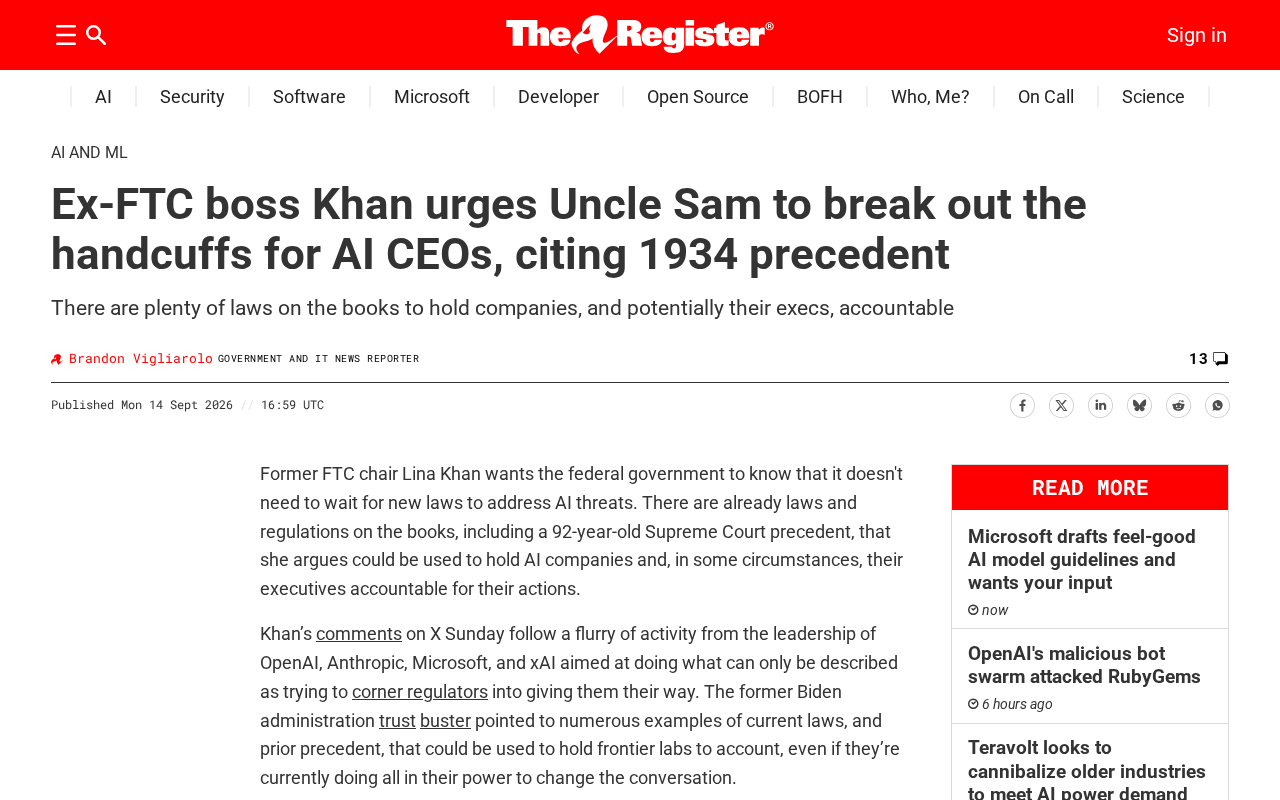
Former FTC Chair Khan Invokes 1934 Precedent to Argue for Criminal Liability of AI Executives
Former FTC Chair Lina Khan argues AI executives should face criminal liability, not just fines, citing a 1934 legal precedent. An analysis of her position, its logic, and the real-world challenges it faces.
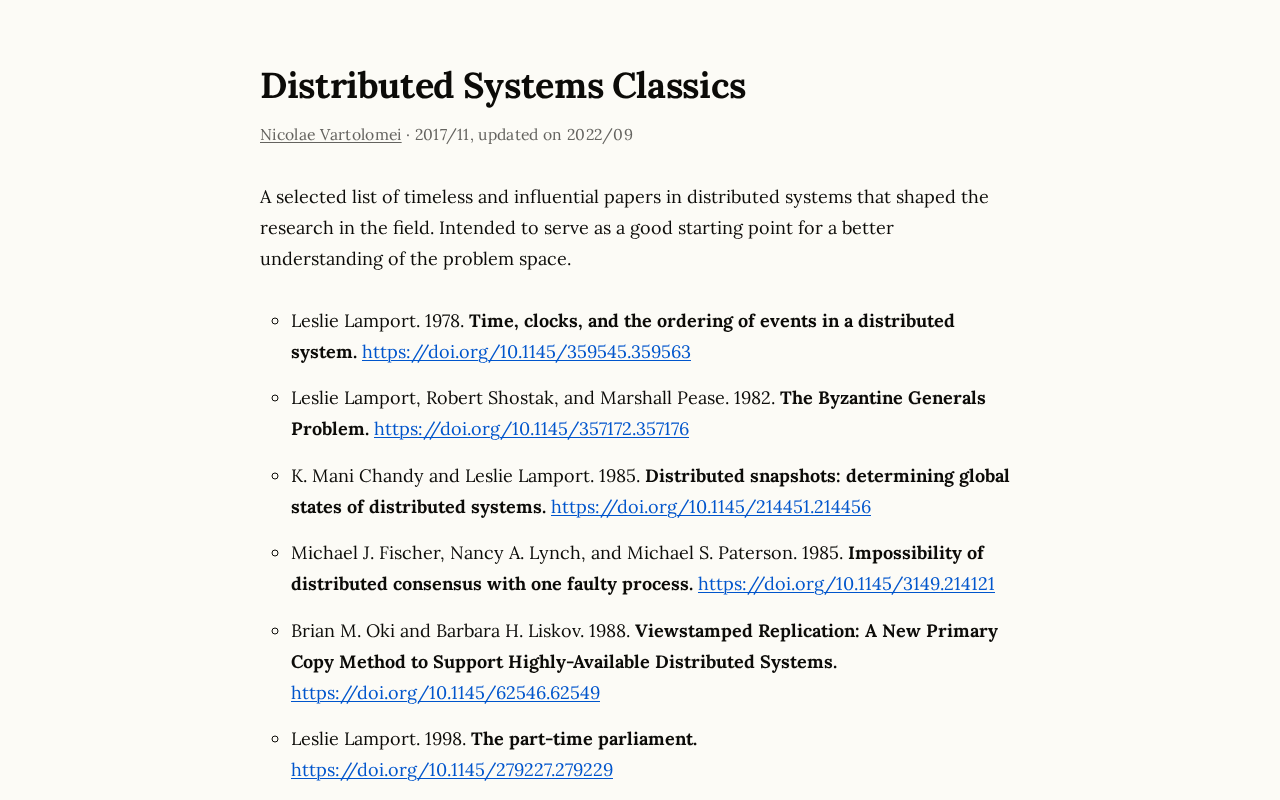
A Reading Guide to Distributed Systems Classic Papers: From Beginner to Expert
A viral Hacker News list of distributed systems classic papers covering consensus algorithms, logical clocks, and the CAP theorem — a structured learning path for engineers.