Spring AI in Practice: A Full-Chain Optimization Guide to the 10 Major Pain Points of RAG Knowledge Bases

A Spring AI hands-on guide to the 10 major RAG knowledge base pain points, helping Java developers transition into AI applications.
Based on Bilibili creator Teacher Xu Shi's Spring AI hands-on course, this article systematically organizes the core topics in enterprise RAG knowledge bases from development to interviews. It explains why RAG deserves a spot on your resume: it solves the inability of traditional keyword search to understand semantics and lets users get answers in natural language, making it the best project vehicle for Java developers transitioning into AI applications. It then explains vector retrieval, the technical foundation of RAG, and lists the 10 pain points interviewers most often follow up on, including chunking strategy, Top-K upper limit, query rewriting, reranking, permission security, and production deployment.
Enterprise knowledge bases are one of the most typical scenarios for putting AI applications into production, but anyone who has actually built a RAG system knows that pitfalls hide in every step, from document ingestion to production deployment. In this hands-on course, Bilibili creator Teacher Xu Shi uses the Spring AI tech stack to systematically walk through the 10 core pain points in RAG knowledge base development and how to solve them.
Why a RAG Knowledge Base Deserves a Spot on Your Resume
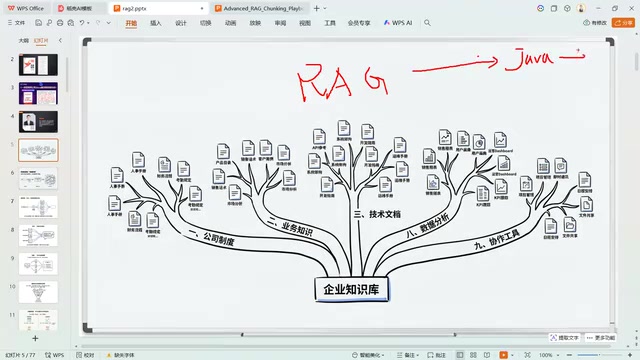
The dilemma of traditional enterprise knowledge bases is easy to see: HR handbooks, product materials, and requirements documents are scattered everywhere, and Elasticsearch can only do keyword matching. A newly onboarded salesperson trying to answer "What should I do when a customer says the product is too expensive?" can only manually search product docs and pricing docs, then spend a lot of time reading and distilling them.
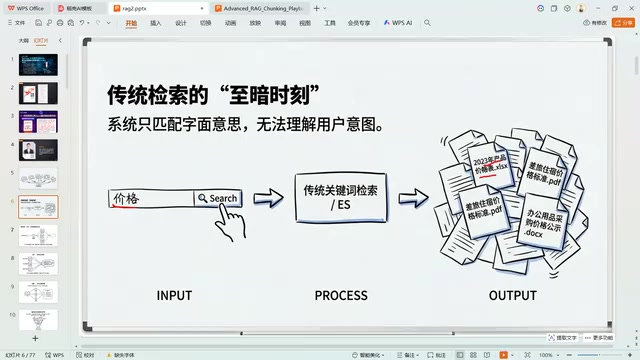
RAG (Retrieval-Augmented Generation) changes this workflow. Users ask questions in natural language, the system understands the semantics and automatically retrieves relevant documents, and then a large language model generates a targeted answer. For a new salesperson, this means going from "flipping through docs for ages" to "getting a ready-made pitch suggestion"; for a developer newly taking over a project, it means quickly understanding historical requirements and rules through the knowledge base.
Precisely because a RAG knowledge base is an AI application scenario almost every company needs, it has become the best project vehicle for Java developers transitioning into AI application development. Whether you're interviewing for a Java role or an AI application role, a complete RAG project experience is a significant plus.
Vector Retrieval: The Technical Foundation of RAG
One question interviewers often ask is: "Why can RAG retrieve semantically similar documents?" The answer lies in vector databases.
Relational databases perform exact matching (e.g., name = 'xxx'), while vector databases perform similarity retrieval. The prerequisite is storing text materials in the vector database in advance—not the text itself, but the vectors corresponding to the text.
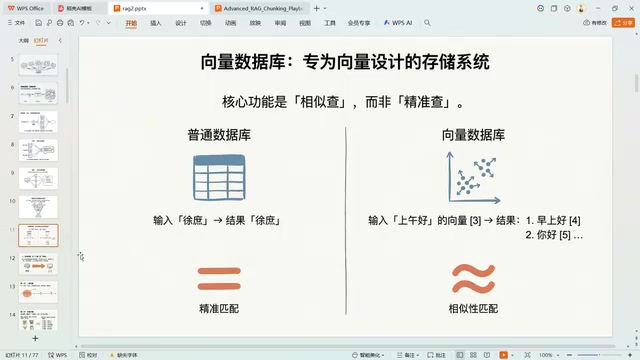
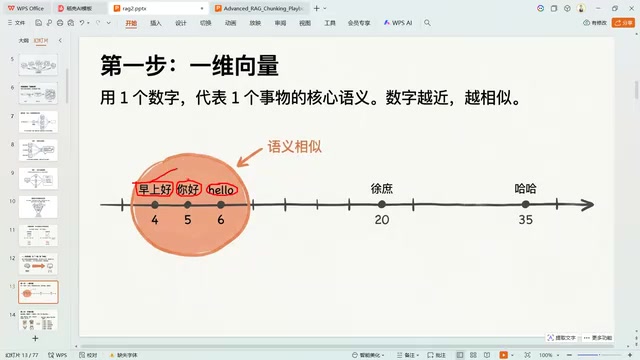
A vector is essentially a set of coordinate values. "Good morning" and "Hello" are semantically close, so after vectorization their coordinates sit very close together in vector space; texts with large semantic differences have coordinates that are far apart. During retrieval, the system finds the nearest vector, which means it has found the most semantically similar text.
The key step in turning text into vectors is calling an embedding model. Unlike the large language models used for conversation, it is specifically responsible for understanding text semantics and generating vector values. Platforms such as Tongyi Qianwen all offer a variety of embedding models to call.
The choice of dimensionality directly affects retrieval precision. Take "dog" as an example: if you only extract one dimension—body size—different breeds of dogs may all have high similarity. But if you simultaneously extract multiple feature dimensions such as body size, coat color, temperament, and shedding level, the similarity judgment becomes much more precise. The more feature dimensions, the higher the precision of similarity retrieval—this is the first principle for understanding RAG retrieval quality.
Embedding Model is a class of neural network models specifically designed to map text into high-dimensional floating-point vectors. Common examples include OpenAI's text-embedding-3, Tongyi Qianwen's text-embedding-v3, and the BGE series. Its core difference from conversational large models lies in the output format: conversational models output natural language tokens, while embedding models output a fixed-length vector (such as 1536 dimensions or 1024 dimensions). To evaluate whether an embedding model is good, people usually look at its retrieval accuracy on benchmarks such as MTEB, the maximum input length it supports, and inference cost.
Cosine similarity and vector distance are the most commonly used metrics in vector retrieval. Cosine similarity measures how close two vectors are in direction, with a value range from -1 to 1; the closer to 1, the more semantically similar they are. Corresponding alternatives include Euclidean distance, dot product, and other metrics. Which metric to choose must stay consistent with the training objective of the embedding model; otherwise, retrieval results will show obvious bias.
ANN (Approximate Nearest Neighbor) retrieval is the key to vector databases maintaining millisecond-level response times at large scale. If you calculated the distance between the query vector and every vector in the database one by one, the time cost at the million-scale level would be unacceptable. Therefore, systems such as FAISS, Milvus, and pgvector all use index structures like HNSW and IVF to approximately find the nearest vectors, trading a small amount of precision for a major speedup.
The Ten Major Pain Points: Core Topics from Development to Interviews
In the course, Teacher Xu Shi lists the 10 questions interviewers most often follow up on in RAG knowledge base development:
- Chunking strategy: How should documents be split to balance retrieval precision and context completeness?
- Top-K upper limit: How should the number of retrieved results be set, and what are the consequences of too many or too few?
- Cross-vector aggregation retrieval: How do multiple vector stores or multiple indexes work together?
- File traceability: How can retrieval results be traced back to the specific location in the original document?
- Data updates: How to incrementally update vectors when knowledge base content changes?
- Improving retrieval precision: Strategies from embedding model selection to hybrid retrieval
- Query rewriting: How to optimize the retrieval query when the user's question is vague?
- RAG reranking: How to use a rerank model for fine ranking after initial recall?
- Permission security: How do different roles see knowledge content in different scopes?
- Monitoring, evaluation, and production deployment: How to measure RAG effectiveness after launch and keep iterating?
These questions cover the full chain of a RAG system—data processing, retrieval and recall, permission security, monitoring and evaluation, and production deployment. Developers who can answer these questions clearly will demonstrate a deep understanding of RAG systems in interviews, rather than staying at the level of "getting the API to work."
Chunking refers to splitting long documents into segments that are each relatively semantically complete, with each segment vectorized separately and stored in the database. Cutting too finely loses context (for example, splitting a sentence in half), while cutting too large makes a single vector carry too many topics and dilute the semantics. Common chunking strategies include fixed-length splitting, splitting by punctuation or paragraph, splitting by Markdown heading hierarchy, and sliding-window splitting with overlap.
Top-K recall refers to returning the top K results with the highest similarity during vector retrieval. If K is too small, key information may be missed; if K is too large, irrelevant content will also be stuffed into the large model's context, causing answers to be disturbed by noise and increasing token cost. In practice, a combination of "multi-route recall + reranking" is often used: first perform rough recall with a larger K, then use a rerank model to finely rank the small number of truly relevant segments.
Rerank uses models with a Cross-Encoder structure. It concatenates the query and candidate documents and encodes them together, which allows it to capture finer-grained semantic interactions, and its precision is usually significantly higher than the Bi-Encoder recall used in vector retrieval. The cost is slower computation, so it is only used for fine ranking a small number of candidates.
Query Rewriting solves the problem of users' colloquial questions and unclear references. Common methods include using a large model to rewrite the question into a phrasing more suitable for retrieval, expanding a single question into multiple related sub-questions, and completing the context based on historical conversation (multi-turn rewriting).
The Transition Path from Java Development to AI Application Development
The value of Spring AI lies in enabling Java developers to build AI applications with a familiar tech stack. There is no need to switch to the Python ecosystem; through Spring AI's abstraction layer, you can complete the entire development workflow of vectorization, retrieval, and generation.
For Java developers currently looking for a transition direction, a RAG knowledge base project is a pragmatic starting point: strong continuity in the tech stack, realistic business scenarios, and plenty to talk about in interviews. It is recommended to go deep into each of the 10 pain points one by one, practice each pain point hands-on, and form your own technical judgment.
One-line Summary
A hands-on Spring AI guide to the 10 major pain points of RAG knowledge bases, helping Java developers transition into AI applications.
Paragraph Summary
Based on Bilibili creator Teacher Xu Shi's Spring AI hands-on course, this article systematically organizes the core topics in enterprise RAG knowledge bases from development to interviews. It first explains why RAG deserves a spot on your resume: it solves the inability of traditional keyword search to understand semantics and lets users get answers in natural language, making it the best project vehicle for Java developers transitioning into AI applications. It then explains vector retrieval, the technical foundation of RAG, pointing out that after text is converted into coordinate values by an embedding model, it can be retrieved by semantic distance in vector space, and that the more feature dimensions, the higher the precision. Finally, it lists the 10 pain points interviewers most often follow up on, including chunking strategy, Top-K upper limit, query rewriting, reranking, permission security, and production deployment, and offers transition advice to practice each pain point hands-on.
Related articles

AI Compute Is the New Oil, But the Market Mechanism Has Yet to Take Shape
Hacker News compares AI compute to the new oil, noting the lack of price discovery, concentrated supply, and no hedging tools. The article analyzes structural issues in compute trading and explores a possible three-tier market of spot, contracts, and derivatives, plus the real impact on AI practitioners' cost management.

Running Full iOS 16.5 Firmware on Android Devices: Technical Demo or Marketing Gimmick?
A Hacker News post claims full iOS 16.5 firmware can run on Android, with 315 upvotes. This analysis argues it is more likely a web UI simulation than a true firmware port, and explores the value and risks of such projects.

Etsy Cracks Down on AI Slop: Addressing Buyer and Seller Anxieties
Etsy introduces stricter rules limiting AI-generated content in listings, addressing buyer confusion over AI products and seller fears of original work being diluted by AI slop.