Spring AI LLM Tutorial for Beginners: A Complete Learning Path from Core Principles to Enterprise Practice

A structured Spring AI course guiding Java developers from LLM fundamentals to enterprise deployment.
This Bilibili Spring AI course — billed as "the most comprehensive online" — tackles the fragmentation and theory-heavy nature of most AI education with a three-module path: foundational coverage of Transformer architecture and prompt engineering, an advanced module on RAG, private deployment, and LoRA fine-tuning, and a practical module featuring real-world projects like intelligent Agents, enterprise knowledge bases, and medical LLMs. Supplementary roadmaps, slides, and e-books round out the package. While the course structure is genuinely systematic, marketing claims like "job-ready in seven days" deserve skepticism — real LLM engineering ability still requires sustained hands-on practice.
A systematic AI tutorial designed for beginners with no prior experience is gaining traction on Bilibili. This Spring AI course — which its author bills as "the most comprehensive on the entire internet" — aims to address a persistent pain point in large language model education: fragmented content that prioritizes theory over hands-on practice. This article breaks down the course structure and knowledge framework to help aspiring developers assess its learning value.
Course Positioning: Filling the Gap in Hands-On Teaching
In his introduction, the author explains that he watched through countless Bilibili videos and studied international content on YouTube before concluding that "90% of available material is either shallow and inconsistent, or purely theoretical with no practical exercises." This observation reflects a genuine challenge in today's AI education market — while large language models are generating enormous buzz, resources that explain concepts thoroughly and pair them with complete hands-on practice remain scarce.
The course emphasizes teaching LLM knowledge "in the most straightforward, intuitive, and pure way possible," claiming the author spent three months reorganizing the entire knowledge framework. For beginners, this no-frills, practice-first philosophy is commendable — though marketing phrases like "go from zero to hero in seven days" deserve a healthy dose of skepticism. The depth of LLM development is simply not something that can be mastered in a week.
Spring AI is an official Spring framework for AI application development, designed to let Java developers interface with various LLM APIs — such as OpenAI, Azure OpenAI, and locally hosted Ollama models — using familiar programming paradigms. It wraps common capabilities including model calls, prompt templates, conversation memory, vector database integration, and function calling, enabling enterprise developers in the Java ecosystem to integrate LLM features into existing Spring Boot projects without needing to dive into Python-based toolchains like LangChain. For backend engineers who primarily work in Java, Spring AI is a low-friction entry point into LLM engineering — which explains the target audience this course is built around.
Three Modules: From Core Principles to Enterprise Deployment
The course is divided into three modules — foundational, advanced, and practical — forming a relatively complete learning path.
Foundational Module: Building Understanding and Setting Up Your Dev Environment
The foundational module covers core LLM principles, AI development environment setup, prompt engineering, the Transformer architecture, and pre-training mechanisms. The pedagogical logic here is sound: first build an understanding of how large models work under the hood, then configure the development environment hands-on. The Transformer architecture and pre-training mechanisms are critical to understanding modern LLMs, and introducing them at the entry level helps learners avoid the common trap of "knowing how to call an API without understanding why it works."
The Transformer architecture was introduced by Google in the 2017 paper Attention Is All You Need and serves as the shared foundation of modern LLMs like GPT and BERT. Its core mechanism — self-attention — allows the model to simultaneously attend to the contextual relationships between every word in a sequence while processing each token, rather than passing information sequentially as early RNNs did. This enables the model to efficiently capture long-range dependencies and fully leverage GPU parallelism, supporting pre-training at scales of tens or hundreds of billions of parameters. Understanding the Transformer's attention mechanism, positional encoding, and feed-forward network structure will help learners later grasp why prompts work, which parameters fine-tuning actually adjusts, and the probabilistic nature of model outputs.
Advanced Module: Enterprise-Grade Core Capabilities
The advanced module goes deep on RAG (Retrieval-Augmented Generation), private deployment, model training, and efficient fine-tuning techniques. These topics are precisely what enterprises focus on most when adopting LLMs. RAG addresses the limitations of a model's knowledge cutoff and enables integration of private data; private deployment addresses data security and regulatory compliance; fine-tuning is the core technique for adapting general-purpose models to specific business scenarios. This module offers the highest practical value and represents the dividing line between casual "players" and serious developers.
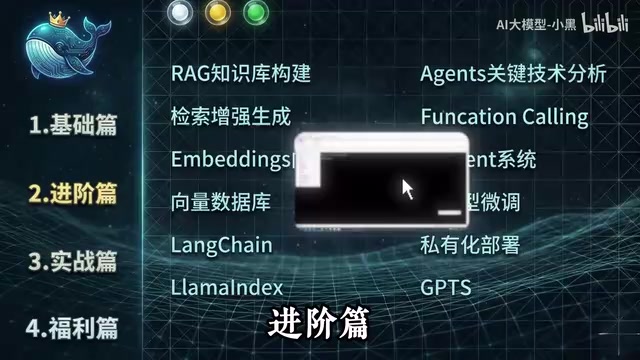
RAG (Retrieval-Augmented Generation) is currently one of the most widely adopted technical approaches for enterprise LLM deployment. The core idea is straightforward: rather than relying solely on knowledge encoded during training, the system retrieves relevant document chunks from an external knowledge base at inference time, injects them into the prompt, and then passes everything to the model to generate an answer. This approach overcomes the model's knowledge cutoff date, enables access to proprietary enterprise data (such as internal documents, product manuals, and contract repositories), and significantly reduces hallucination risks. Compared to full fine-tuning, RAG requires no model retraining, making it far cheaper to deploy and maintain — which is why it has become the preferred architecture for enterprise knowledge bases and customer service Q&A systems.
On the fine-tuning side, LoRA (Low-Rank Adaptation) is currently the most widely used parameter-efficient fine-tuning method. Rather than updating all of a model's original weights, LoRA inserts small low-rank matrices as bypasses on specific layers and only trains these newly added parameters. This makes it feasible to fine-tune models with billions of parameters on consumer-grade GPUs, dramatically lowering the hardware barrier for enterprises looking to customize models.
Practical Module: Real-World Project Implementation
The practical module is where the course delivers its payoff, featuring projects including intelligent Agent development, digital human applications, enterprise knowledge bases and Q&A systems, and medical LLM applications. These case studies cover the most active commercial directions in LLM adoption today. Intelligent Agents and enterprise knowledge bases are among the fastest-moving application categories, while medical LLMs represent deep exploration of vertical industry use cases. Driving learning through real projects aligns well with how engineering competence actually develops.
Supporting Resources and Learning Approach
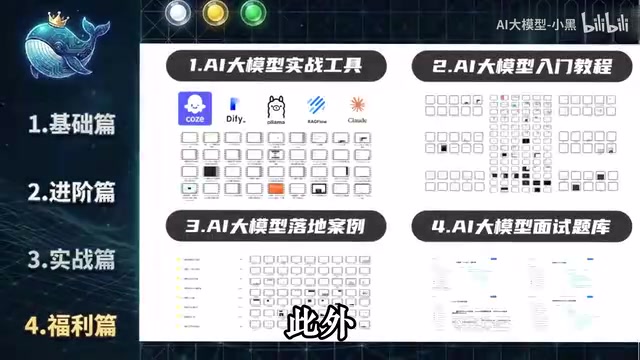
Beyond the video content, the author has prepared a learning roadmap, slides, and e-books, emphasizing that learners don't need to worry about falling behind or taking exhaustive notes. These supplementary resources are genuinely useful for structured learning — particularly the roadmap, which gives learners a clear picture of the overall knowledge framework and helps prevent getting lost in a sea of content.
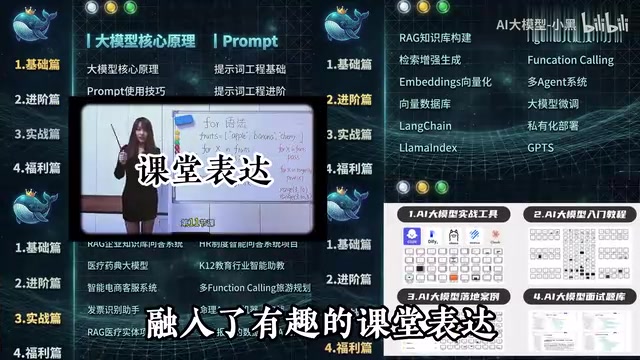
The course emphasizes "extensive hands-on examples" and "dense, high-throughput knowledge delivery." This pace works well for developers with some background who want to level up quickly, but complete beginners may need to revisit material multiple times. The recommended approach is to practice alongside the videos rather than passively watching.
A Balanced Assessment of the Marketing Claims and Real Value
In terms of content planning, this course is genuinely systematic — moving from principles through advanced topics to practical application in a coherent loop that covers the major milestones of LLM development from entry-level to enterprise use. That said, promotional language like "748 episodes," "job-ready upon completion," and "skip 99% of the wrong turns" is largely traffic-driving rhetoric. Learners should evaluate the course based on the density of its knowledge and the quality of its hands-on exercises, not on numbers and promises.
For readers looking to systematically enter LLM development, this kind of structured tutorial can serve as a useful reference framework. Real capability, however, still comes from sustained hands-on work and reflection in actual projects.
Related articles
AI Agent Fundamentals: The Three Core Components — Brain, Memory, and Tools
A beginner's guide to AI Agents: covering the three core components (brain, memory, tools), four stages of LLM deployment, and why Agents matter for real business use cases.

Boycotting Software That Doesn't Support Linux: One Developer's Philosophy of Choice
A Linux-only developer shares his philosophy of boycotting non-Linux software — without sacrificing productivity — and explains how coding agents like Claude Code are closing the gap with commercial tools.

Why Do All AI-Generated Projects Look the Same? The Aesthetic Homogenization Problem in Vibe Coding
Why do vibe coding projects all use purple gradients and dark glassmorphism? We break down the technical roots of AI aesthetic homogenization and how to escape it.