Spring Boot Quick Start: A One-Hour Learning Path Guide for Absolute Beginners

A beginner-friendly guide to learning Spring Boot in one hour using a big-picture-first approach.
This article reviews a Spring Boot tutorial designed for absolute beginners, built around a "focus on the big picture, don't sweat the small stuff" philosophy. Instead of grinding through every detail, the course walks learners through the evolution from a simple Java project to a full Spring Boot web application in one hour, helping them understand why each technology exists. The guide also covers IDE setup, JDK selection, and foundational Java concepts, while honestly noting that deeper topics like dependency injection and Bean lifecycle will need further study.
Why Most Beginners Struggle with Backend Development
On the journey of learning to code, many absolute beginners fall into a common trap: despite having a comprehensive learning roadmap, they get stuck at a certain point and can't seem to move forward. This Bilibili creator hits the nail on the head — students often discover at some knowledge point that "you need to learn this, and you need to learn that," ending up spending enormous amounts of time on minor details.
The most classic example is Object-Oriented Programming. OOP is the core programming paradigm of Java, encompassing four fundamental principles: encapsulation, inheritance, polymorphism, and abstraction. Many beginners get stuck here because OOP is essentially a "design philosophy" rather than mere syntax rules — it requires developers to think about and model real-world problems using "objects." Many people believe that mastering OOP requires doing tons of practice problems and grinding exercises to verify their understanding. But the creator clearly points out that this is actually a very misguided learning approach. This shift in thinking can't be achieved through brute-force problem grinding — it needs to be gradually internalized through real projects. In fact, in enterprise development, a developer's depth of understanding OOP typically deepens through using frameworks like Spring and designing modular architectures. Obsessing over local perfection and exhaustive detail actually causes learners to lose sight of the overall technical landscape, ultimately leading to the embarrassing situation of "spending half a year studying without ever reaching Spring Boot."
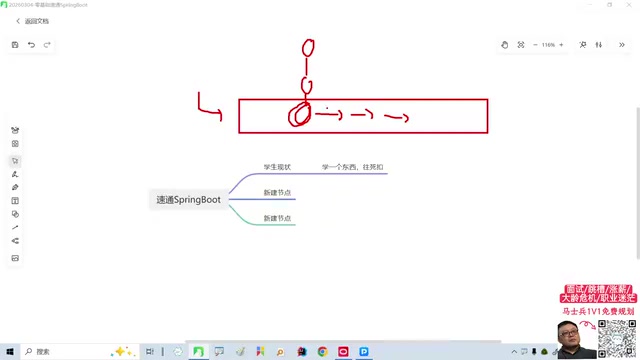
The "Big Picture First" Learning Philosophy
The core principle of this Spring Boot tutorial is "focus on the big picture, don't sweat the small stuff." Rather than grinding through every single knowledge point, it's better to first establish the connections between technologies and understand the entire evolution process. In other words, learners should prioritize understanding fundamental questions like "Why do we need to learn Spring?" and "Why do we need to learn Spring Boot?" instead of getting bogged down in syntax details from the start.
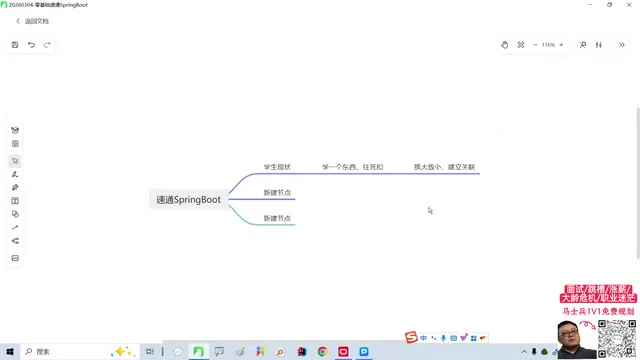
This top-down, big-picture-to-details approach is undoubtedly a more efficient path for beginners who want to quickly get started with enterprise-level development.
The One-Hour Challenge: From a Java Project to Spring Boot
This course sets an ambitious goal — getting absolute beginners up and running with a Spring Boot project (an essential skill in the industry) within one hour. While it sounds aggressive, the teaching logic behind it is clear.
Gradual Technical Evolution
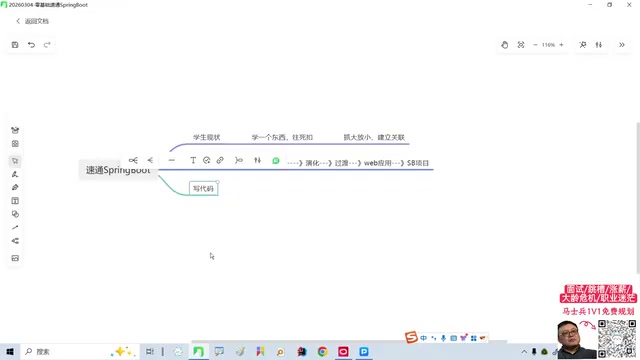
The creator's overall approach is: start with the simplest possible Java project, gradually evolve and transition it, and ultimately transform it into an efficient web application. This "evolutionary" teaching method has unique value — learners can witness firsthand how an ordinary Java program gets upgraded step by step into a modern enterprise application, thereby understanding the purpose of each technology layer.
To appreciate this evolutionary path, it helps to review an important piece of technical history. The Spring Framework was created in 2003 by Rod Johnson, with the core goal of simplifying the complexity of Java enterprise development — particularly compared to the cumbersome EJB (Enterprise JavaBeans) specification of that era. Spring made Java development more flexible and testable through two core mechanisms: IoC (Inversion of Control) and AOP (Aspect-Oriented Programming). However, as the Spring ecosystem expanded, its XML configuration files became increasingly verbose and complex — a mid-sized project could contain hundreds of lines of configuration code. Spring Boot emerged in 2014 with the core philosophy of "Convention over Configuration," automating much of the manual configuration work through auto-configuration, embedded servers, and Starter dependencies. This is exactly why the creator emphasizes the importance of understanding the technology evolution — only by knowing what problems Spring Boot solves can you truly grasp its design philosophy and usage patterns.
For beginners, this process is far more meaningful than simply being told "this is how you use Spring Boot." It reveals the internal logic of technological progress: every framework evolution exists to solve pain points exposed by the previous stage.
Choosing and Setting Up Development Tools
The course starts from the very basics of setting up a coding environment. The creator mentions that many students initially write code in Notepad, but real programmers use professional Integrated Development Environments (IDEs).
An IDE (Integrated Development Environment) is a software tool that integrates code editing, compilation, debugging, version control, and other functions into one package. Compared to Notepad or simple text editors, IDEs offer code auto-completion, syntax highlighting, real-time error detection, refactoring support, built-in terminals, and many other productivity-boosting features. In the Java ecosystem, there are three mainstream IDEs: IntelliJ IDEA, Eclipse, and VS Code (with Java plugins). Among them, IntelliJ IDEA is widely considered to offer the best Java development experience, especially its Ultimate Edition, which includes deep built-in support for enterprise scenarios like Spring Boot, databases, and web development — which is why most Spring Boot tutorials choose it as their teaching tool.
Getting IntelliJ IDEA Through Legitimate Channels
The tutorial uses IntelliJ IDEA Ultimate Edition. It's important to note that the creator mentions obtaining a "cracked version" in the video. We must emphasize: using pirated software carries legal and security risks, and we neither recommend nor encourage such practices. JetBrains officially offers free educational licenses for students — enrolled students can use the full Ultimate Edition features through legitimate channels at no cost. This is the approach we recommend.
Creating Your First Java Project
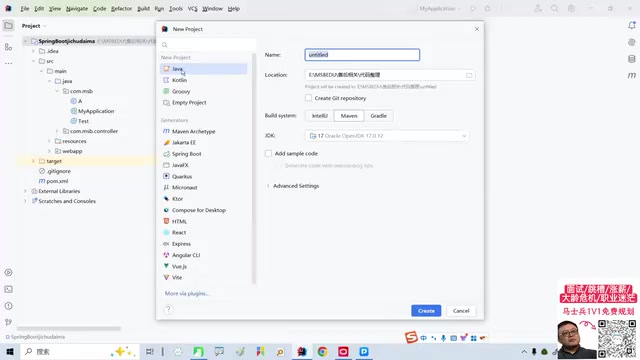
In the hands-on section, the creator demonstrates how to create the most basic Java SE project through "New Project," selecting an appropriate JDK version before building.
Regarding JDK version selection, here's some useful background. The JDK (Java Development Kit) is the foundational toolkit for Java development, containing the Java compiler, runtime environment (JRE), and standard class libraries. As of now, Java releases a new version every six months, but not all versions are suitable for production use. Oracle designates certain versions as LTS (Long-Term Support), including Java 8, 11, 17, and 21. In enterprise development, Java 8 is still widely used due to the massive number of existing projects, while Java 17 and 21 are recommended for new projects. Notably, Spring Boot 3.x requires a minimum of Java 17, so choosing JDK 17 or higher when learning Spring Boot is the current best practice.
After the project is created, the first step is to create the most basic "class." In Java, a Class is the fundamental building block of object-oriented programming — think of it as a "blueprint" or "template" for creating objects. A class defines a set of properties (variables) and behaviors (methods), and specific object instances can be created from it. For example, a "Car" class might define properties like color and brand, along with methods like start and brake, while a specific red Toyota would be an instance of that class. The entry point of a Java program is a class containing the main method, and all Java code must be written inside classes — this is a fundamental requirement of Java as a purely object-oriented language. Understanding the concept of classes is the foundation for later learning core Spring Framework concepts like Bean management and dependency injection.
As a course designed entirely for absolute beginners, the creator pauses here, preparing to answer that most fundamental question — "What exactly is a class?" This approach of starting from the most basic concepts reflects the course's beginner-friendly positioning.
Verdict: Who Is This Spring Boot Tutorial For?
From a pedagogical standpoint, the biggest highlight of this Spring Boot tutorial is its "rapidly building a technical big picture" approach. It doesn't try to be exhaustive — instead, it helps beginners run through a complete project in the shortest time possible, building a sense of accomplishment and holistic understanding. This is genuinely a great remedy for beginners who tend to get stuck on details.
That said, we should be objective: a one-hour quick start is more of an "experiential" introduction. Truly solid backend development skills still require extensive project practice down the road. "Focus on the big picture" works well for the initial stage of building a framework, but once learners move into real-world development, the details that were temporarily skipped (such as Spring's dependency injection principles, Bean lifecycle, etc.) will eventually need to be filled in.
Specifically, Dependency Injection (DI) is one of Spring Framework's most core design patterns and a concrete implementation of Inversion of Control (IoC). In traditional programming, objects are responsible for creating and managing their own dependencies, but in Spring, this responsibility is transferred to the Spring container (also known as the IoC container). Developers simply declare "what I need," and Spring automatically injects the corresponding objects. Beans are objects managed by the Spring container, and their lifecycle includes five stages: instantiation, property population, initialization, usage, and destruction — each with corresponding extension points. These concepts can be temporarily skipped during the quick start phase, but when dealing with complex business development or troubleshooting issues like circular dependencies and Bean loading order, a deep understanding of them becomes indispensable.
Overall, if you're a complete programming beginner looking to quickly build a holistic understanding of Spring Boot development and avoid getting lost in the early stages of learning, this tutorial offers a solid entry point. Just make sure to obtain your development tools through legitimate channels — lay a compliant foundation for your tech journey.
Related articles

Uber Deploys ChatGPT Work Company-Wide: AI in the Workplace Enters the Scaled Implementation Phase
Uber deploys ChatGPT Work to 30,000+ employees, extending it from engineering to all roles. We analyze its expert-engineer pairing, end-to-end automation, and questions of AI control and power concentration—insights for scaling AI in the workplace.

Shift at Midnight Hands-On: When "ID Verification" Becomes Alien Hunting
Shift at Midnight blends ID verification with horror survival in a four-player co-op game. We break down its inspection mechanics and chaotic humor.

Zelensky Recounts the Outbreak of War: I Need Ammunition, Not a Ride
Zelensky recalls the first day of war in a YouTube interview: farewell to family, rejecting Biden's evacuation offer with "I need ammunition, not a ride," and how Bucha shaped his stance on compromise and peace talks.