SpringAI+RAG Enterprise实战: Breaking Through Three Major LLM Bottlenecks

Breaking down how Spring AI Alibaba+RAG+Milvus solves four types of LLM enterprise deployment shortcomings.
Based on the Bilibili tutorial "SpringAI+RAG Traditional Application AI Upgrade Enterprise实战," this article outlines the four structural shortcomings exposed when LLMs are deployed in enterprises: knowledge cutoff, no cross-turn memory, hallucinations, and private data blind spots, and points out that RAG is the engineering solution to fill these gaps. The solution forms a complete pipeline with Spring AI Alibaba + RAG + Milvus, covering model integration, document vectorization, similarity retrieval, concurrency handling, and containerized deployment. The tutorial's capability goals include local deployment of Qwen3 via Ollama, integration of Qwen Plus and Embedding, JDK 21 virtual threads, and Docker deployment. The target audience is primarily Java developers, who can enter AI application development without switching to Python. The article also reminds that retrieval quality, document splitting, and Embedding selection will significantly affect implementation results, and corrects "Muverse" in the original narration to Milvus.
Why Simply Calling LLMs Isn't Enough
Calling LLM APIs is nothing new, but when it comes to real enterprise deployment, four barriers—knowledge cutoff, goldfish memory, hallucinations, and private data blind spots—leave many teams stuck at the demo stage. The Bilibili tutorial "SpringAI+RAG Traditional Application AI Upgrade Enterprise实战" offers a solution: a tech stack combining Spring AI Alibaba + RAG + Milvus (the original narration says "Muverse," which is actually the vector database Milvus). This article breaks down what problems this solution addresses, who it's for, and what goals it can achieve.
No matter how strong an LLM's language capabilities are, structural shortcomings emerge in enterprise scenarios. The tutorial categorizes the problems into three types:
- Knowledge cutoff: Model training data has a temporal boundary. The original text gives an example that model data may only be updated to a certain month, and it knows nothing about events after that.
- Goldfish memory: In multi-turn conversations, the user has already provided an order number, but when asking again, the model still asks for it to be repeated—it has no persistent memory across turns.
- Hallucinations: The model fabricates answers to questions without data support. The original text uses "asking about someone's gender but getting a wrong answer" to illustrate this kind of "nonsense."
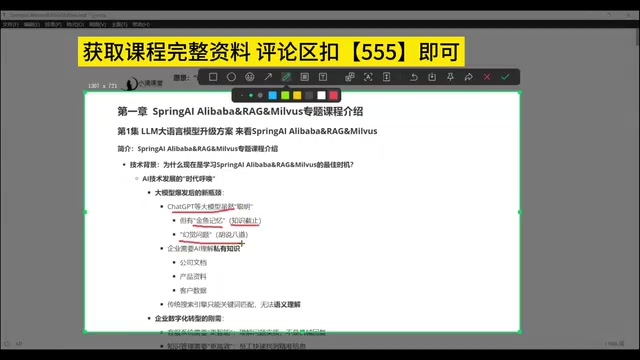
These three problems point to the same root cause: the model is a general-purpose model trained by others—it doesn't know your private data, nor does it inherently possess the context required for enterprise business.
The Dual Gap of Private Knowledge and Semantic Search
Enterprise documents, product information, and customer data never enter the training set of general-purpose models, so direct questions will inevitably yield no answers. Traditional search engines are similarly limited—they rely on keywords and literal matching. Searching for "phone" brings up "gloves" and "watches," but cannot understand semantic associations like "smart products." The tutorial thus introduces the core value of RAG: using retrieval-augmented generation to feed private knowledge to the model, while leveraging the LLM's language understanding to compensate for the shortcomings of semantic search.
RAG (Retrieval-Augmented Generation) is a technical paradigm that combines external knowledge bases with large language models. Its core workflow has two steps: in the retrieval phase, the system converts the user's question into a vector and searches the vector database for the most semantically similar document fragments; in the generation phase, these fragments are assembled as context into the prompt, allowing the model to answer based on real materials. The value of RAG lies in injecting private knowledge without fine-tuning the model, while significantly reducing hallucinations—the model is constrained to answer within the scope of retrieved evidence. Compared to fine-tuning, RAG offers more timely knowledge updates and lower costs, making it suitable for scenarios where enterprise documents change frequently.
Vectorization and Embedding Models: Text cannot directly compute semantic similarity; an Embedding model is needed to map sentences into high-dimensional floating-point vectors, where semantically similar text is closer in vector space. The Qwen3 Embedding model used in the tutorial handles this conversion. Before documents are stored, they go through three steps: extraction, splitting, and vectorization. The granularity of splitting directly affects retrieval hit rates—too fine loses context, too coarse introduces noise. Similarity search typically uses cosine similarity or inner product, and vector databases like Milvus achieve millisecond-level retrieval among billions of vectors through approximate nearest neighbor algorithms (such as HNSW, IVF).
Where Enterprises' Real Needs Lie
The tutorial breaks down enterprise needs into three levels, corresponding to three focal points of AI upgrade.
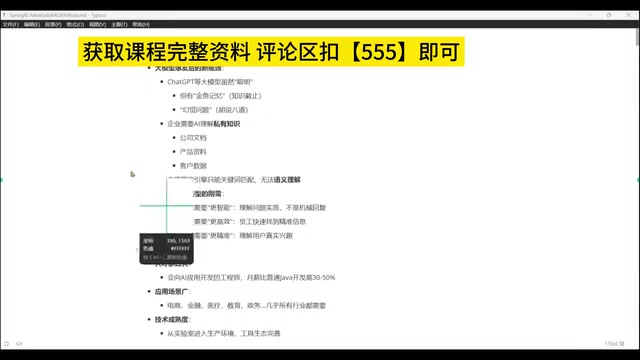
Smarter customer service systems. Questions users have expressed should be remembered, and replies should be based on understanding rather than mechanical matching. The order number should only be provided once; subsequent follow-ups should not ask for it again—this is exactly what the memory mechanism solves.
More efficient knowledge management. Employees no longer need to rack their brains to come up with professional terminology when looking up information; they can retrieve target information by describing their needs in natural language.
More precise content recommendations. When the model can understand semantic descriptions like "cute, sweet, sour, bitter," recommendation systems can capture users' true preferences rather than stopping at literal matching.
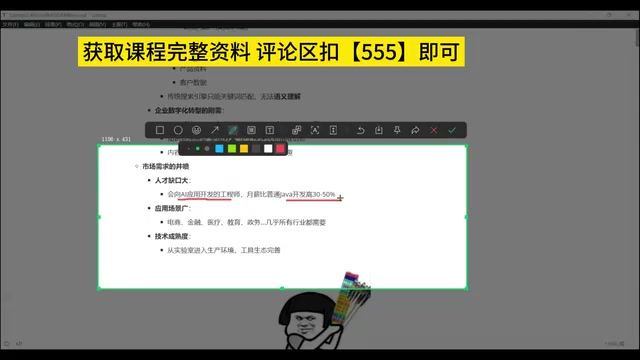
The tutorial also mentions market signals: engineers skilled in AI application development earn 30% to 50% more than ordinary developers, and demand is trending upward; application scenarios cover e-commerce, finance, healthcare, education, government, and other industries; Spring AI Alibaba has released version 1.0, and the technology is moving from the lab to production environments.
The Learning Path and Goals of This Tech Stack
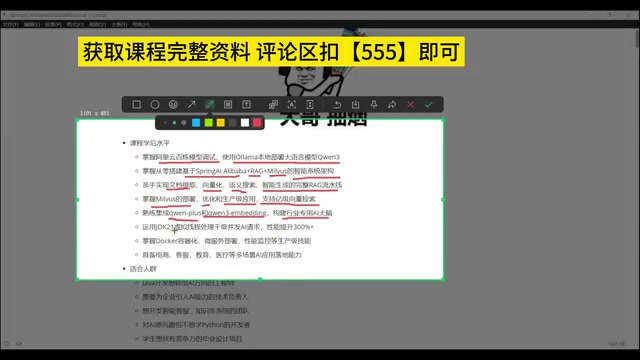
The capability list given by the tutorial is quite specific and can be seen as a complete chain from model integration to production deployment:
- Model layer: Master model debugging on the Alibaba Cloud Bailian platform, and local deployment of the Qwen3 model using Ollama.
- Architecture layer: Build an intelligent system with Spring AI Alibaba + RAG + Milvus from scratch, implementing smart customer service or knowledge base scenarios.
- Data layer: Hands-on implementation of document extraction, vectorization, and similarity search, running the complete RAG pipeline.
- Storage layer: Master the deployment, optimization, and production-level application of the Milvus vector database, supporting billion-scale vector retrieval.
- Model integration: Integrate the Qwen Plus LLM and Qwen3 Embedding vector model to build a professional AI brain.
- Engineering: Handle concurrency based on JDK 21 virtual threads (the original text claims nearly 300% performance improvement), and use Docker for containerized deployment and performance monitoring.
- Project实战: Focus on education scenarios, covering e-commerce customer service, healthcare, and other industry scenarios, training AI application implementation capabilities.
A detail worth mentioning—the introduction of JDK 21 virtual threads: RAG systems involve massive concurrent retrieval and model calls. Traditional thread models incur significant overhead under high concurrency, while virtual threads make concurrent processing more lightweight. This is also why the tutorial chose JDK 21 rather than older versions.
JDK 21 Virtual Threads are lightweight thread implementations introduced by the Java platform, scheduled by the JVM rather than the operating system, with extremely low creation costs and the ability to support millions of virtual threads per machine. Traditional platform threads correspond one-to-one with OS threads, each occupying about 1 MB of stack space; under high concurrency, thread pool exhaustion becomes a bottleneck. In RAG systems, much time is spent waiting for vector retrieval and model API responses—this is I/O-intensive load. Virtual threads automatically yield the carrier thread when blocked, thus significantly improving throughput. The "nearly 300% performance improvement" claimed in the original text should be understood as a throughput comparison under specific stress-test scenarios; actual gains depend on the proportion of I/O waiting.
Who Should Learn This
The target audience is clearly defined, essentially covering three types of roles:
- Transitioners: Java developers who want to move into AI application development without learning Python. The tutorial explicitly lists "developers interested in AI but unwilling to learn Python" as suitable, and the Spring tech stack background can be directly reused.
- Enterprise technical decision-makers: Technical leaders who need to introduce AI capabilities to their teams, or teams developing smart customer service or knowledge bases.
- Project seekers: Students needing highly competitive graduation projects, entrepreneurs wanting to quickly experience AI products, and IT departments in traditional industries doing technical upgrades.
A Few Observations
From the tutorial content, the value of this solution lies not in any single technology, but in stringing together model integration, private knowledge retrieval, vector storage, concurrency handling, and container deployment into a deliverable engineering pipeline. For developers with a Java background, Spring AI Alibaba lowers the barrier to entering AI application development—no need to switch to the Python ecosystem; you can build RAG systems using the familiar Spring framework.
It should be noted that the tutorial's description of RAG effectiveness focuses on the capability level. In actual implementation, retrieval quality, document splitting strategies, and Embedding model selection will significantly affect final results; these details need to be refined gradually through project实战. Also, the "Muverse" in the original narration should be Milvus; refer to official documentation when learning.
One-line Summary
Breaking down how Spring AI Alibaba+RAG+Milvus addresses four types of shortcomings in enterprise LLM deployment.
Paragraph Summary
Based on the Bilibili tutorial "SpringAI+RAG Traditional Application AI Upgrade Enterprise实战," this article outlines the four structural shortcomings exposed when LLMs are deployed in enterprises: knowledge cutoff, lack of cross-turn memory, hallucinations, and private data blind spots, and points out that RAG is the engineering solution to fill these gaps. The solution uses Spring AI Alibaba + RAG + Milvus to form a complete pipeline, covering model integration, document vectorization, similarity retrieval, concurrency handling, and containerized deployment. The tutorial's capability goals include local deployment of Qwen3 via Ollama, integration of Qwen Plus and Embedding, JDK 21 virtual threads, and Docker deployment. The target audience is primarily Java developers, who can enter AI application development without switching to Python. The article also reminds that retrieval quality, document splitting, and Embedding selection will significantly affect implementation results, and corrects "Muverse" in the original narration to Milvus.
Related articles
 Tech Frontiers
Google Omni 1.2 Flash: 15-Second AI Video at Just $0.07 per Second
Google DeepMind releases Gemini Omni 1.2 Flash: 15-second video, 720p at $0.07/sec (30% cheaper), multi-turn editing without regeneration, draft upscaling to 4K.
 Tech Frontiers
No AI Ghostwriting: Writer's Quarter Reinvents Novel Writing with a Visual Workbench
The Writer's Quarter is an AI-free novel writing and planning tool that unifies character building, story planning, and manuscript writing in one visual workbench. This article analyzes its positioning, target users, and differentiated value amid the rise of AI writing tools.
 Tech Frontiers
Fleeep: A Unified Inspiration Collection Notes App for Creatives
Fleeep is a notes app for creatives that unifies screenshots, bookmarks, saved posts, and inspiration into one calm, cross-device, offline-capable space. This article analyzes its positioning, differentiation, and target users.