SquadRoom: How a 24/7 Team of AI Employees Is Reshaping Workflows
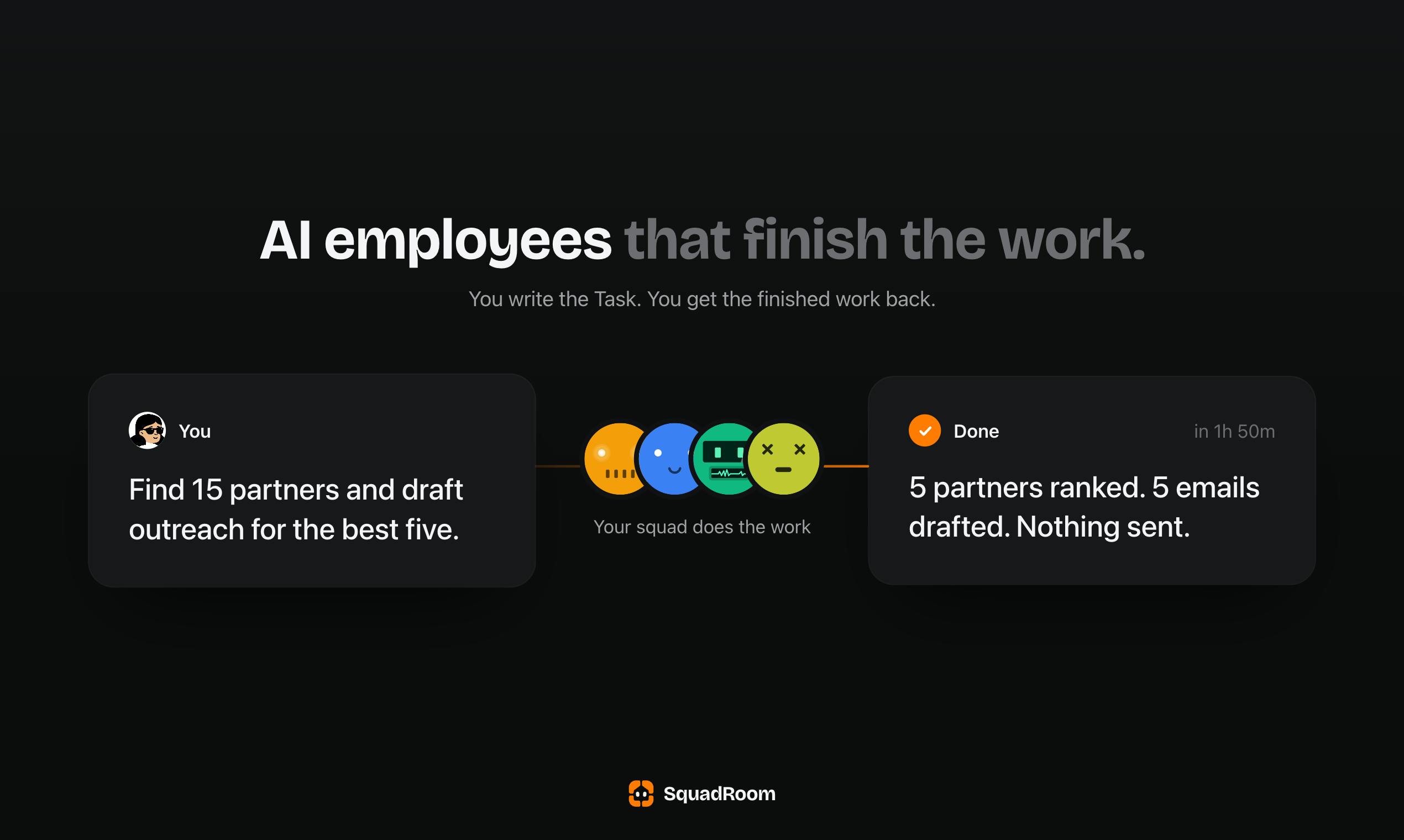
SquadRoom builds a traceable, human-supervised AI employee team with a lead agent plus specialized Agents.
SquadRoom launched on Product Hunt, positioned as a 24/7 AI employee team. Its core design replaces "an all-purpose assistant" with "an AI organization": a lead agent learns company background and plans tasks, supported by four specialized Agents in research, writing, partnerships, and operations, letting users simply drop tasks onto the board. The product emphasizes traceable reports covering every step and source to address trust in black-box content, while narrowing human intervention to "decision" and "send permission" nodes between fully automatic and fully manual. It also supports BYOK and a no-signup demo to lower the trial barrier. At launch it received 71 upvotes and 5 comments, ranking 16th. The author believes its value depends on practical metrics such as lead agent planning quality, context passing, and report readability.
SquadRoom, launched on Product Hunt, sums up its ambition in a single line: giving you a team of AI employees that never rests, 24/7. That positioning sounds like yet another wrapper Agent product, but its approach to breaking down workflows is worth a closer look.
A structured AI team, not an all-purpose assistant
The core design of SquadRoom is to replace "a single AI assistant" with "an AI organization." According to the official description, the team has a lead agent that learns your company's background and plans tasks, supported by specialized Agents in four areas: research, writing, partnerships, and operations. You just drop a task onto the board and walk away.
The judgment behind this architecture is that general-purpose large models are already strong enough for single-point tasks—what's really bottlenecking efficiency is task decomposition, context handoff, and result acceptance. A division of labor where a lead agent plans first and specialized Agents execute afterward mirrors the "project manager + executors" structure of human teams.
Multi-Agent Collaboration refers to an architectural pattern in which multiple AI Agents—each with independent goals and capability boundaries—jointly accomplish complex objectives through division of labor, negotiation, or task decomposition. Unlike a monolithic large model, a multi-agent system typically includes an "orchestrator" (or lead agent) responsible for planning and scheduling, plus several "worker Agents" executing specific subtasks. The core difficulty lies not in any single Agent's capability, but in context passing, state synchronization, and result aggregation—once information is lost or distorted between Agents, overall output degrades. SquadRoom's lead agent + specialized Agent structure is a typical implementation of this paradigm: planning quality determines whether task breakdown is reasonable, and the context protocol determines whether downstream Agents receive sufficient information. Current multi-agent frameworks (such as AutoGen, CrewAI, and LangGraph) all try to solve the same problem, but production-grade reliability remains a common industry challenge.
Traceable reports are the trust foundation for this kind of product
SquadRoom emphasizes that when you come back, the work is done, and there's a report showing every step taken and every information source. This design targets the biggest psychological barrier to AI Agent adoption: users don't dare to use content generated by an unfamiliar black box directly in external contexts.
Making "every step and every source" a default output means the product is doing two things: first, making results verifiable; second, giving subsequent human review something to grip onto. For work like research and writing that requires traceability, this is far more practical than simply producing a generated chunk of text.
Traceability in the AI Agent context refers to a system's ability to fully record and present its reasoning path, tool calls, retrieval sources, and intermediate decisions, often associated with "citation sourcing" and "chain-of-thought auditing." It's not just a plus for product experience—it's compliance and risk-control infrastructure for AI deployment: the EU AI Act, along with content review regulations across industries, requires generated content to be explainable and reviewable in specific scenarios. For research, writing, and compliance review tasks, output lacking source attribution is nearly unusable directly, because the cost of human review may exceed just redoing it yourself. Therefore, making "every step + every source" a default output essentially transforms the Agent from a "black-box generator" into an "auditable collaboration partner"—one of the most mainstream paths for Agent products today to build user trust.
Human-in-the-loop, but only when it matters
There's a key setting in the product description: Agents only stop to ask you when they genuinely need you to make a decision, and nothing gets sent out without your confirmation.
This is a compromise between two extremes: "fully automatic" and "fully manual." A fully automatic Agent easily goes off track on critical judgments, while fully manual loses the efficiency advantage. SquadRoom narrows human intervention to two nodes—"decision" and "send permission"—leaving the rest of the flow to Agents to push forward on their own. Whether this boundary is drawn accurately will be where the biggest experiential differences show up in actual use.
Human-in-the-Loop (HITL) is a classic principle in automated system design, referring to introducing human confirmation or intervention at key decision nodes to balance automation efficiency and risk control. In AI Agent scenarios, the difficulty of HITL lies in choosing "intervention points": too much intervention loses automation value, while too little may stack errors on top of errors. A common approach is to bind HITL to two types of nodes—irreversible operations (such as external sending, payment, publishing) and highly uncertain judgments (such as strategy selection, compliance boundaries). SquadRoom limits intervention points to "decision" and "send permission," a fairly restrained design. Whether this boundary is accurate depends on whether Agents can autonomously converge on correct results in most workflows; if planning frequently goes off track, users will ultimately end up watching everything anyway.
Bring Your Own Key and a no-signup demo lower the trial barrier
SquadRoom supports Bring Your Own AI key, letting users drive Agents with their own model keys. For users who already have model subscriptions, this saves an extra cost and makes model choice more flexible. At the same time, the official team offers a no-signup live demo, so you can see the results before deciding whether to go deeper.
As of launch, SquadRoom had 71 upvotes and 5 comments on Product Hunt, ranking 16th. It was posted by Kartike Bansal and categorized under Productivity, SaaS, and Artificial Intelligence. These numbers aren't a breakout hit, but for a workflow-oriented Agent product, early validation was never really about the vote count.
Bring Your Own Key (BYOK) is a model that lets users drive a product using their own model API keys. For users, it brings three benefits: costs stay under their control (they can use existing subscriptions or pay-as-you-go accounts directly), model choice is more flexible (they can switch between GPT, Claude, and Gemini), and the data path is more transparent (they can connect directly to their own vendor accounts). For the product side, BYOK avoids the cash flow pressure and compliance burden of paying for model calls on users' behalf, but it also means giving up some usage data and pricing power. In today's fiercely competitive AI application layer, BYOK is gradually shifting from a differentiating selling point to a standard capability for professional users, especially favored by developers and small teams who already have model subscriptions.
The question this kind of product really has to answer
Multi-agent collaboration is not a new concept, and SquadRoom's value depends on several practical metrics: whether the lead agent's planning quality is stable, whether specialized Agents can effectively pass context between each other, and whether report readability can support fast review. None of these can be verified from the Product Hunt copy—only the live demo and real tasks can test them.
For teams wanting to try the AI employee model, SquadRoom offers a clearly structured sample: replace single-point intelligence with organizational division of labor, trade traceable reports for trust, and control risk with limited human-in-the-loop. Whether these three ideas hold up is worth running through in real tasks.
One-line Summary
SquadRoom uses a team structure of lead agent planning plus specialized Agent execution to build a traceable, human-supervised AI employee team.
Paragraph Summary
SquadRoom launched on Product Hunt, positioned as a team of AI employees working 24/7. Its core design replaces "an all-purpose assistant" with "an AI organization": a lead agent learns the company background and plans tasks, supported by four specialized Agents in research, writing, partnerships, and operations—users simply drop tasks onto the board. The product emphasizes a report mechanism that traces every step and source to address user distrust of black-box generated content; it also narrows human intervention to two nodes—"needs a decision" and "send permission"—sitting between fully automatic and fully manual. It also supports Bring Your Own Key and a no-signup demo to lower the trial barrier. At launch it received 71 upvotes and 5 comments, ranking 16th. The author believes the product's value depends on practical metrics such as lead agent planning quality, context passing, and report readability, and must be tested through real tasks.
Related articles

Amphibious Transforming Drone: Beyond 100x Power Savings, What Are the Real Needs?
Is the amphibious transforming drone just a gimmick? Starting from the 100x power difference of the M4 Morphobot, explore real application scenarios and thesis topic ideas, analyzing boundary conditions where pure drones and pure ground robots both fail.

Warhound Raises $200 Million: Genetically Engineered "War Dogs" Paired with Anduril Gear
Warhound raises $200M, backed by Ben Lamm and Palmer Luckey, to genetically engineer dogs for military and law enforcement use and equip them with Anduril gear. This article analyzes its technology direction, funding logic, and ethical controversy.

Claude API Comes to Google Cloud: IAM Integration and SDK Access Guide
Anthropic hosts the full Claude API on Google Cloud with IAM-controlled permissions and unified billing. This guide covers the Vertex AI and Anthropic-hosted entry points, IAM role configuration, and SDK access.