Square Launches AI Ordering Kiosk: The Era of Voice Conversation Ordering Arrives

Square launches Kiosk, a self-service ordering terminal with an agentic AI voice assistant, exploring a new voice-first restaurant interaction model.
Square has released Square Kiosk, a self-service ordering terminal with a "large pill" design, a large touchscreen, and an AI voice assistant. Its core selling point is an "agentic conversational voice layer" that can deeply understand a merchant's menu structure, add-on options, and inventory status, and complete orders through multi-turn dialogue. The device aims to lower the barrier to use, especially for older users unfamiliar with digital devices and fast-paced consumption scenarios. The article analyzes the technical requirements of agentic AI in integrating a menu knowledge graph and ordering system, discusses its potential impact on reducing staffing pressure and improving ordering efficiency in the restaurant industry, and also notes that speech recognition accuracy in noisy environments and the AI's actual ability to understand complex menus still need verification. In the competitive landscape, Square's move may lead a "voice-first" trend in ordering hardware.
Square recently released a brand-new hardware device — Square Kiosk, a self-service ordering terminal equipped with a large touchscreen and a built-in AI voice assistant that allows customers to place orders through conversation. According to the official description, the device uses an "agentic, conversational voice layer" that can "fully understand the merchant's menu and listen and respond to customer needs in real time."
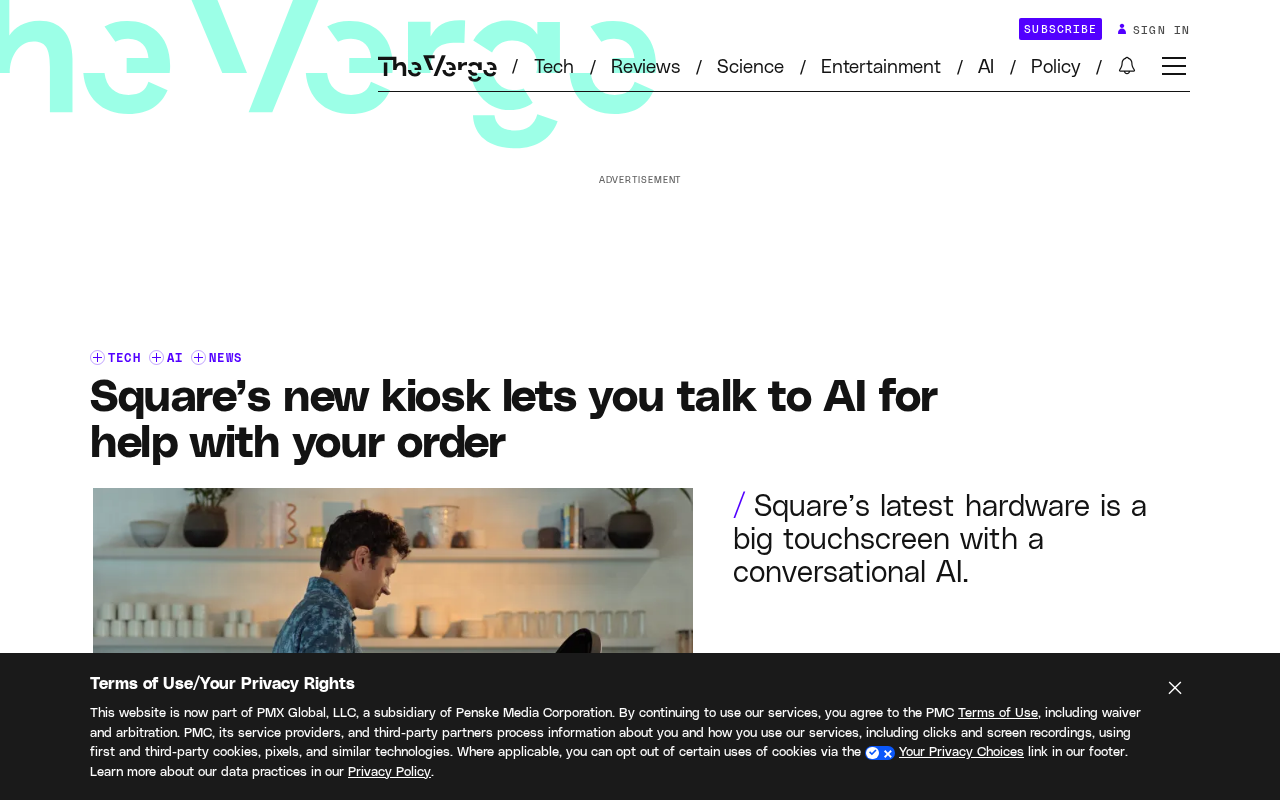
Hardware Form Factor and Interaction Design
Square Kiosk features a distinctive "large pill" shape, with an overall design that is clean and modern. Unlike traditional self-service ordering machines, it does not rely solely on touchscreen operation but makes voice interaction its core selling point. Customers can simply speak to the device about what they want, and the AI will understand the menu content and respond.
This design approach reflects Square's rethinking of offline dining scenarios: in a fast-paced consumer environment, voice is often more intuitive and efficient than touch. Especially for older users who are unfamiliar with digital devices, or customers whose hands are full with luggage, voice ordering can significantly lower the barrier to use.
How "Agentic" AI Understands the Menu
Square describes this voice system as "agentic," meaning it is not merely simple speech recognition plus keyword matching, but an AI agent with a certain degree of autonomous understanding and decision-making capability. It needs to deeply understand the merchant's menu structure, dish ingredients, optional add-ons, and inventory status in order to accurately respond to customer questions during conversation.
For example, when a customer asks, "What options do you have that are gluten-free?" the AI needs to know which dishes meet the criteria; when a customer says, "I want a burger, no onions, and an extra slice of cheese," the AI needs to correctly parse these modification instructions and generate the corresponding order. Behind this is deep integration of natural language understanding, a menu knowledge graph, and the ordering system.
What is "Agentic AI"?
Agentic AI refers to AI systems with autonomous planning, tool invocation, and multi-step reasoning capabilities, as distinct from traditional "question-and-answer" conversational models. It can proactively break down tasks according to goals, call external data sources (such as menu databases and inventory systems), and maintain contextual consistency across multiple rounds of interaction.
In the ordering scenario, a typical agentic AI workflow includes: parsing the customer's natural language input → querying the menu knowledge base to confirm dish availability → handling personalized modifications (such as removing ingredients or adding extras) → generating a structured order → submitting it to the POS system. In this process, the AI must not only "understand" but also "get it done," which places extremely high demands on system integration. Compared with a simple voice assistant, agentic AI is closer to a "digital employee" that can independently complete tasks.
The Role of the Menu Knowledge Graph
The menu knowledge graph is a technical solution that organizes information such as dishes, ingredients, allergens, optional add-ons, and pricing rules in a graph structure. It enables the AI to perform reasoning rather than just keyword matching. For example, when a customer asks about "gluten-free options," the system needs to traverse the relationship chain of "dish → ingredient → allergen" and exclude dishes containing ingredients such as wheat and barley.
The knowledge graph also supports dynamic updates: when a dish is sold out or an ingredient is out of stock, the status of the graph nodes changes synchronously, and the AI's responses adjust accordingly. This structured representation is the infrastructure that enables agentic AI to accurately respond to complex needs in dining scenarios, and it is also one of the core technical barriers that distinguishes Square Kiosk from traditional ordering machines.
Impact on the Restaurant Industry
The launch of Square Kiosk marks the evolution of self-service ordering devices from "touchscreen menus" to "conversational service." For restaurants, this kind of device is expected to reduce front-desk staffing pressure while improving ordering efficiency and accuracy. Especially during peak hours, voice ordering can divert pressure from the counter and reduce customer queue times.
However, whether voice interaction can maintain a high recognition rate in noisy restaurant environments, and whether the AI can truly "fully understand" complex and ever-changing menus, still needs to be verified through actual deployment. Square's claimed ability to "listen and respond in real time" needs to withstand testing in real-world scenarios.
Speech Recognition Challenges in Noisy Environments
Restaurant environments usually contain multiple noise sources such as background music, crowd conversations, and clinking tableware, resulting in a signal-to-noise ratio far lower than in home or office settings. Speech recognition systems are prone to misrecognition or missed recognition under such conditions, especially when multiple people are speaking at the same time, when the "cocktail party effect" can significantly reduce recognition accuracy.
To address this issue, modern voice systems typically use beamforming microphone arrays for directional pickup, combined with noise reduction algorithms and voice activity detection (VAD) to separate the target speech. However, these technologies may still fall short during peak periods when voices are booming. Whether Square Kiosk can maintain stable performance in real restaurant environments depends on the robustness of its microphone hardware design and AI model, which is also one of the biggest technical uncertainties facing the product.
Competitive Landscape and Outlook
At present, the self-service ordering terminal market already has players such as Toast and Clover, but devices that use AI voice conversation as the core interaction method are still rare. Square's move may lead a wave of "voice-first" ordering hardware. If the actual experience is smooth, this solution is expected to become a new standard for digital transformation in the restaurant industry.
The specific pricing and launch date of Square Kiosk have not yet been fully announced, but its direction is already clear: make AI the first point of contact in offline consumer scenarios.
One-line Summary
Square launches Kiosk, a self-service ordering terminal equipped with an agentic AI voice assistant, exploring a new voice-first form of restaurant interaction.
Paragraph Summary
Square has released a new hardware product, Square Kiosk, a self-service ordering terminal with a "large pill" shape, a large touchscreen, and an AI voice assistant. Its core selling point is an "agentic conversational voice layer" that can deeply understand a merchant's menu structure, add-on options, and inventory status, and complete orders through multi-turn dialogue. The device aims to lower the barrier to use, making it especially suitable for older users unfamiliar with digital devices and fast-paced consumption scenarios. The article analyzes the technical requirements of agentic AI in integrating a menu knowledge graph and ordering system, discusses its potential impact on reducing staffing pressure and improving ordering efficiency in the restaurant industry, and also points out that speech recognition accuracy in noisy environments and the AI's actual ability to understand complex menus still need verification. In terms of the competitive landscape, Square's move may lead a "voice-first" trend in ordering hardware.
Related articles

AI Digital Twin in Action: Using DOT to Automatically Track Bugs and User Feedback
DOTS engineers demonstrate how AI digital twin DOT collects cross-platform user feedback, categorizes issue themes, opens threads to investigate bug root causes, and submits PRs—showcasing a complete AI agent workflow for defect triage with auditable design.

Why Transistors Are No Longer Flat: The Evolution from Planar to Gate-All-Around
Transistor evolution from planar to FinFET to gate-all-around: why gates went from three-sided to four-sided wrapping to suppress short-channel effects and leakage current, extending Moore's Law.

Swarm Intelligence = a Single RL Agent? A Proof of Multi-Armed Bandit Equivalence
A paper proves that collective decision-making through local imitation in swarms is mathematically equivalent to single-agent reinforcement learning: N blind imitators act as N parallel environment samples, with an effective learning rate of 1/N. This article explains the derivation and implications of the Maynard-Cross Learning algorithm.