Stanford Medicine Study: The Human Brain May Be Two Separate Organs

Stanford research proposes the human brain may be two independent organs, challenging long-held neuroscience assumptions.
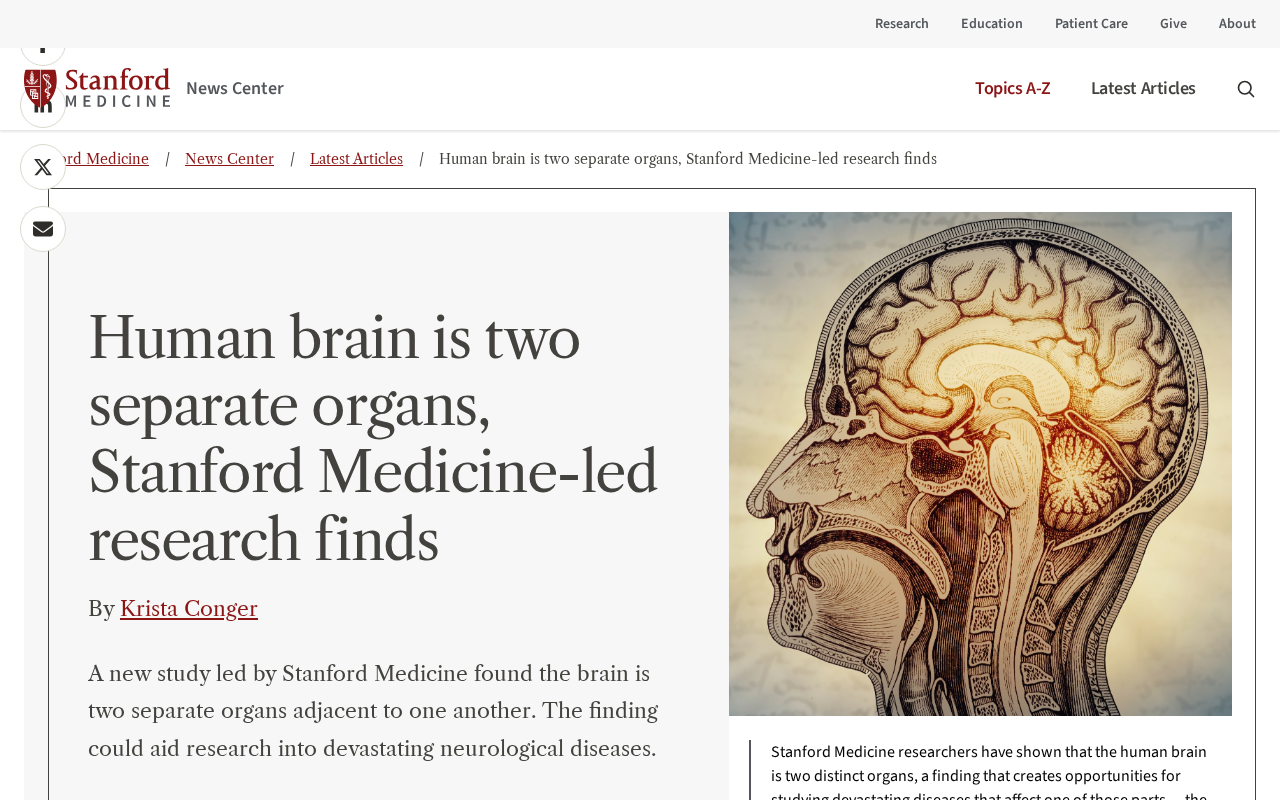
A new Stanford Medicine study suggests the human brain may be closer to two relatively independent organs than the highly coordinated whole described by traditional neuroscience. Rooted in classic split-brain research — where patients with a severed corpus callosum showed each hemisphere operating independently — the Stanford team extends this framework to the normal brain's structure and function. The study raises core questions about consciousness research, including whether multiple 'subjects' could coexist in one brain, and has potential implications for brain-computer interfaces and modular AI design.
A Brain Science Finding That Challenges Conventional Wisdom
A study led by Stanford Medicine has put forward a thought-provoking idea: the human brain may not be the single, unified organ we typically think it is — it may be closer to two relatively independent organs. The research quickly sparked heated debate on Hacker News, garnering 264 upvotes and over a hundred comments, reflecting the ongoing interest among academic and tech communities in the fundamental nature of brain architecture.
For decades, mainstream neuroscience has viewed the brain as a highly coordinated, unified system, with the left and right hemispheres communicating densely through the corpus callosum — a massive bundle of nerve fibers. The Stanford team's research revisits the relationship between the two hemispheres from a fresh perspective, suggesting that their functional and informational independence may have been underestimated by previous models.
The Scientific Background on Hemispheric Independence
The division of labor between the brain's left and right hemispheres is not a new topic. As far back as the split-brain research era, scientists observed patients whose corpus callosum had been severed to treat epilepsy and discovered that the two hemispheres could exhibit striking independence in information processing — information received by one hemisphere was sometimes unknown to the other.
The significance of the Stanford study lies in the fact that it does not focus solely on the separation seen in pathological states. Instead, it proposes — at a more fundamental structural and functional level — that framing the brain as "two separate organs" may better fit the observed evidence. This framing challenges the intuitive notion that "the brain is a single whole," and offers new perspectives for understanding consciousness, cognitive division of labor, and certain neurological disorders.
It's worth noting that describing the two hemispheres as "separate organs" is more of a conceptual reframing than a denial that communication between them exists. The key question is whether that communication constitutes a unified system, or merely connects two processing units that each operate on their own.
The corpus callosum is the largest white matter fiber tract connecting the left and right cerebral hemispheres, containing approximately 200 to 300 million nerve fibers that transmit motor, sensory, and cognitive information between the two sides. Classical neuroscience holds that the corpus callosum is precisely what allows the brain to function as a coordinated whole. In the 1960s, neuroscientists Roger Sperry and Michael Gazzaniga conducted systematic experiments on "split-brain patients" — individuals whose corpus callosum had been severed to treat intractable epilepsy. They found that the two hemispheres not only have distinct roles — typically the left hemisphere dominates language and logic, while the right governs spatial reasoning and holistic perception — but that after severing the corpus callosum, the two sides could nearly independently "think" and "act," sometimes even producing mutually contradictory behaviors. Sperry was awarded the 1981 Nobel Prize in Physiology or Medicine for this body of research. The breakthrough of the current Stanford study is that it does not rely on the extreme pathological state of a severed corpus callosum. Instead, it reexamines the functional boundaries between the two hemispheres in the normal brain, extending the "separate organs" framework from a special case to a more general principle.
Why This Finding Deserves Attention
For neuroscience, how to define "one organ" is itself a profound question of definition. If the two hemispheres can largely independently handle perception, decision-making, and even the formation of experience, this affects not only how we classify brain anatomy, but also touches on a central question in consciousness research — whether there might be more than one "subject" simultaneously present in the brain.
From an applied perspective, this type of research has potential implications for brain-computer interfaces, neural repair, and brain-inspired computing in AI. Artificial neural networks are often designed with inspiration drawn from the biological brain. If the brain is fundamentally a collaborative system of two semi-independent modules, then modular, distributed AI architecture design may find new theoretical grounding in this idea.
The "Neural Correlates of Consciousness" (NCC) is a central concept in current consciousness science research, referring to the minimal neural mechanisms necessary to produce a specific conscious experience. Researchers such as Christof Koch have long worked to identify NCCs, seeking to answer the fundamental question of where in the brain consciousness actually arises. If the brain is fundamentally two relatively independent processing units, then theoretically there could be two sets of NCCs simultaneously — two parallel streams of consciousness. Philosopher Derek Parfit, in his work Reasons and Persons, used split-brain cases to argue that "personal identity" is not indivisible, providing a profound philosophical echo to this neuroscientific question. This theoretical tension poses new challenges and tests for mainstream theories of consciousness such as Integrated Information Theory (IIT) and Global Workspace Theory (GWT).
Divergences and Reflections in the Community Discussion
In the Hacker News discussion, the tech community showed its characteristic caution toward this proposition. Some commenters suggested that the "two separate organs" framing looks more like a repackaging of existing split-brain research, and that its novelty needs to be assessed against the specific data in the original paper. Others emphasized that the categorization of organs is itself a human-made conceptual tool, and what matters depends on the research goals and definitional standards being used.
This kind of discussion illustrates exactly the point that many seemingly settled concepts in brain science are actually built on specific assumptions. When new evidence emerges, revisiting these foundational frameworks is a normal part of scientific progress.
Conclusion
The Stanford Medicine study reminds us that even for one of the most familiar organs in the human body — the brain — our understanding continues to be revised. Whether framing the brain as "two separate organs" will become a mainstream paradigm remains to be seen, pending further peer review and follow-up research. But regardless of the ultimate conclusion, research that challenges our intuitions like this is pushing both neuroscience and brain-inspired AI to explore deeper.
(Note: This article is compiled based on Stanford Medicine's official news release and Hacker News community discussion. For specific research details, please refer to the original paper.)
Related articles

Free Unlimited Claude Code Solution: Agnes AI + CC Switch Setup Guide
No paid subscription needed — pair the free AI platform Agnes AI with the open-source tool CC Switch to provide a backend for Claude Code, enabling unlimited free calls to text, image, and video models. This guide covers the full setup, test results, and usage boundaries.

A Complete Zero-Cost Guide to Getting Started with Claude Code for Beginners in China
A beginner's guide to Claude Code for users in China: two installation methods (command line and IDE plugin), full configuration steps for replacing the official API with the free domestic LongCat model, and a hands-on demo of building a small tool with natural language, plus tips.

When the NSA Gets Involved: The AI Supply Chain Crisis Behind Open-Source CVEs and API Key Hijacking
Multiple open-source projects disclosed severe CVEs in one day, PHP flaws alarmed the FBI, and Railway and OpenCode were breached with API keys stolen. This article breaks down the vulnerability window, AI-accelerated exploitation, and the AI supply chain crisis behind the API key black market, with a developer defense checklist.