Statistical Testing of Algebraic Complete Intersections: From the Manifold Hypothesis to Computable Algorithms
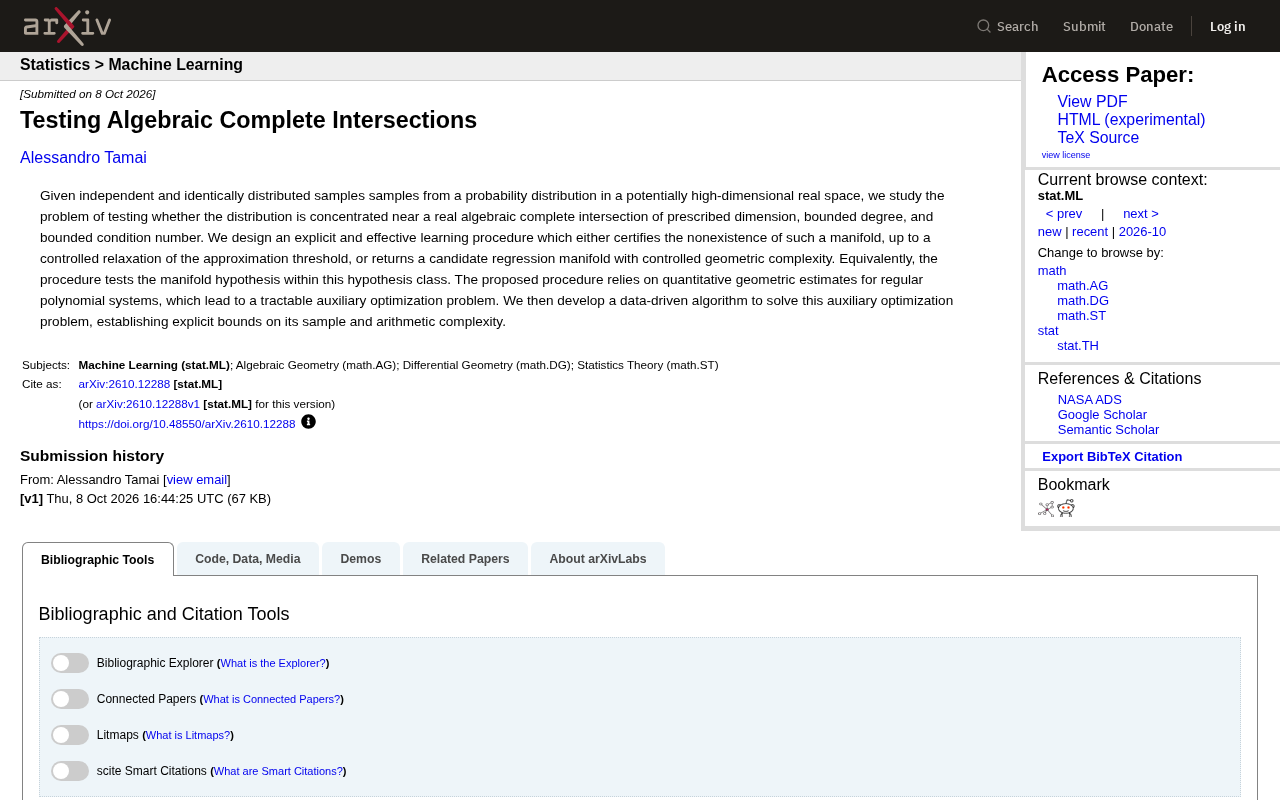
The paper proposes testing the manifold hypothesis for high-dimensional data under an algebraic complete intersection hypothesis class and transforms it into a solvable optimization problem.
This study addresses the manifold hypothesis—whether high-dimensional data concentrates near a low-dimensional manifold—by proposing a rigorous testing scheme under a restricted hypothesis class. The hypothesis class is limited to real algebraic complete intersections with specified dimension, bounded degree, and bounded condition number. The authors design an explicit learning procedure that either certifies non-existence under a controlled relaxation of the approximation threshold or returns a candidate regression manifold with controlled geometric complexity. The core method uses quantitative geometric estimates for regular polynomial systems to reduce the geometric test over infinitely many candidate manifolds to a finite-dimensional auxiliary optimization problem. A data-driven algorithm is developed to solve it, with explicit sample and arithmetic complexity bounds. The work connects algebraic geometry with statistical testing.
When High-Dimensional Data Lies Near an Algebraic Variety
In high-dimensional data analysis, there is a widely used assumption: although real data may appear to have high dimensionality on the surface, its intrinsic structure often concentrates near a low-dimensional manifold. This is the so-called "manifold hypothesis." But how to rigorously test whether a dataset truly supports this assumption has long lacked a feasible computational approach.
A recent theoretical study addresses this gap with a concrete proposal. The paper "Testing Algebraic Complete Intersections" investigates the following problem: given independent and identically distributed samples from a probability distribution on a high-dimensional real space, can one test whether the distribution concentrates near an algebraic complete intersection? Here, the target manifold is restricted to real algebraic complete intersections with a specified dimension, bounded degree, and bounded condition number.
This setup is more specific than general manifold testing, and it offers more algebraic-geometric structure to exploit. An algebraic complete intersection is the intersection of the zero sets of a system of polynomials, and there are mature tools for it in algebraic geometry and computational algebra. Restricting the hypothesis class to this scope makes it possible to transform the testing problem into a tractable optimization problem.
Manifold hypothesis (manifold hypothesis) is a foundational prior in machine learning and high-dimensional statistics: it posits that although observed data is embedded in a high-dimensional space such as (\mathbb{R}^D), its effective degrees of freedom are governed by some low-dimensional structure, so data points approximately lie on a manifold of dimension (d \ll D). This hypothesis is one of the theoretical justifications for dimensionality reduction (PCA, autoencoders), semi-supervised learning, and representation learning. But strictly speaking, the manifold hypothesis is mostly a modeling convention rather than a tested conclusion. To test it, one needs to formalize "data lies near some manifold" as a falsifiable statistical proposition—typically by specifying a manifold family, a distance metric, and a significance threshold. The family of general smooth manifolds is too large and lacks finite parameterization, making testing non-computable; this is precisely the motivation for tightening the manifold family to algebraic complete intersections in this paper.
The Core Idea of the Testing Procedure
The authors design an explicit learning procedure whose output has two possibilities:
- Certify non-existence: Under a controlled relaxation of the approximation threshold, prove that no algebraic complete intersection satisfying the conditions exists;
- Return a candidate manifold: Provide a regression manifold with controlled geometric complexity.
In other words, the procedure tests the manifold hypothesis within the given hypothesis class—if the data does not support the hypothesis, it tells you "no"; if it does, it provides a concrete candidate.
Interestingly, "certifying non-existence" here is not an absolute negation, but allows a certain degree of relaxation of the approximation threshold. Such relaxation is necessary in statistical testing because finite samples cannot support exact geometric assertions.
Condition number (condition number) in the context of algebraic geometry measures the sensitivity of the solution set of a polynomial system under perturbation, and can be roughly understood as the degree to which the solution manifold deviates from singular points or deforms. A bounded condition number excludes pathological cases such as severe bending, near-self-intersection, or dimensional collapse of the solution set, thereby ensuring that estimates of geometric quantities are stable. Without this restriction, even with fixed dimension and degree, an algebraic complete intersection could exhibit structures that are difficult to distinguish numerically on extremely small scales, rendering any finite-sample test meaningless. The paper's requirement of a bounded condition number essentially sets a threshold for computability and statistical stability, at the cost of narrowing the hypothesis class, which may fail to cover some real complex data distributions.
How Geometric Estimation Becomes a Solvable Optimization
The key technical support for this method comes from quantitative geometric estimates for regular polynomial systems. Such estimates provide explicit relationships between geometric quantities of the solution set of a polynomial system (such as dimension, degree, and condition number) and its coefficients. Using these estimates, the authors transform the original geometric testing problem into an auxiliary optimization problem.
The significance of this transformation lies in the following: the original testing problem involves searching over infinitely many possible algebraic complete intersections, which is infeasible to handle directly; with the help of quantitative geometric estimates, the problem is compressed into a finite-dimensional, structurally clear optimization problem.
In the words of the original text, these estimates "lead to a tractable auxiliary optimization problem."
Algebraic complete intersection (algebraic complete intersection) refers to the common zero set of (D-d) polynomials (f_1,\dots,f_{D-d}) in (\mathbb{R}[x_1,\dots,x_D]), where these polynomials have linearly independent gradients on a dense open set. In this case, the dimension of the zero set is exactly (d), and its codimension equals the number of polynomials. This "complete" condition excludes redundant equations, allowing the dimension to be read directly from the number of equations. Moreover, if the degrees of the polynomials are (d_i), then the total degree is given by Bezout's theorem as (\prod_i d_i). Compared with general real algebraic varieties, complete intersections have explicit formulas for both dimension and degree, which is precisely the key to their parameterization and characterization by finite-dimensional optimization, and also the technical reason the authors chose them as the hypothesis class.
Data-Driven Algorithm and Complexity Guarantees
Formalizing the optimization problem alone is not enough; one also needs an algorithm that can actually run. The authors then develop a data-driven algorithm to solve this auxiliary optimization problem and provide explicit complexity bounds in two respects:
- Sample complexity: How many samples are needed to guarantee the reliability of the test;
- Arithmetic complexity: How many arithmetic operations the algorithm requires to run.
Both bounds are explicit, rather than merely existential. This means there is one less obstacle between theory and practice—although practical deployment still needs to account for issues such as constant factors and numerical stability.
Sample complexity characterizes the minimum number of independent and identically distributed samples needed to guarantee the correctness of the test conclusion with high probability; arithmetic complexity characterizes how many basic operations the algorithm needs at a given precision. Together they define the learnability of the problem. In this type of geometric testing, sample complexity typically grows polynomially or exponentially with the intrinsic dimension, the degree upper bound, and the condition number upper bound, while arithmetic complexity is also related to the cost of solving the polynomial system. The paper's explicit bounds mean that these dependencies are written as formulas directly computable from the parameters, rather than merely as existence theorems, enabling readers to judge whether the problem is practically solvable under specific parameters. Note that explicit bounds usually hide large constant factors, and practical implementation is also affected by numerical stability and errors in condition number estimation.
What This Work Means
From a methodological perspective, the contribution of this work is not in proposing some new statistical test statistic, but in bringing quantitative results from algebraic geometry into the statistical testing framework. Algebraic complete intersections, as a hypothesis class, have stronger structure than general smooth manifolds, which makes the usually difficult-to-formalize problem of "testing" computable.
Of course, whether real data actually lies near an algebraic complete intersection is another question. The requirement of bounded condition number may not be satisfied in many real scenarios, and whether the theoretical guarantees still hold after relaxing the conditions is not discussed in the original text. This research is more like opening a path at the theoretical level: when the hypothesis class possesses sufficient algebraic structure, testing the manifold hypothesis can be feasible.
For readers interested in high-dimensional statistics, computational algebra, or machine learning theory, this paper offers a direction worth following—it connects two usually separate fields (quantitative estimation in algebraic geometry and statistical hypothesis testing) into a unified algorithmic framework.
One-line Summary
The paper proposes testing the manifold hypothesis for high-dimensional data under the hypothesis class of algebraic complete intersections, transforming it into a solvable optimization problem.
Paragraph Summary
This study addresses the manifold hypothesis—whether high-dimensional data concentrates near a low-dimensional manifold—by proposing a rigorous testing scheme under a restricted hypothesis class. The hypothesis class is limited to real algebraic complete intersections with specified dimension, bounded degree, and bounded condition number, allowing the use of mature structures and tools from algebraic geometry. The authors design an explicit learning procedure whose output is twofold: under a controlled relaxation of the approximation threshold, certify that no complete intersection satisfying the conditions exists, or return a candidate regression manifold with controlled geometric complexity. The core of the method is to use quantitative geometric estimates for regular polynomial systems to compress the geometric test over infinitely many candidate manifolds into a finite-dimensional, structurally clear auxiliary optimization problem. The authors further develop a data-driven algorithm to solve this optimization problem and provide explicit sample complexity and arithmetic complexity bounds. The significance of this work lies in introducing quantitative results from algebraic geometry into the statistical testing framework, offering a feasible testing path for hypothesis classes with sufficient algebraic structure.
Related articles

Uber Deploys ChatGPT Work Company-Wide: AI in the Workplace Enters the Scaled Implementation Phase
Uber deploys ChatGPT Work to 30,000+ employees, extending it from engineering to all roles. We analyze its expert-engineer pairing, end-to-end automation, and questions of AI control and power concentration—insights for scaling AI in the workplace.

Shift at Midnight Hands-On: When "ID Verification" Becomes Alien Hunting
Shift at Midnight blends ID verification with horror survival in a four-player co-op game. We break down its inspection mechanics and chaotic humor.

Zelensky Recounts the Outbreak of War: I Need Ammunition, Not a Ride
Zelensky recalls the first day of war in a YouTube interview: farewell to family, rejecting Biden's evacuation offer with "I need ammunition, not a ride," and how Bucha shaped his stance on compromise and peace talks.