Steam Machine In-Depth: The Sweet Spot Between Console Convenience and PC Freedom

The Steam Machine finds its niche as the flexible middle ground between console convenience and PC freedom.
Despite scoring only a 6, the Steam Machine wins over a hands-on reviewer who already owns a PS5 and Xbox Series X, thanks to its ability to move seamlessly between living room and desk. Powered by a mature SteamOS and robust Proton compatibility, it's a pragmatic pick for heavy Steam users seeking console ease with PC openness.
A Gaming Device That's Just Right
Over the past few weeks, I've had the chance to spend a lot of quality time with Valve's Steam Machine. While we gave the device a 6 out of 10 in our earlier review, and I agree with many of the points my colleague Sean Hollister raised in his assessment, the Steam Machine has still carved out a unique place in my daily routine—even though I already own both a PS5 and an Xbox Series X.
The Steam Machine isn't perfect. Its pricing, its performance positioning, and its identity as an intermediate form between console and PC all feel a bit awkward in a review context. And yet, it's precisely this "in-between" nature that makes it surprisingly well-suited to many real-world gaming scenarios.
The Right Size to Blend Seamlessly Into Both Living Room and Desk
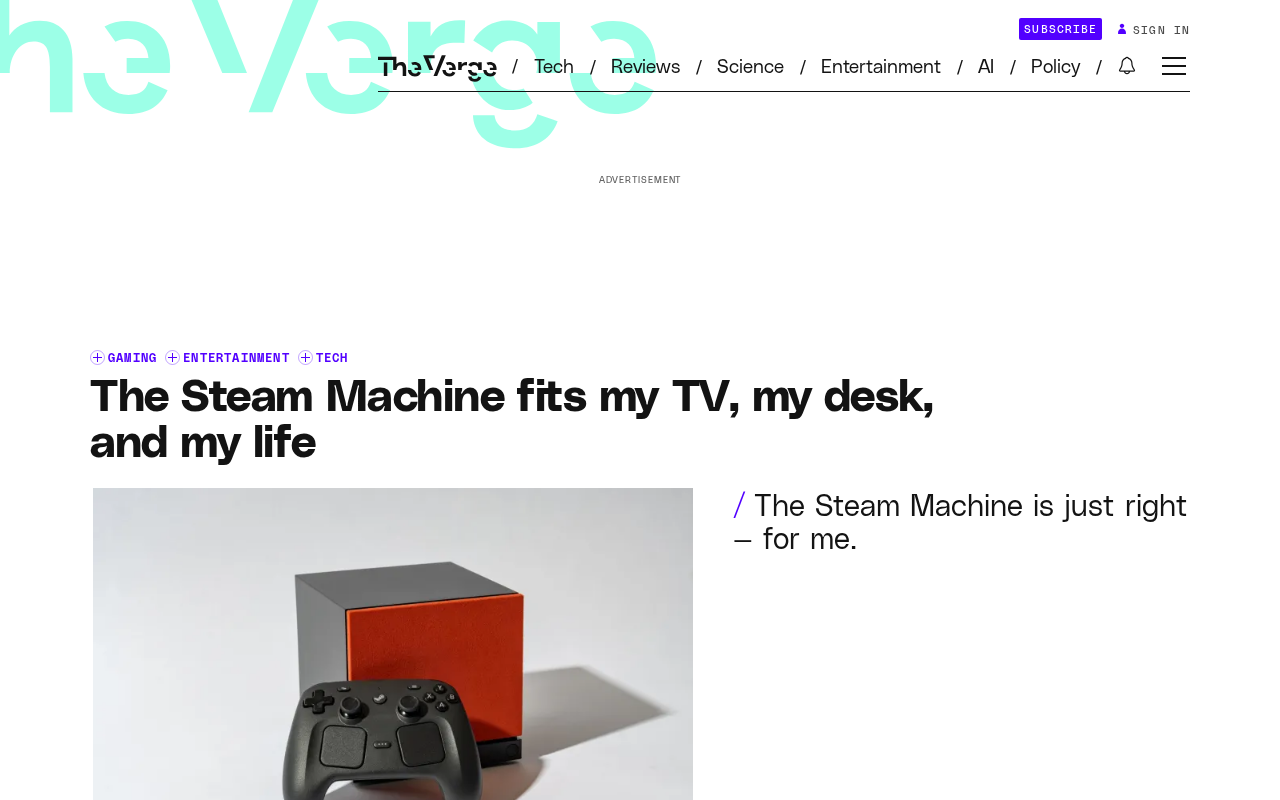
What impressed me most about this device is its physical form factor. It can slip into a TV cabinet to serve as a couch gaming machine in the living room, or sit on a desk as a lightweight desktop gaming PC. This "amphibious" capability is something traditional consoles and desktop PCs both struggle to offer simultaneously.
The PS5 and Xbox Series X are bulky, essentially confined to sitting next to the TV. Meanwhile, a proper gaming PC tends to be too cumbersome and lacks the clean simplicity expected of living room equipment. The Steam Machine fits right between the two—compact enough to flexibly switch roles across different spaces.
It's worth noting that the gaming device market has long been polarized: on one end are closed console systems like the PS5 and Xbox Series X, which emphasize out-of-the-box usability and the couch experience, but come with closed ecosystems and limited expandability; on the other end are powerful but higher-barrier gaming PCs that require users to have a degree of hardware knowledge and maintenance ability. The "third form factor" device sitting between these two has long been a market gap.
The formation of this gap is closely tied to the increasingly diverse usage habits of modern gamers. In recent years, the Mini PC gaming machine segment has heated up rapidly: the ASUS ROG Ally X pairs with a dock for seamless transitions between big screen and handheld scenarios; the Lenovo Legion Go features detachable controllers that balance portability and living room mode; and the GPD WIN series has cultivated the ultra-portable gaming PC niche. The emergence of these products reflects a single user demand—gamers are no longer satisfied with binding a single device to a single scenario, but instead want the same piece of hardware to adapt flexibly to their lifestyle. The millions of active users the Steam Deck has accumulated since its 2022 launch are the most powerful market validation of this trend. Consumer research data shows that more and more gamers own multiple gaming devices at once and switch between them depending on the situation—precisely the usage pattern the Steam Machine targets: not replacing existing devices, but becoming a flexible piece of the ecosystem puzzle.
The Real Value of Scenario Flexibility
For gamers who want to lounge and play on a big-screen TV while also being able to do precise operations at a desk, this flexibility is highly appealing. It doesn't force you to choose between a "living room console" and a "desktop PC," but instead offers a solution that switches freely with the scenario.
The Maturity of SteamOS: Proton Makes Compatibility a Non-Issue
The Steam Machine runs SteamOS, a Linux-based system that has been thoroughly polished on the Steam Deck. Compared to the software ecosystem back when the original Steam Machine plan failed, today's SteamOS is a world apart. The Proton compatibility layer allows the vast majority of Windows games to run smoothly on Linux, dramatically lowering the psychological barrier to platform migration.
To understand this change, one first needs to grasp the fundamental architectural evolution of SteamOS itself. SteamOS 3.x (codenamed "Holo") is built on Arch Linux. Compared to the earlier Debian-based SteamOS 1.x/2.x, it adopts a rolling-release update mechanism that continuously pulls in the latest Mesa graphics drivers (the open-source driver stack for AMD GPUs) and Linux kernel updates, representing a qualitative leap in both the timeliness of driver support and the overall modernization of the system. Notably, the maturity of AMD GPUs' open-source drivers on Linux has now substantially outpaced NVIDIA's proprietary driver ecosystem—which partly explains why the Steam Machine chose the AMD APU platform. This is a strategic decision deeply intertwining hardware selection with software ecosystem, rather than a purely cost-driven consideration.
Background: Mesa and the AMD Open-Source Driver Ecosystem Mesa is the most important open-source graphics driver framework on Linux, providing open-source implementations of graphics interfaces such as OpenGL and Vulkan for GPUs from AMD (RADV/RadeonSI), Intel, and others. Around 2019, AMD gradually shifted its focus toward the open-source driver route, continuously contributing code upstream to Mesa. This significantly improved the quality and update speed of driver support on Linux, forming a virtuous cycle of "hardware vendor—open-source community—end user." By contrast, NVIDIA has long stuck to a proprietary driver strategy (though it has begun opening up some kernel modules in recent years), and has consistently faced friction in compatibility and community collaboration within the Linux ecosystem. This ecosystem difference fundamentally determines Valve's choice of GPU partner for the SteamOS platform, and is a key prerequisite for the Steam Machine's ability to deliver a stable graphics driver experience.
To understand the far-reaching significance of the Proton compatibility breakthrough, one needs to grasp its technical essence. Proton is a compatibility tool Valve deeply customized based on the Wine project—Wine itself is an open-source compatibility layer that implements Windows API calls on Linux and macOS. Its name comes from the recursive acronym "Wine Is Not an Emulator," and it has over three decades of development history, making it one of the largest cross-platform compatibility engineering efforts the open-source community has ever produced. On top of Wine, Valve introduced several key technical components that make up Proton's unique tech stack:
- DXVK: Responsible for translating the DirectX 9, 10, and 11 graphics interfaces called by games into the cross-platform Vulkan API in real time. Vulkan is a next-generation graphics standard led by the Khronos Group; compared to OpenGL, it has lower driver overhead and better multi-core CPU utilization. This translation path substantially boosts rendering performance, in some scenarios even approaching native Windows performance.
- VKD3D-Proton: Specifically handles the translation of the more modern DirectX 12 instruction set. It's a deeply forked and optimized version of the upstream VKD3D project, enabling good support even for recently released AAA titles.
- Steam Linux Runtime: Provides an isolated runtime environment based on containerization technology (using Flatpak/bubblewrap underneath), ensuring that different games' dependency libraries don't interfere with each other, while giving Valve a unified cross-distribution runtime foundation to maintain—solving the long-standing chronic problem of Linux ecosystem fragmentation.
- Steam Input and Pressure Vessel: The former uniformly abstracts input mappings for various game controllers, while the latter handles packaging the runtime container, making the entire compatibility layer completely transparent to the user.
Background: Shader Pre-Compilation and the Stutter Problem at Launch Proton still has one notable user-experience pain point in practice: the first time a game runs, the system needs to translate and compile the game's shader programs from DirectX bytecode into a Vulkan-executable format in real time. This process can cause noticeable stutter or even frame hitching during the game's initial launch (known as "shader compilation stutter"). To address this, Valve introduced a Shader Pre-Compilation mechanism—compiling shaders ahead of time after a game is downloaded, and distributing the pre-compiled cache through Steam's cloud so subsequent players don't have to wait again. This mechanism has significantly improved the first-play experience in practical use on the Steam Deck, but for new games with incomplete caches, the compilation stutter problem persists—one of the few perceptible gaps between the Proton compatibility experience and native Windows.
The end result of this combination is: no manual configuration needed—launch a game and it just runs. Since Proton first debuted alongside the Steam Play feature in 2018, over 20,000 games on the Steam platform have been verified by the ProtonDB community to run on Linux, with a considerable proportion achieving "perfect compatibility" (Platinum/Gold) ratings. ProtonDB itself is a crowdsourced compatibility database maintained voluntarily by players, providing an important reference for users to evaluate a game's Linux playability before purchase. The commercial success of the Steam Deck has further accelerated the maturation of this ecosystem, prompting more game developers to proactively test and optimize for Linux compatibility, forming a positive feedback loop—and allowing the new generation of Steam Machine to stand on a much more solid software foundation.
This means users can directly tap into the massive Steam game library without worrying too much about compatibility issues. For longtime users who have accumulated a large library of games on the Steam platform, this device is essentially plug-and-play.
The History of the Steam Machine and the Significance of This Reboot
The Steam Machine is not a brand-new concept. Back in 2015, Valve partnered with numerous hardware makers including ASUS, Dell, and Gigabyte to release the first batch of Steam Machine products, attempting to challenge Sony and Microsoft with a "living room Linux console" positioning. The product lineup at the time was quite impressive: the Alienware Steam Machine, Zotac SN970, Syber Steam Machine, and more than a dozen other models launched around the same time, with prices ranging from a few hundred to over a thousand dollars, each with different configurations and positioning.
However, this grand attempt ended in near-total failure. The root cause was a convergence of multiple structural difficulties:
The inherent inadequacy of the software ecosystem was the most fatal shortcoming. Around 2015, the number of games natively supporting Linux on the Steam platform was fewer than 1,500—a world of difference from today. Wine's compatibility was also far from mature at the time, with many mainstream games unable to run, and Proton had not yet been born. Linux game compatibility was almost a structural dead end.
The insufficient product maturity of SteamOS 1.0 likewise constrained the user experience. Early SteamOS was rough in features, its interface design was still imperfect, and its system stability could not compare with Windows, with significant friction in everyday use. More critically, the update mechanism wasn't transparent enough, making it hard for ordinary users to resolve driver compatibility or system faults on their own—a huge gap from the "out-of-the-box" console experience.
The fragmented multi-vendor strategy brought unexpected negative effects. Multiple hardware makers simultaneously launched products with wildly different specifications, leaving consumers overwhelmed by choice and diluting Valve's ecosystem maintenance efforts—Valve couldn't perform unified software optimization for the hardware the way Apple or Sony could, resulting in uneven experiences across different models.
Market timing and user habits were also important factors. Gamers at the time had not yet developed the habit of "running a Linux gaming device in the living room," mobile gaming and handheld devices had not yet reached scale, and the market education cost was too high. Valve eventually quietly stopped actively updating SteamOS 1.x/2.x around 2018, bringing the first-generation Steam Machine plan to a close and leaving behind an instructive case study of failure in Silicon Valley tech history.
Background: The Rise and Fall of the Steam Controller and the Evolution of Input Design Philosophy The 2015 Steam Machine plan was accompanied by another ambitious hardware product: the Steam Controller. This controller replaced traditional joysticks with two circular touchpads, aiming to let gamers smoothly control strategy and shooter PC games—originally suited only to a mouse—from the living room. The design philosophy behind it was quite forward-thinking: bridging the experience gap between mouse-and-keyboard and gamepad through customizable haptic feedback and high-precision touchpads. However, the steep learning curve and limited game support meant the Steam Controller never broke through beyond its core user circle. Valve officially discontinued the Steam Controller in 2019, but the input abstraction technology and user research data it accumulated ultimately became an important reference for the Steam Deck's controller design—the Steam Deck retained the touchpad solution and developed Steam Input's mapping capabilities into a mature universal input framework. This is a textbook example of first-generation failure being transformed into second-generation product competitiveness.
The logic behind this rebooted Steam Machine is entirely different from that of 2015. Viewed from a broader strategic perspective, Valve's continued large-scale investment in SteamOS and Proton reflects its long-term positioning to counter the potential threat of Microsoft's Windows platform. As a PC game distribution platform, Steam's business model is highly dependent on the Windows ecosystem—should Microsoft strengthen its walled garden through Xbox Game Pass PC or the Windows Store, it would pose a structural threat to Steam. By driving the maturation of the Linux gaming ecosystem, Valve is essentially cultivating an "escape route" for the Steam platform: should its relationship with the Windows ecosystem deteriorate, a Linux player base of considerable scale would become an important bargaining chip. Understanding this strategic backdrop helps explain why Valve is willing to keep investing in infrastructure projects with long payback cycles—the Steam Machine is both a product and a piece in this larger chess game.
Since its 2022 launch, the Steam Deck has accumulated millions of users, validating the market viability of "small Linux gaming devices" with actual sales; SteamOS has also completed its transformation from a rough prototype to a mature system through the Steam Deck's continuous iteration, and Proton's technical accumulation has filled in what was once the deepest chasm. In a sense, the new Steam Machine is Valve using nearly a decade of technical accumulation to re-answer a question it once got wrong—and this time, the foundation of the software ecosystem is solid, and the burden of history has instead become the most convincing endorsement.
The Awkwardness of Positioning and Where the Real Value Lies
It must be admitted that the Steam Machine is not outstanding on the pure dimensions of value-for-money and performance comparison. If you only pursue ultimate visuals and frame rates, a high-end gaming PC or a next-gen console may be the more rational choice—which is why it only scored a 6.
This performance ceiling has an inherent cause at the hardware architecture level. The AMD APU (Accelerated Processing Unit) used by the Steam Machine integrates CPU compute cores and GPU graphics cores onto the same chip, sharing a memory pool (i.e., Unified Memory Architecture, UMA). In power-constrained compact devices, this delivers graphics performance far exceeding that of discrete GPU solutions at the same power level—which is precisely the key to it providing playable frame rates within a small chassis. However, the cost of the UMA architecture is that the GPU and CPU compete for the same memory bandwidth, creating a noticeable bandwidth bottleneck in high-resolution or high-frame-rate scenarios.
Background: The Evolution of AMD APUs and the Key Leap of the RDNA Architecture Since the "Llano" generation debuted in 2011, AMD APUs have always faced the stereotype of "adequate CPU, weak GPU." This situation changed qualitatively after AMD introduced RDNA 2 architecture GPU cores into its APU product line (i.e., the "Van Gogh" series, which is exactly the SoC used in the first-generation Steam Deck). RDNA 2 brought hardware ray tracing support, Variable Rate Shading, and substantially improved performance-per-watt, giving integrated graphics the ability to run mainstream AAA games for the first time. Entering the RDNA 3 era, AMD further introduced AI acceleration units (for hardware acceleration of super-resolution algorithms such as FSR), along with memory controllers optimized for the UMA architecture, easing the bandwidth bottleneck somewhat. FSR (FidelityFX Super Resolution) technology is especially important in this context—it renders the image at a lower native resolution and then upscales the output using spatial super-resolution algorithms, trading minor quality loss for significant frame-rate gains. It's one of the core tools in the "trade visuals for performance" strategy of APU devices, and an important software pillar for the Steam Machine to maintain a playable experience within its performance limits.
This fundamentally determines the Steam Machine's performance positioning range—it isn't built for ultimate 4K/144Hz visuals, but is optimized for a "good enough to be fun" combination of frame rate and visuals. Within this range, its performance relative to size and power consumption is quite excellent.
But the meaning of a gaming device has never been just about benchmark scores. For a gamer who already owns a PS5 and an Xbox Series X, the Steam Machine can still find a role to play—which in itself shows it fills a gap that has long been overlooked. Its goal isn't to replace existing consoles, but to occupy that middle ground between console and PC.
Which Gamers Is the Steam Machine For?
If you're a heavy Steam user who craves a gaming device that can flexibly move between the living room and the desk, while not wanting to bother with the tedium of PC assembly and system maintenance, the Steam Machine is worth considering. It merges the open ecosystem of PC gaming with the convenience of a console—a pragmatic compromise. Especially for users with rich Steam libraries who struggle to play comfortably in front of the TV, this device is almost tailor-made as a complementary solution.
Background: Steam Remote Play and Game Streaming as Complementary Solutions It's worth mentioning that for users who already own a high-performance gaming PC, Steam Remote Play offers another path to bring Steam games into the living room: the host machine runs the game, then streams the video over LAN or the internet to a receiving device on the TV side (such as a small SteamOS-based console, Steam Link hardware, or even the Steam Link app on a smart TV). However, the Remote Play solution is extremely sensitive to network latency—in action or shooting games requiring precise reactions, even tens of milliseconds of latency can significantly affect the experience. Moreover, it depends on another PC staying powered on, which is inferior to local execution in both energy consumption and convenience. The Steam Machine's local compute architecture fundamentally avoids these two pain points of streaming, which is one of the core reasons for its existence as a standalone device—the seemingly basic ability to "run independently" has an undeniable qualitative gap in experience compared to "streaming-dependent" solutions.
Conclusion: Imperfect, but Just Right
The Steam Machine may not top the review charts, but it proves one thing: the true value of a device often depends on how well it fits your lifestyle. For me, it adapts to the TV, the desk, and a variety of everyday scenarios all at once—and this "just right" experience is more convincing than any performance number.
The Steam Machine Valve has released this time is less a contestant in a performance race and more a reinterpretation of a way to play games—between the simplicity of a console and the freedom of a PC, it has found its own point of balance. This judgment is made all the more credible by Valve's nearly decade of steady accumulation with SteamOS, Proton, and the Steam Deck. That failure in 2015 may well have been the necessary tuition Valve paid for this success.
Key Takeaways
Related articles

Bilibili's Hit Dify Tutorial: A Practical Guide to Building 20+ AI Apps from Scratch
A distilled guide to Bilibili's top-rated Dify tutorial: Windows + Docker deployment, MySQL connection, five app types, model integration strategy, and publishing.

Agent Skills Beginner's Guide: From Concepts to Multi-Agent Collaboration in Practice
A comprehensive guide to Agent Skills: core concepts, components, the importance of Description, standardization, beginner learning paths, and multi-agent collaboration.

One Neuron Detects Both Cats and Cars? We Reproduced It and Found a New Explanation
The cat-car neuron reinterpreted: researcher Cammarata argues it distinguishes pointy from round, not cats from cars. We reproduced the experiment and found the new explanation holds on most inputs—but cars are the exception. The interpretability debate continues on language models.