STLT: A New Approach to Energy Optimization for Satellite-Ground Collaborative Inference

STLT uses a two-stage design of offline analysis plus online lightweight decision-making to significantly reduce energy consumption and latency in satellite-ground collaborative inference.
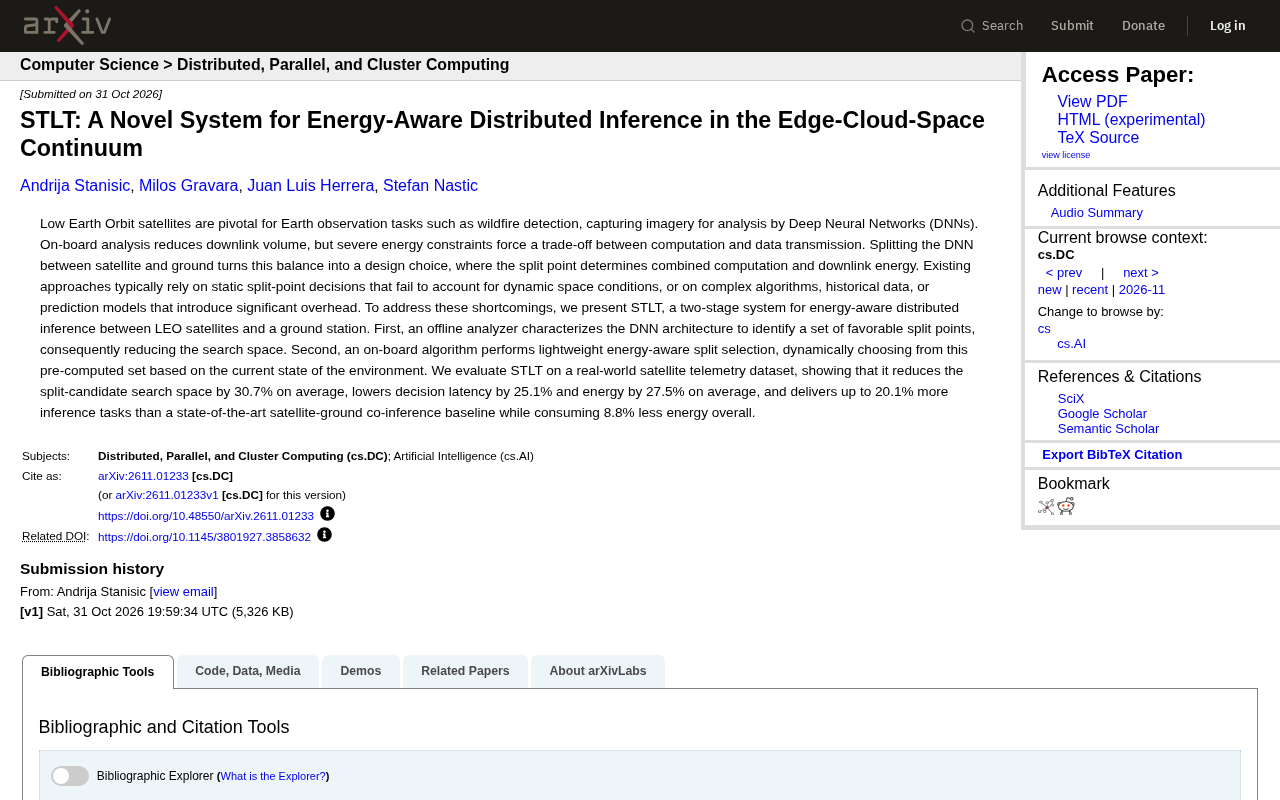
STLT is a two-stage system for energy-aware distributed inference between LEO satellites and ground stations, aimed at resolving the trade-off between constrained on-board inference energy and downlink transmission energy. Its core idea is to decouple search from decision-making: the offline stage characterizes DNN architecture features to identify favorable split points and narrow the online search space; the online stage dynamically selects the optimal split from a precomputed set based on current conditions, avoiding the overhead of complex algorithms or prediction models. On real satellite telemetry datasets, STLT reduces the search space by 30.7%, lowers decision latency by 25.1%, and cuts energy consumption by 27.5% on average; compared with advanced baselines, it delivers up to 20.1% more inference tasks while consuming 8.8% less overall energy.
The Energy Dilemma of Satellite-Ground Collaborative Inference
Low Earth Orbit (LEO) satellites play a critical role in Earth observation tasks such as wildfire detection. Images captured by satellites need to be analyzed through deep neural networks (DNNs), and on-board inference can reduce downlink data volume, yet it is constrained by stringent energy limitations. The trade-off between computation and transmission becomes an unavoidable core contradiction in system design.
Splitting the DNN across the satellite and ground station turns this contradiction into an optimizable design choice: the location of the split point determines the total energy consumption of computation and downlink transmission. However, existing methods either adopt static split decisions that struggle to adapt to dynamic space environments, or rely on complex algorithms, historical data, or prediction models that introduce significant additional overhead. According to the paper, these shortcomings are precisely the key problems that STLT attempts to solve.
LEO satellites typically operate in orbits 500 to 2000 kilometers above the ground, featuring low transmission latency and wide coverage, and are widely used for Earth observation, meteorological monitoring, and communication services. However, on-board energy relies primarily on solar panels and batteries, with an extremely limited power budget and harsh heat dissipation conditions. DNN inference involves extensive matrix operations, and executing it on-board significantly consumes energy; meanwhile, downlinking all raw images to ground stations is constrained by the bandwidth and communication energy of the satellite-ground link. Therefore, the energy trade-off between computation and transmission becomes the core constraint in the design of satellite-ground collaborative inference systems.
STLT's Two-Stage Design: Offline Analysis + Online Lightweight Decision-Making
STLT is a two-stage system for energy-aware distributed inference between LEO satellites and ground stations. Its core idea is to decouple "search" from "decision-making" to reduce the complexity of real-time on-board decisions.
Offline Stage: Narrowing the Candidate Space
The first stage is performed by an offline analyzer. It characterizes the DNN architecture and identifies a set of favorable split points, thereby reducing the online search space. This step does not consume real-time on-board resources but lays the foundation for subsequent lightweight decision-making.
Online Stage: Dynamically Selecting Split Points
The second stage is an on-board algorithm that performs lightweight, energy-aware split selection. It dynamically selects the optimal split from a precomputed set of split points based on the current environmental state. This design avoids the overhead of complex algorithms or prediction models while maintaining adaptability to dynamic space conditions.
The paper notes that this two-stage structure enables the system to make timely and reasonable inference task scheduling under energy constraints while maintaining adaptability.
A DNN split point refers to the location where the neural network model is divided into two parts: the layers before the split point are executed on the satellite, and the layers after it are executed on the ground station. The choice of split point directly affects the amount of on-board computation and the volume of intermediate data transmitted downlink—the earlier the split point, the less on-board computation but the larger the intermediate features transmitted; the later the split point, the more on-board computation but the less data transmitted. Therefore, the split point location essentially determines the allocation ratio between computation energy and communication energy, making it a key decision variable in satellite-ground collaborative inference optimization.
Measured Results: Comprehensive Optimization of Search Space, Latency, and Energy
STLT was evaluated on real satellite telemetry datasets. Results show that the system reduces the split candidate search space by an average of 30.7%, lowers decision latency by 25.1%, and reduces energy consumption by an average of 27.5%.
Compared with state-of-the-art satellite-ground collaborative inference baselines, STLT delivers up to 20.1% more inference tasks while consuming 8.8% less overall energy. This set of data indicates that STLT achieves a better balance between task throughput and energy efficiency. According to the paper, these improvements all stem from the two-stage design's effective control of search space and decision overhead.
Implications for Satellite-Ground Collaborative Computing
The value of STLT lies not only in specific metrics. It offers an approach: by combining offline precomputation with online lightweight decision-making, it transforms a complex energy optimization problem into fast selection over a limited candidate set. This has reference significance for satellite edge computing scenarios with extremely limited resources and dynamically changing environments.
The paper places the problem in the context of the edge-cloud-space continuum, emphasizing the energy trade-off between on-board inference and downlink transmission. STLT's measured performance demonstrates that reasonable split point management can significantly improve overall system efficiency without introducing heavy prediction overhead. In the future, this approach may be extended to more on-board DNN tasks and dynamic network conditions.
Related articles

9 AI Subscription Plans Compared: The Real Cost Per 100M Tokens Revealed
Bilibili creator tests 9 AI subscription plans from Volcano, Alibaba, Tencent, Baidu, Zhipu, Xiaomi, MiniMax and more, converting them all to real cost per 100M tokens, breaking down fixed-quota vs. three-tier coefficient billing and how caching, time-of-day discounts, and window limits affect actual quota.

Vibe Coding for Beginners: Expressing Intent Instead of Handwriting Code
What is Vibe Coding? A 137-episode Bilibili course defines it: the core is expressing intent, not writing code. This article analyzes Vibe Coding's productivity logic, target audience, and entry expectations to help beginners decide if it's worth learning.

LangChain Beginner's Guide: An Agent Development Roadmap from LangGraph to Deep Agents
Clarify the encapsulation relationship among LangChain, LangGraph, and Deep Agents, and master the learning path and selection logic for agent development frameworks—suitable for beginners in large model development.