Stop Letting AI Agents Do These 5 Things: Lessons from Community Failures

Reddit community discusses five task categories where AI agent permissions were revoked and conditions for rebuilding trust.
Based on Reddit community discussion, the article reverses the lens on AI agent boundaries: users commonly revoked agent permissions for final payment confirmation, auto-sending formal communications, direct production changes, automated personal data organization, and multi-step unsupervised workflows. The common thread: errors are irreversible or troubleshooting costs exceed manual execution. The community proposes four trust-rebuilding conditions—explainable failures, fine-grained permissions, rollbackable execution, and confidence calibration—and recommends positioning agents as co-pilots with human checkpoints.
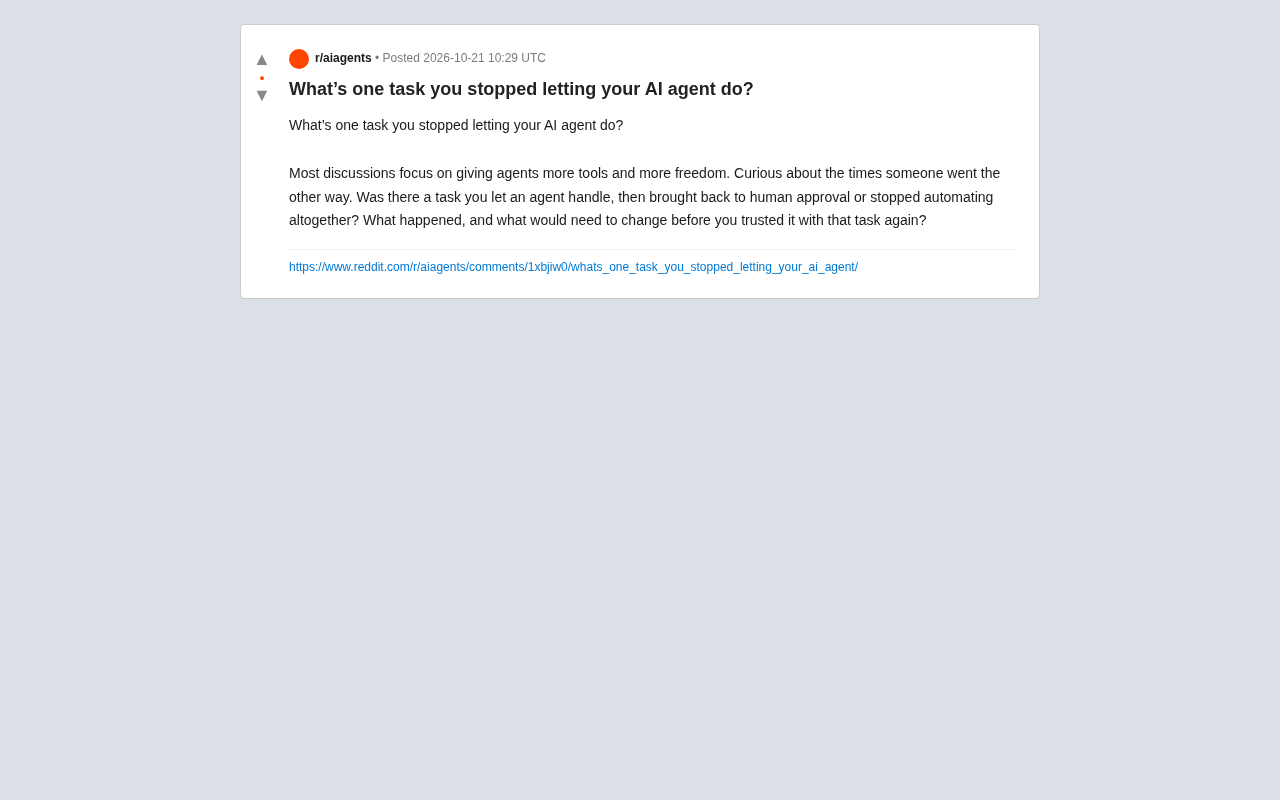
While everyone is discussing how to give AI agents more tools and freedom, the Reddit community posed a reverse question: Have you ever let an AI agent do something, then later revoked its permissions or switched back to human review? This question drew a flood of real-world failure stories, revealing the current boundaries of AI agent capabilities.
Why "Revoking Permissions" Is More Worth Discussing Than "Adding Permissions"
In the real-world deployment of AI agents, community discussion has focused almost unanimously on capability expansion—connecting more APIs, granting longer context, and building more complex automation chains. But the original Reddit poster astutely pointed out that few voices discuss which tasks have proven unsuitable for agents.
The value of this reverse perspective lies in the fact that the true boundaries of agent capability are often defined not by demo videos, but by failure cases. When users proactively revoke automation permissions for a task, it means the task's risk or unreliability has exceeded the benefits of automation. These lessons are more valuable reference points for anyone designing agent workflows than any success story.
Community Consensus: Five Categories of Tasks That Had Permissions Revoked
Drawing from multiple highly upvoted replies in the Reddit discussion, the following categories of tasks are ones users commonly choose to "revert to manual" or "stop automating":
1. Final Operations Involving Funds and Payments
Multiple users mentioned that they allow agents to generate payment suggestions or draft invoices, but insist on keeping humans in the loop for final confirmation. The reason: agents have made subtle deviations in amount calculations or account selection, and the cost of such errors is direct financial loss. Even when the agent's accuracy rate is high, users still believe that "one mistake is enough to offset long-term gains."
2. Formal Outbound Communications
Having agents draft emails and generate reply summaries is widely accepted, but directly auto-sending messages to external clients, partners, or regulatory bodies has been halted by many users. Feedback centers on inappropriate tone, missing key context, and an inability to judge the sensitivity of certain information. One user reported that an agent inadvertently leaked an internal project codename in what appeared to be a routine email.
3. Direct Changes to Production Environments
In development and operations scenarios, agents generating code and proposing changes is welcome, but directly executing deployments or modifying production configurations has been removed from agent permissions by a large number of users. A recurring pattern is that agents can complete 90% of an operation correctly, but the remaining 10% of errors tend to occur in the least expected places—and are extremely costly to troubleshoot.
4. Automated Organization of Long-Term Memory and Personal Data
Some users tried having agents automatically summarize meeting notes and organize personal knowledge bases, but quickly discovered that agents would lose important qualifying conditions during summarization or incorrectly merge information from different sources. After revoking permissions, users switched to a collaborative model where the agent generates drafts and a human gives final review.
5. Multi-Step Unsupervised Complex Workflows
When a task chain exceeds a certain length, minor deviations in intermediate steps get amplified at each stage, and the final result may look complete but is difficult to trace back to the source of error. Multiple users mentioned splitting long-chain tasks into multiple shorter tasks with checkpoints, inserting human confirmation at key nodes.
Common Patterns Behind Failures and Conditions for Rebuilding Trust
These tasks that had permissions revoked are not randomly distributed. Analyzing the replies reveals a common characteristic: errors are irreversible, or the cost of troubleshooting exceeds the cost of manual execution. Agents perform well on reversible, low-risk tasks with fast feedback, but once errors are difficult to undo or locate, user trust quickly collapses.
On the question of "under what conditions would you trust an agent again," the community's answers are remarkably consistent:
- Explainable failures: The agent can not only report success but also clearly explain the basis for each step, allowing users to quickly locate the source of deviation.
- Fine-grained permission control: The ability to grant different levels of autonomy by task type and by operation stage, rather than all-or-nothing.
- Rollbackable execution: Every agent operation has a clear undo path, and the rollback itself is simple enough.
- Confidence calibration: The agent can proactively stop and request confirmation when uncertain, rather than forcing out what appears to be a complete output.
Confidence Calibration is a key metric for measuring agent reliability, referring to the degree of match between an agent's estimated correctness of its own output and its actual accuracy rate. A well-calibrated agent rarely errs when it claims "high confidence," and can proactively lower its confidence and trigger human confirmation when uncertain. Current large language models generally suffer from overconfidence: even when the reasoning chain has gaps, the model tends to give answers with a definitive tone. This makes it difficult for users to judge risk from the surface of the output and forces reliance on external validation. The community's proposal to "proactively stop when uncertain" essentially requires agents to have introspective calibration capability, which requires introducing uncertainty modeling during training and exposing confidence as an interactive signal to users at the product level, rather than hiding it in the backend.
Implications for Agent Design
The most noteworthy takeaway from this discussion for product designers is this: users' expectations of agents are not "automate as much as possible," but "automate within the right boundaries." Most current agent frameworks iterate rapidly on capability expansion but invest明显不足 in permission granularity, rollbackability, and failure explainability.
For teams building agent applications, the community experience provides a practical checklist: if a task's errors are irreversible, or locating an error takes longer than manual execution, then that task should not be fully delegated to an agent at this stage. Position the agent as a "co-pilot" first, retaining human confirmation at key nodes—this accumulates long-term trust better than pursuing full automation.
The original Reddit question itself suggests a healthier discussion paradigm: rather than asking "what else can agents do," regularly ask "what have we decided not to let agents do, and why."
Rollbackability in agent systems differs from traditional software rollback. Traditional transaction rollback relies on database snapshots or version control, whereas agent operations often span multiple external systems (sending emails, calling payment APIs, modifying cloud configurations)—once these side effects occur, they are difficult to automatically undo. Therefore, agent architecture needs to introduce "compensating operation" design: pre-defining reverse operations for each irreversible action (such as sending a retraction email, initiating a refund, restoring a configuration snapshot), and evaluating the feasibility of compensation before execution. A further pattern is "dry-run" and "staged commit": the agent first simulates the complete operation chain in a sandbox, confirms correctness, then implements it stage by stage. Without such infrastructure, users can only mitigate risk by revoking permissions—this is the engineering gap behind the community phenomenon.
One-line Summary
Reddit community reverses the discussion: five task categories where AI agent permissions were revoked, and the conditions for rebuilding trust.
Paragraph Summary
Based on a Reddit community discussion, the article examines the boundaries of AI agent capabilities from a reverse angle: users commonly revoked agent permissions for five task categories—final confirmation of fund payments, auto-sending formal external communications, direct changes to production environments, automated organization of personal data, and multi-step unsupervised workflows. The common thread is that errors are irreversible or the cost of troubleshooting exceeds manual execution. The community further proposes four conditions for rebuilding trust—explainable failures, fine-grained permission control, rollbackable execution, and confidence calibration. The article notes that current agent frameworks emphasize capability expansion while neglecting permission granularity and failure explainability, recommends positioning agents as "co-pilots" with human confirmation at key nodes, and provides a practical checklist.
Related articles
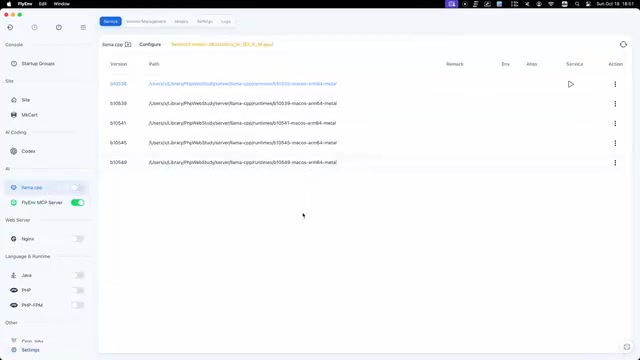
FlyEnv Plugin Review: Visually Running llama.cpp and Managing GGUF Models
FlyEnv launches the official llama.cpp plugin with side-by-side Metal runtime management, public GGUF repository indexing with file type labels, and visual configuration of context, threads, and GPU layers—saving templates and speculative decoding with each model for one-click local LLM inference.
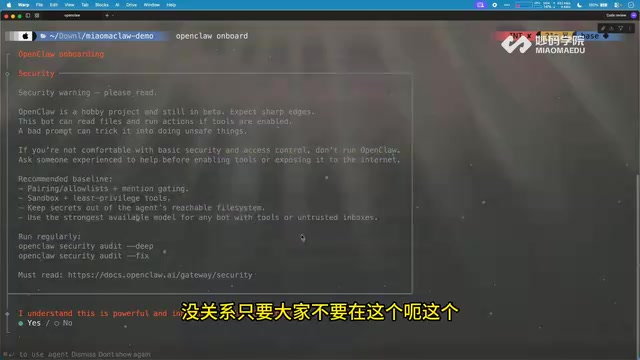
How Can Frontend Developers Advance into AI Agent Development? Deconstructing System-Level Agent Architecture from OpenClaw
Starting from the OpenClaw demo in a Bilibili open class, this article breaks down the three-layer architecture and universal formula of system-level AI agents, and analyzes the path for frontend developers to enter agent development based on TypeScript, including plugin-based design and security/memory layer challenges, with an interview answer framework.
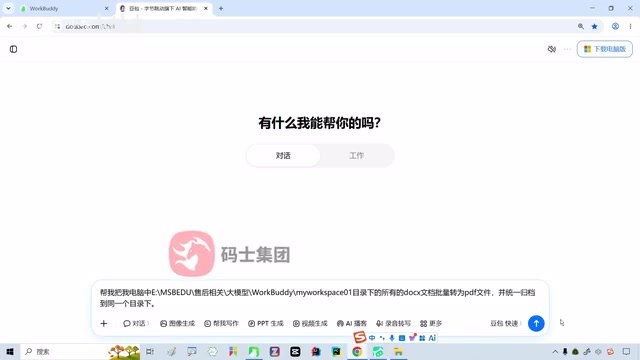
WorkBuddy in Action: How AI Agents Automate Batch File Conversion and Archiving
Bilibili creator Teacher Shanyao tests WorkBuddy vs. Doubao on batch file conversion, showing how AI Agents move from "giving solutions" to "direct execution," with a full workflow and credit cost reference.