Strata Upgrade Goes Wrong? Users Warn of Numerous Breaking Changes

Reddit users warn of numerous breaking changes in Strata upgrades on Windows and Linux, advising backups before upgrading.
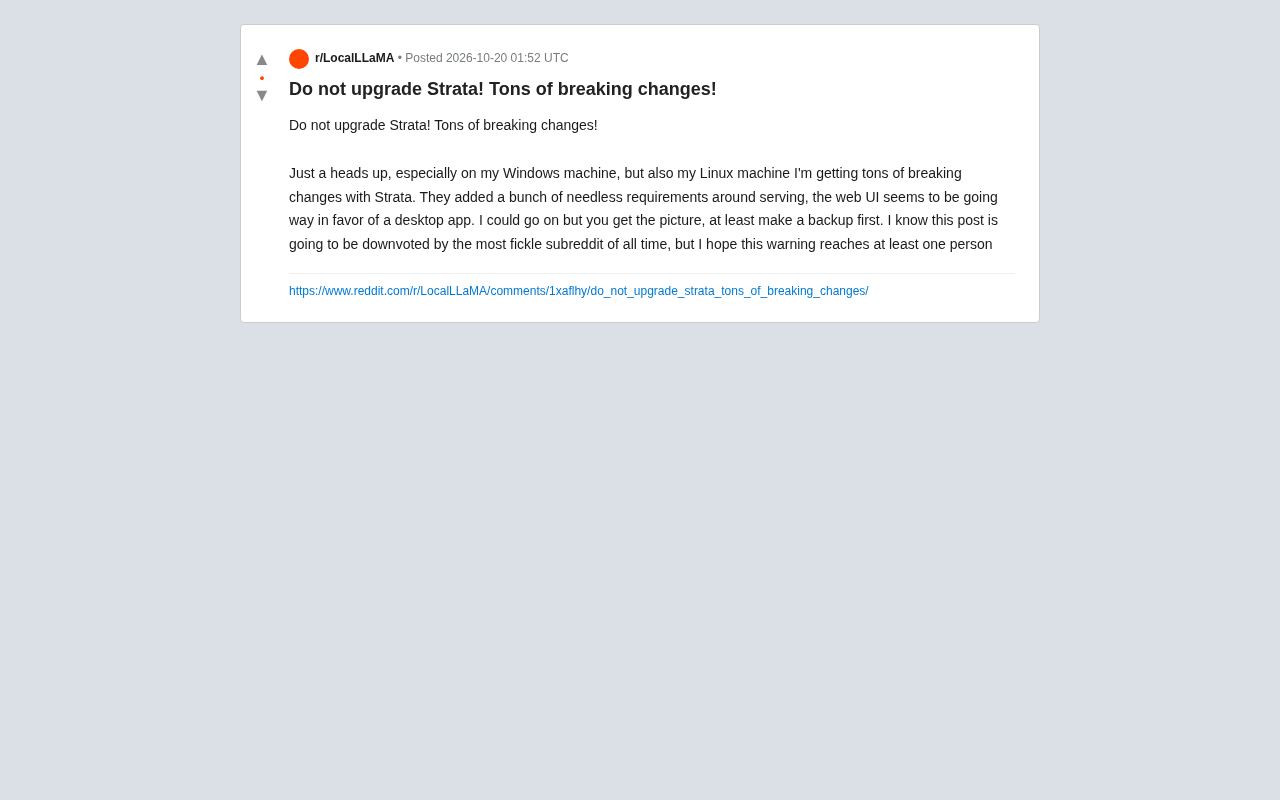
Recently, a Reddit user warned that upgrading Strata resulted in numerous breaking changes affecting both Windows and Linux platforms. The user noted the new version imposes unnecessary dependency requirements for service deployment, and the Web UI appears to be shifting significantly toward a desktop app, potentially impacting users accustomed to browser access. The poster advised backing up before upgrading and anticipated possible downvotes. Currently, the information comes from a single source without official confirmation or cross-validation; the article recommends following official update notes and taking a conservative approach until a detailed migration guide is released.
Upgrade with Caution: Strata Users Report Numerous Breaking Changes
Recently, a Reddit user posted a warning that upgrading Strata resulted in numerous breaking changes across both Windows and Linux platforms. The user advised backing up before upgrading and noted that the new version imposes unnecessary dependency requirements for service deployment, while the Web UI appears to be shifting significantly toward a desktop application.
Cross-Platform Issues Arise Frequently
According to the user, the problems occurred not only on Windows machines but also affected Linux machines. Although the post did not detail all error messages, the phrase "tons of breaking changes" suggests the upgrade may disrupt existing workflows. For users who rely on Strata for daily tasks, this is undoubtedly a signal worth heeding.
Breaking Changes is a term in software engineering referring to modifications that, after a new version is released, cause existing code, configurations, or workflows to become incompatible. Common breaking changes include: removing or renaming public APIs, changing configuration file formats, altering default behavior, bumping major version numbers of dependencies, etc. According to Semantic Versioning (SemVer), a major version increment typically indicates breaking changes, and users should read the migration guide before upgrading. For self-hosted service software, breaking changes often also affect deployment scripts, environment variables, and database schemas, so the community generally recommends validating in a test environment first and keeping a rollback plan.
Service Deployment and UI Direction Changes
The user specifically mentioned that the new version adds "a bunch of unnecessary requirements" around serving, which may imply increased deployment complexity. Additionally, the Web UI's direction seems to favor a desktop application, which could affect users accustomed to browser access. Although the post provided no specific technical details, such directional adjustments often come with configuration and compatibility changes.
Web UI shifting to a desktop app refers to a project gradually migrating its originally browser-based management interface to a standalone desktop client (e.g., applications packaged with frameworks like Electron or Tauri). This transition typically brings richer local system integration capabilities (such as file system access, background persistence, system tray), but it also means users can no longer access the interface remotely via a browser, need to install an additional client, and the update mechanism changes from unified server-side upgrades to individual client updates. For multi-user or remote management scenarios, this may significantly change operational habits and introduce new distribution and compatibility costs.
Community Reaction and Recommendations
The poster anticipated that the post might be downvoted but still hoped the warning would help at least one person. This "go forth even if thousands oppose" attitude reflects some users' concerns about upgrade risks. Before the official release of a detailed migration guide, a conservative approach—back up before upgrading—may be the wise choice.
Summary
Currently, information about the Strata upgrade issues comes mainly from a single Reddit user, lacking official confirmation or cross-validation from more independent sources. Users are advised to follow updates from the project's official channels and back up data before upgrading.
Note: This article is based on Reddit post content; for specific technical details, please refer to the official documentation.
Related articles

OneMemory 1.4.2 Released: A Self-Hosted Shared Memory Tool Built for AI Agents
OneMemory 1.4.2 released: a self-hosted shared memory server supporting MCP and REST, with writer tracking, distrusted list, offline command queuing, and safer upgrade backups. Ideal for individual developers and AI agents.

How Can RAG Debugging Knowledge Be Retained? The Knowledge Management Pain of AI Teams
How can AI teams effectively retain and reuse knowledge from RAG debugging and audits? This article analyzes three current knowledge management modes and their pain points, and explores the technical feasibility and business challenges of an evidence-supported case memory system.

Reactive Optimizers: Rewriting Optimizer Source Code During Training — A New Paradigm for Performance Gains
Reactive Optimizers dynamically rewrites optimizer source code during training for code-level adaptivity. This article explains its core mechanism, differences from meta-learning, and challenges in stability and reproducibility, and explores its potential impact on AI training frameworks.