Streaming Is Becoming Cable Again: A Full-Circle Moment

Streaming platforms are recreating cable TV's ads, bundles, and linear channels under profitability pressure.
This article traces how the streaming industry has evolved from disruptor to cable TV imitation. Platforms like Netflix once upended traditional TV with ad-free, on-demand viewing — but are now retracing old steps: FAST channels revive linear broadcasting, ad-supported tiers and multi-platform bundles recreate cable's payment structure. This isn't coincidence; it's an inevitable convergence as subscription growth stalls and profitability demands mount. For consumers, the savings from cord-cutting are being quietly erased. Technology changed distribution, but not the underlying economics of entertainment.
From Disruptor to Imitation
When Netflix upended traditional cable TV years ago with its ad-free, on-demand model, nearly everyone believed the era of bundled packages, channel tiers, and fixed broadcast schedules was finished for good. Streaming promised users pure freedom — watch what you want, whenever you want, on whatever device you choose.
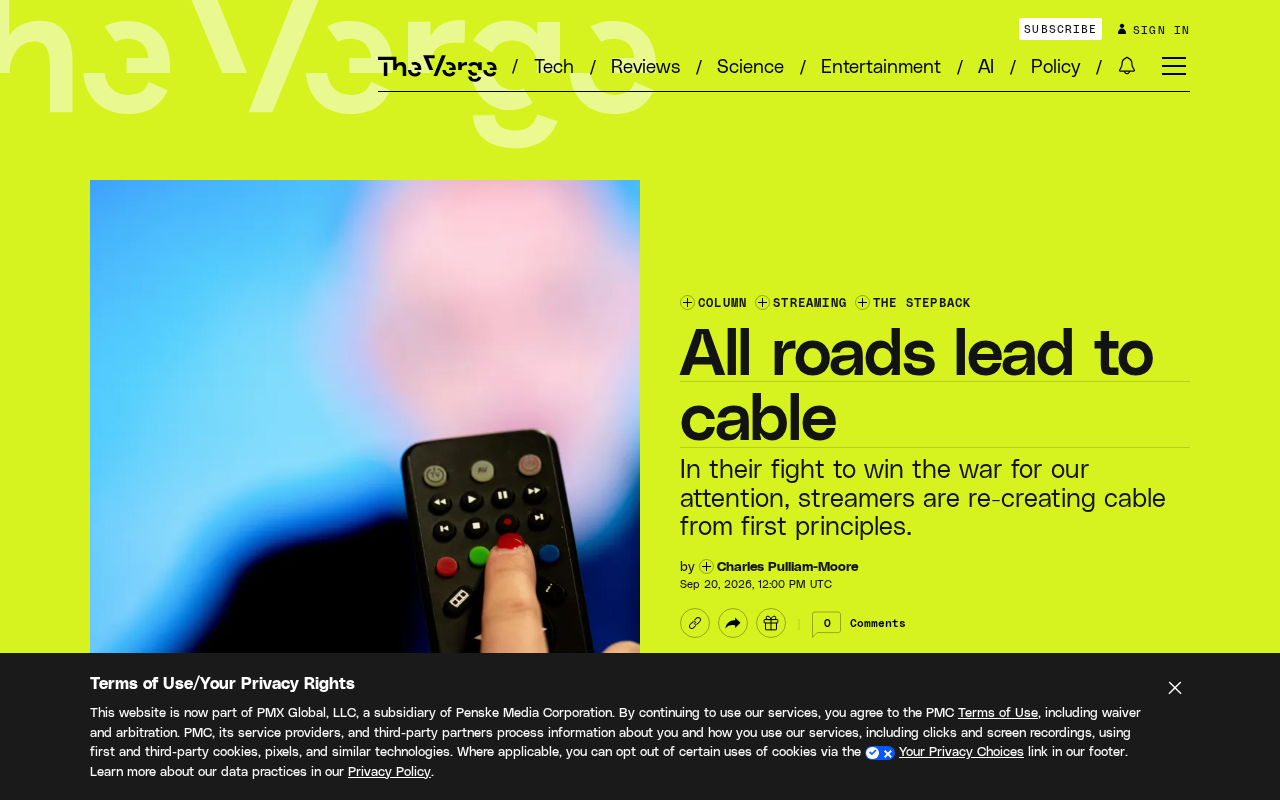
Yet things are unfolding in a deeply ironic direction. According to analysis from The Stepback, a newsletter from tech publication The Verge, the streaming industry is retracing cable TV's footsteps, step by step. The one-time disruptors are beginning to look more and more like the very thing they set out to replace.
The Return of FAST Channels
The most telling signal in this full-circle story is the rise of FAST channels — Free Ad-Supported Streaming TV. These channels essentially replicate the linear viewing experience of traditional television: no on-demand menu, content rolling out on a preset schedule, viewers tuning in to whatever's on, with ads in between.
This is almost the exact opposite of what Netflix promised in its early days. The popularity of FAST channels reveals that a segment of users actually doesn't want to choose from tens of thousands of titles. They'd rather just open a screen and passively receive content — which is precisely the core experience of the cable TV era.
For platforms, FAST channels also provide a valuable advertising revenue stream. As subscription growth hits a ceiling, advertising has become an indispensable income source, and linear channels are the most proven vehicle for ad delivery.
FAST channels aren't entirely new — their early forms can be traced back to around 2014, when platforms like Pluto TV and Tubi first commercialized the model. What really brought FAST channels into the industry spotlight was the deep involvement of hardware and OS makers like Roku, Amazon Fire TV, and Samsung TV Plus — embedding their own FAST channels directly into the startup screen, requiring no registration or payment from viewers. This distribution advantage allowed FAST channels to rapidly penetrate mainstream markets in the early 2020s. Today, there are more than 1,500 FAST channels globally (primarily in North America), with content skewed toward catalog reruns, documentaries, and sports events — exactly the kind of library content that major platforms can no longer afford to keep or continue producing. For these platforms, it's a way to monetize existing assets with almost no additional production investment. Ad CPMs (cost per thousand impressions) in live linear environments also tend to run higher than in on-demand contexts, making the business case quite compelling.
The Revival of Ads and Bundling
Two of the streaming industry's biggest recent trends are near-carbon copies of the cable TV business model.
The Spread of Ad-Supported Tiers
Major platforms have rolled out low-cost, ad-supported subscription plans — some even migrating existing subscribers into ad tiers by default. If you want an ad-free experience, you pay more. This logic of "trading your viewing time for a lower price" is exactly how cable television operated for decades.
The Return of Bundle Packages
To reduce churn and boost stickiness, platforms have started bundling with one another. Multiple streaming services are sold together in a single package at what looks like a discount — but what this really reconstructs is the old cable TV structure of "pay for a bunch of channels just to get the one you want." Users are no longer facing a single low-cost subscription but a layered stack of bundled plans, often adding up to more than what they used to pay before cutting the cord.
Why It All Comes Back Around
There's a clear commercial logic behind this full-circle moment. Streaming initially relied on capital subsidies and massive content spending to capture market share. When growth slowed and profitability pressure mounted, platforms had to find sustainable ways to make money. The model that cable TV honed over decades — advertising, bundling, linear channels — happens to be the one that's been market-validated as a profitable path.
Technology changed how content is distributed, but it hasn't changed the fundamental economics of the media industry. Producing content requires enormous capital; recouping that capital requires stable revenue; and advertising and bundling are the two most effective mechanisms for generating it. Once the disruption dividend runs dry, the industry naturally converges toward proven business models.
For consumers, this means the savings from cord-cutting are being quietly reclaimed. Subscribing to multiple platforms, tolerating ads, accepting bundle packages — the end experience and the bill look startlingly similar to the cable TV era.
There's an economic concept called convergence pressure: companies competing in the same market, facing the same cost structures and profitability constraints, tend to independently evolve toward similar business models. The streaming industry's full-circle moment is a textbook example. After Netflix reported its first net subscriber loss in 2022, Wall Street's valuation logic shifted fundamentally — the market stopped awarding a premium for "growth stories" and started demanding real profits. That pressure cascaded across the entire industry, forcing Paramount+, Peacock, Disney+, and others to slash content spending, introduce ad tiers, and pursue bundle consolidations. In other words, the "return" of the cable model wasn't the industry choosing to get nostalgic — it was an inevitable convergence toward the profit-maximizing solution under capital constraints. The economies of scale required for content production are prohibitively high, and advertising plus bundling are among the very few paths known to generate positive cash flow at mass-market scale.
Final Thoughts
"All roads lead to cable." This phrase neatly captures the state of the streaming industry today. Technology has delivered genuine innovation in distribution channels and user interfaces, but the underlying commercial logic of the entertainment industry has never really changed.
Streaming may continue to evolve in personalized recommendations, interactive experiences, and content quality — but at the business model level, it may have already completed the full loop from disruption back to its origins. For anyone who lived through the cable TV era, all of this feels remarkably familiar.
Related articles

Free Unlimited Claude Code Solution: Agnes AI + CC Switch Setup Guide
No paid subscription needed — pair the free AI platform Agnes AI with the open-source tool CC Switch to provide a backend for Claude Code, enabling unlimited free calls to text, image, and video models. This guide covers the full setup, test results, and usage boundaries.

A Complete Zero-Cost Guide to Getting Started with Claude Code for Beginners in China
A beginner's guide to Claude Code for users in China: two installation methods (command line and IDE plugin), full configuration steps for replacing the official API with the free domestic LongCat model, and a hands-on demo of building a small tool with natural language, plus tips.

When the NSA Gets Involved: The AI Supply Chain Crisis Behind Open-Source CVEs and API Key Hijacking
Multiple open-source projects disclosed severe CVEs in one day, PHP flaws alarmed the FBI, and Railway and OpenCode were breached with API keys stolen. This article breaks down the vulnerability window, AI-accelerated exploitation, and the AI supply chain crisis behind the API key black market, with a developer defense checklist.