Stripe Acquires OpenRouter for $7 Billion: The Rising Value of AI Model Aggregation Layers

Stripe bets $7B on AI middleware by acquiring model routing platform OpenRouter.
Stripe has acquired OpenRouter, the leading LLM API aggregation and routing platform, for approximately $7 billion. The deal's core logic: as frontier model providers have grown from one or two to dozens, choosing the right model has become an ongoing engineering and economic decision — giving aggregation layers real infrastructure value. For Stripe, this is a natural extension of its "abstract complexity, unify the interface" DNA, with OpenRouter's per-token billing and cross-vendor metering aligning directly with Stripe's usage-based billing infrastructure. The acquisition also highlights the structural risks aggregation layers face, squeezed between powerful model providers and developers. For the industry, it's both an architectural signal and a vivid validation of the picks-and-shovels thesis in the AI era.
A Landmark Deal: Stripe Acquires OpenRouter for $7 Billion
Payment giant Stripe has acquired OpenRouter — one of the most prominent LLM API aggregation and routing platforms — for approximately $7 billion. The signals this deal sends are far more interesting than the price tag itself. It marks a clear endorsement, from mainstream tech capital, of the "middle layer" infrastructure built around large language models.
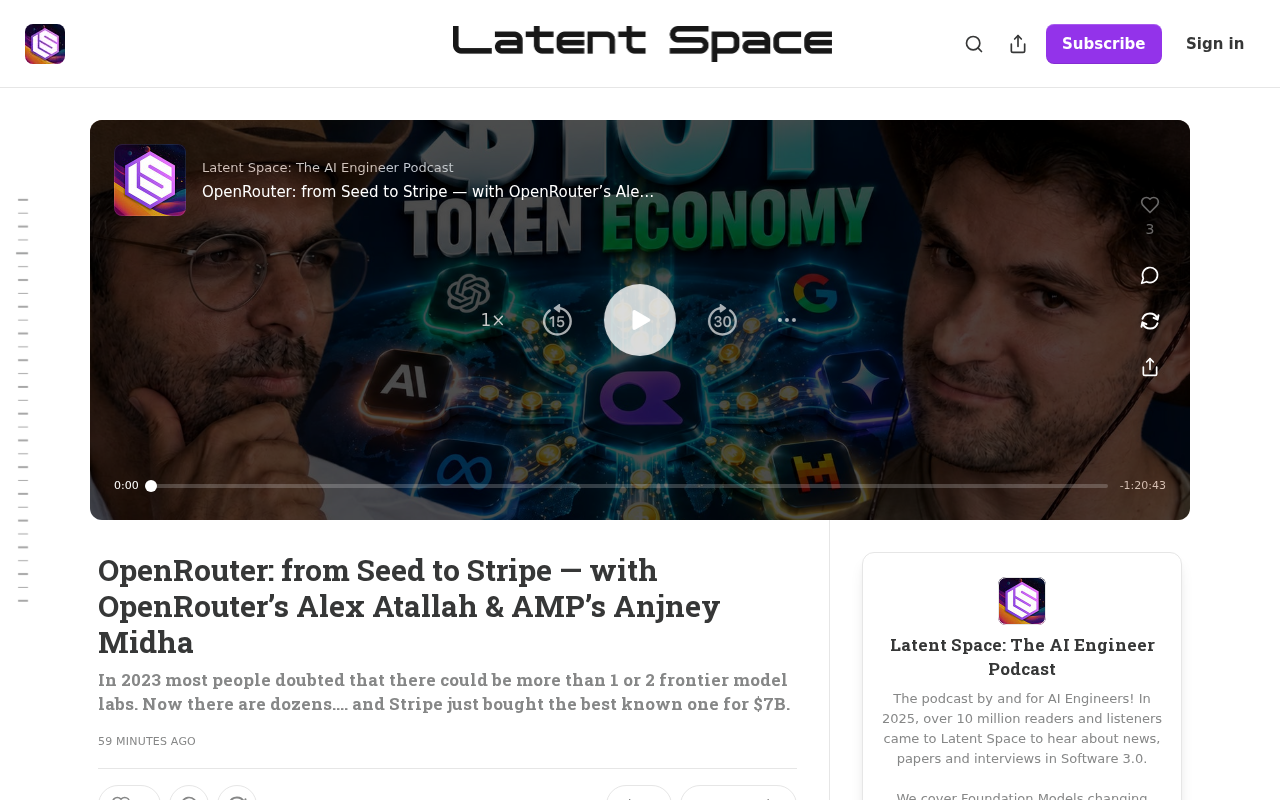
OpenRouter operates as a unified routing layer that connects developers to multiple model providers: with a single API integration, developers can flexibly switch between dozens of frontier models, compare pricing, perform load balancing, and build in failover. This model-agnostic architecture hits squarely on one of the most significant shifts in today's AI ecosystem.
From "One or Two" to "Dozens": How the Frontier Model Landscape Has Changed
In a conversation between OpenRouter founder Alex Atallah and investor Anjney Midha (sourced from the original material), one observation cuts right to the heart of the matter: in the early days, the conventional wisdom was to question whether more than one or two frontier model labs could ever coexist. Today, there are dozens of frontier model providers.
This shift in the competitive landscape is precisely what drives the commercial value of aggregation layers. When there were only one or two models on the market, developers could integrate directly with providers — a middleware layer was barely necessary. But as the number of models has exploded, each with its own tradeoffs in cost, latency, context length, and task specialization, "which model should I use" has become an ongoing engineering and economic decision.
OpenRouter abstracts that decision into a programmable layer of infrastructure. It means application developers no longer have to rewrite integration code every time a model is updated, nor do they have to be locked into any single vendor.
This landscape shift has been driven by two forces working in tandem: lower barriers to compute access and a maturing open-source model ecosystem. Before 2023, training and operating frontier large models was almost exclusively the domain of a handful of giants like OpenAI and Google. But with the entry of Mistral, Cohere, Anthropic, Meta's open-source LLaMA series, and players like DeepSeekAd and Zhipu AI from China, the very definition of "frontier model" has fragmented. It's no longer just about the model with the most parameters — different models now lead in code generation, multilingual understanding, long-context handling, inference cost, and more. For application developers, this means the optimal model choice has become a dynamic, task-specific question rather than a one-time decision.
Why Stripe?
Stripe, the canonical company in payment and commercial infrastructure, might seem like an unlikely buyer for an AI model routing platform — but the logic is internally consistent. At their core, both businesses are in the same game: abstracting complexity and unifying interfaces. Stripe abstracts the complexity of global payments; OpenRouter abstracts the complexity of multi-model access.
From a business model perspective, OpenRouter naturally carries metering and billing characteristics — per-token pricing, unified cross-vendor billing, usage analytics — all of which align closely with Stripe's strengths in billing and revenue infrastructure. It's reasonable to infer that Stripe intends to fold AI inference consumption into its broader ambition of becoming a "business operating system."
Stripe's core product philosophy has always been about making complex things transparent for developers — its API design has long been considered the gold standard in payments. Extending that capability to AI inference consumption fits neatly within Stripe's strategic shift in recent years from a pure payment tool to a "revenue and commercial infrastructure" platform. Stripe has already launched Billing, Revenue Recognition, Tax, and other products, steadily building out a complete toolchain around SaaS and consumption-based monetization. AI application billing — per token, per request, per model tier — is a textbook use case for usage-based billing, and maps directly onto Stripe's existing Meter API and Billing modules. Acquiring OpenRouter essentially means acquiring the largest demand aggregation entry point in this emerging consumption category.
The Long-Term Value — and Risks — of the Aggregation Layer
This deal has reignited debate about where value ultimately accrues in the AI value chain. The optimistic view holds that as models commoditize, value will migrate from the models themselves toward the application layer and the aggregation layer — platforms like OpenRouter, which control demand aggregation and routing decisions, will only grow more important.
But the risks are real: the aggregation layer is squeezed between powerful model providers and application developers, and its pricing leverage is structurally fragile. Leading model providers could easily build out their own multi-model access solutions, or use pricing strategies to erode the cost-comparison advantages that make aggregation layers attractive. OpenRouter being folded into Stripe is, in part, a way to give the aggregation layer a backer with far greater payment and distribution resources.
The structural pressure on aggregation layers has precedent in internet history. Price comparison platforms, app store distribution layers, and cloud resellers have all faced similar dynamics: as upstream suppliers scale, they tend to move toward direct end-user relationships, compressing margins for the intermediary. In AI, OpenAI has already introduced differentiated capabilities like its Batch API and fine-tuning — features that currently cannot be transparently proxied through third-party routing layers, creating a natural moat against aggregators. Whether aggregation layers can remain competitive will largely depend on their ability to accumulate capabilities that model providers cannot offer on their own — such as cross-vendor usage data insights, documented reliability records for automatic failover, and deep integration with downstream payment and billing systems. That last point is precisely the core incremental value that the Stripe acquisition brings.
What This Means for Developers and the Industry
For developers, this acquisition reinforces a practical architectural recommendation: keep your application decoupled from any specific model, and avoid premature vendor lock-in. Model routing layers are becoming a standard component of the AI application stack.
For founders, this is a vivid case study in the "picks and shovels" thesis — in a period when the model wars are fierce and the outcome is uncertain, the middleware that provides access, metering, and orchestration for the entire ecosystem tends to generate stable and substantial returns. From seed round to Stripe acquisition, OpenRouter's trajectory validates how infrastructure-oriented companies ultimately realize their value.
Note: This article is based on publicly available conversation materials. Some of the commercial reasoning represents analytical inference based on industry trends. Specific transaction details should be verified against official disclosures.
Related articles

Frontend to AI Agent Development: A Frontline Architect Explains Career Paths and Opportunities
A frontline AI architect explains the industry changes and practical paths for frontend developers transitioning to AI Agent development: why pure frontend jobs are disappearing, why Agent + full-stack has become mainstream in hiring, and three transformation routes—Agent development engineer, FDE, and remote contracting—along with corresponding learning strategies.

How to Choose an AI Agent Development Course: Five Pitfall-Avoidance Guidelines
A mechanical-engineering career changer's two-year pitfall-tested checklist for screening AI Agent development courses: complete delivery pipeline, resume-worthy projects, real development perspective, update frequency, and coaching feedback—with concrete judgment methods and pitfall-avoidance tips.

Coze AI Agent Building for Beginners: A Zero-Code AI Agent Development Guide
Coze, ByteDance's one-stop AI application development platform, supports zero-code drag-and-drop AI agent building. This article outlines Coze's core concepts, three advantages, differences between the domestic and international versions, and the distinction between agents and apps, helping beginners quickly get started with AI Agent development.