Stripping Model Identity: Erasing Self-Awareness from LoRA Weights
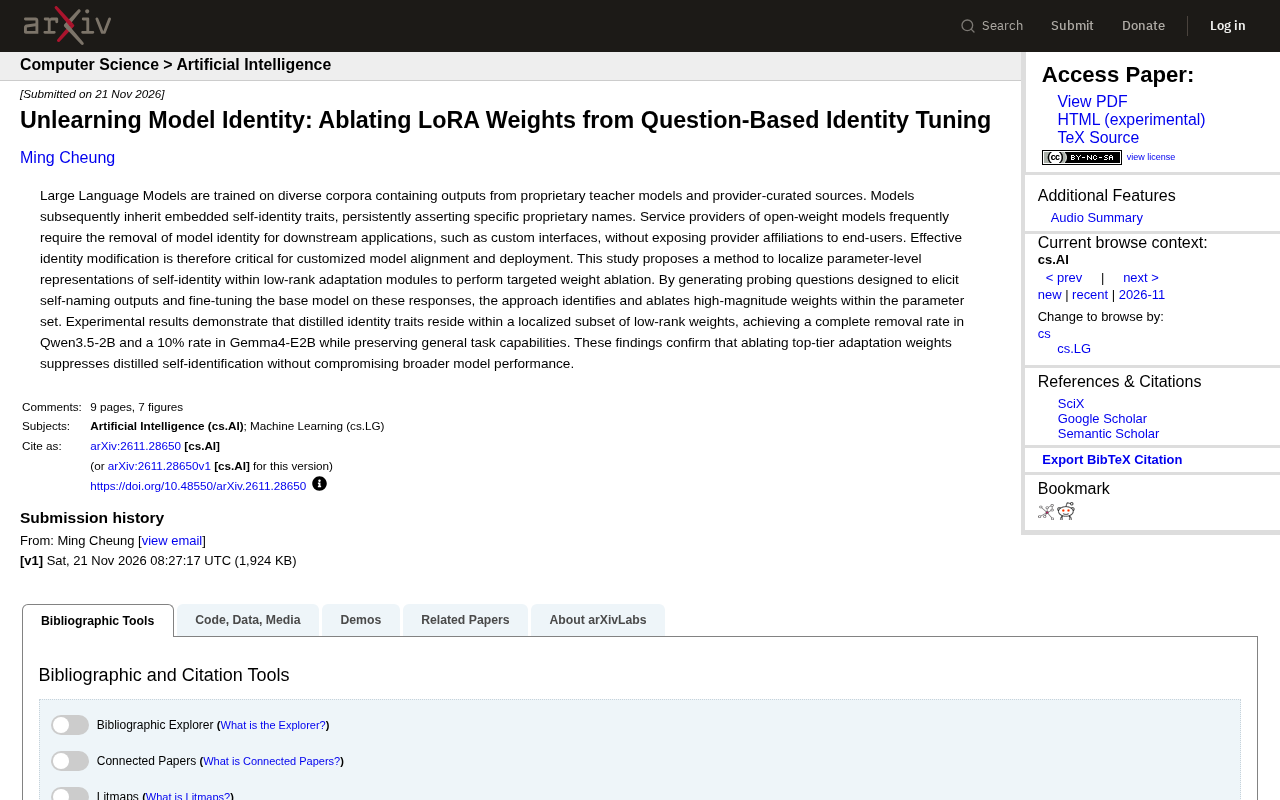
Study locates and ablates identity weights in LoRA to remove model self-identity, with effectiveness varying by model.
The article presents a study that removes open-source models' self-identity through parameter-level operations. The method uses guided questions to probe self-naming behavior, fine-tunes on responses to concentrate identity activations, then locates and ablates high-magnitude weights in LoRA modules. Qwen3.5-2B achieves complete removal, Gemma4-E2B only 10%, while both retain general capabilities. The authors argue identity traits partially reside in a localized subset of low-rank weights, but localization varies with architecture, training data, and distillation, making the method model-dependent.
Why Open-Source Models Need to "Forget" Who They Are
Large language models are exposed to vast amounts of output from proprietary teacher models and vendor-curated corpora during training, so they inevitably inherit embedded self-identity traits—they persistently claim to be a specific brand or model. For service providers who want to integrate open-weight models into their own products, this identity "branding" creates problems: downstream applications (such as customized conversational interfaces) often need to hide the model's provenance and avoid exposing vendor associations to end users. How to effectively modify model identity has become an unavoidable topic in model customization and deployment.
A recent study proposes a method to locate parameter-level representations of self-identity within low-rank adaptation (LoRA) modules, achieving identity removal through targeted weight ablation. Experiments show that distilled identity traits are indeed concentrated in a localized subset of low-rank weights, and ablating high-magnitude weights can suppress the model's self-naming tendency without harming general task capabilities.
Method: Probe Identity with Questions, Then Precisely "Excise" It
The researchers' approach has two steps. First, they generate a set of probe questions that deliberately prompt the model to produce self-naming responses (e.g., "Who are you?" "Who is your developer?"). Then, they fine-tune the base model on these responses so that identity-related activation patterns become more concentrated and observable.
On this basis, the method identifies weights with high magnitude in the parameter set and performs targeted ablation. The core hypothesis here is that self-identity is not diffused throughout the entire parameter space, but compressed into a small number of high-magnitude weights in the LoRA module. Ablating these weights is equivalent to precisely severing the association between the model and a specific name, while preserving the general capabilities carried by the remaining parameters.
This approach differs from traditional full-parameter fine-tuning or refusal training: it does not rely on additional data coverage, but directly removes identity representations at the parameter level, making interference with model behavior more controllable.
Why Low-Rank Modules Are the Breakthrough Point
LoRA injects trainable parameters through low-rank decomposition, and its parameter count is far smaller than full fine-tuning. The study chooses LoRA as the operation target for two reasons: on one hand, many downstream deployment scenarios already use LoRA for adaptation, so ablation operations can act directly on these adapter weights; on the other hand, the low-rank structure naturally compresses the parameter space, making the question "is identity localized?" easier to test.
Low-Rank Adaptation (LoRA) is a parameter-efficient fine-tuning technique. Its core idea is to freeze all original weights of the pretrained model and inject a pair of trainable low-rank matrices $A$ and $B$ as a bypass in each layer (typically attention or feed-forward layers), approximating the weight update as $\Delta W = BA$. If the original weight matrix has dimensions $d \times k$, then $A$ is $r \times k$ and $B$ is $d \times r$, where the rank $r \ll \min(d,k)$. This reduces the number of trainable parameters by several orders of magnitude compared with full fine-tuning while maintaining strong adaptation capability.
Since LoRA modules themselves carry incremental information injected during the fine-tuning stage, if the model's self-identity is "written in" during fine-tuning or distillation, this information is very likely to reside in the LoRA weights. The low-rank structure compresses the parameter space to a very low dimension, effectively concentrating the identity signal into a small number of singular directions, so the question "is identity localized?" is easier to observe and verify on LoRA than in a full-parameter model. This is also the key reason the researchers chose LoRA as the ablation target.
Weight ablation here means something different from random dropout during training. It refers to directly setting to zero or substantially reducing the values of specific parameters identified in the model after training is complete, thereby cutting off their contribution to the forward pass. Unlike refusal training or instruction overriding that relies on additional data, weight ablation introduces no new samples and does not change the remaining parameters, so its scope is narrower and more interpretable.
The "targeted" nature of this method is reflected at two levels: first, targeted localization—it acts only on LoRA modules rather than all weights; second, targeted selection criteria—candidate weights are screened by parameter magnitude, under the assumption that high-magnitude weights correspond to strong identity-related activation pathways. After ablation, probe questions are used to retest whether the model still self-names, while general task performance is also evaluated to confirm the effectiveness of removal and the boundaries of side effects.
Experimental Results: Clear Differences Across Models
Experiments yield differentiated results on two models. On Qwen3.5-2B, the method achieves a complete removal rate; on Gemma4-E2B, the removal rate is 10%. Both maintain general task capabilities.
This contrast suggests that the degree to which identity traits are concentrated in low-rank weights may vary with model architecture, training data composition, and identity distillation method. Qwen3.5-2B's identity representation appears more concentrated and easier to locate and ablate; Gemma4-E2B may distribute identity information across a broader parameter range or couple it more tightly with other capabilities, so targeted ablation can remove only a small portion.
The researchers attribute this phenomenon to "distilled identity traits residing in a localized subset of low-rank weights," but the 10% removal rate also suggests that the localization hypothesis does not hold for all models, and the method's effectiveness is model-dependent.
Why General Capabilities Are Preserved
The experiments emphasize that the model's general task performance is not damaged after ablation. The logic behind this is that high-magnitude weights mainly carry strong identity-related activations, while general language capabilities are distributed across more numerous and more dispersed parameters. Removing the former has limited impact on the latter. However, this conclusion is currently based on only two models and limited task evaluations, and broader generalization still needs verification.
Knowledge distillation is a training paradigm in which a smaller student model learns the output distribution of a larger teacher model, typically by minimizing the difference from the teacher's soft labels to fit its behavior. When the teacher model itself carries a clear brand identity and the training corpus contains large amounts of teacher-generated text, the student model not only learns task capabilities but also inherits the teacher's habit of expressing "who I am," forming so-called identity distillation.
This background explains why identity removal rates differ significantly across models: the concentration of identity traits depends on the scale and composition of distillation data, the consistency of identity expressions in teacher outputs, the capacity and inductive biases of the student model architecture, and the injection position and rank size of LoRA adaptation. The gap in removal rates between Qwen3.5-2B and Gemma4-E2B (100% vs. 10%) precisely shows that the "writing method" of identity distillation affects its distribution pattern in parameter space.
Implications for Model Deployment and Alignment
The practical significance of this work lies in providing a parameter-level tool for model identity management. For teams building customized products with open weights, identity ablation can serve as a preprocessing step before deployment, reducing end users' perception of model provenance.
But it also raises questions worth considering. The completeness of identity removal varies by model, meaning one cannot assume a single ablation pipeline works for all models. In addition, whether ablating high-magnitude weights introduces hard-to-detect behavioral shifts requires more detailed evaluation.
From a research perspective, this work confirms that self-identity is localized to some extent in parameter space, offering clues for understanding how model identity representations are stored. Future research could explore finer-grained localization methods or explain differences in removal rates in light of architectural differences.
For developers focused on model alignment and customization, this study suggests that identity is not an abstract attribute but a parameter pattern that can be located and manipulated. This opens up room for customization while requiring deployers to more carefully evaluate model behavior after ablation.
One-line Summary
A study uses probe fine-tuning to locate identity weights in LoRA and perform targeted ablation, achieving model identity removal but with model-dependent effectiveness.
Paragraph Summary
The article introduces a study that removes open-source models' self-identity through parameter-level operations. The method first probes the model's self-naming behavior with guided questions, then fine-tunes on the responses to concentrate identity activations, and subsequently locates high-magnitude weights in LoRA modules and performs targeted ablation. Experiments show that Qwen3.5-2B achieves complete identity removal while Gemma4-E2B reaches only 10%, but both retain general capabilities. The authors argue that identity traits partially reside in a localized subset of low-rank weights, but the degree of localization varies with model architecture, training data, and distillation method, making the method model-dependent. This work provides a parameter-level identity management tool for downstream customized deployment, while also indicating the need for careful evaluation of behavioral shifts and generalization after ablation.
Related articles
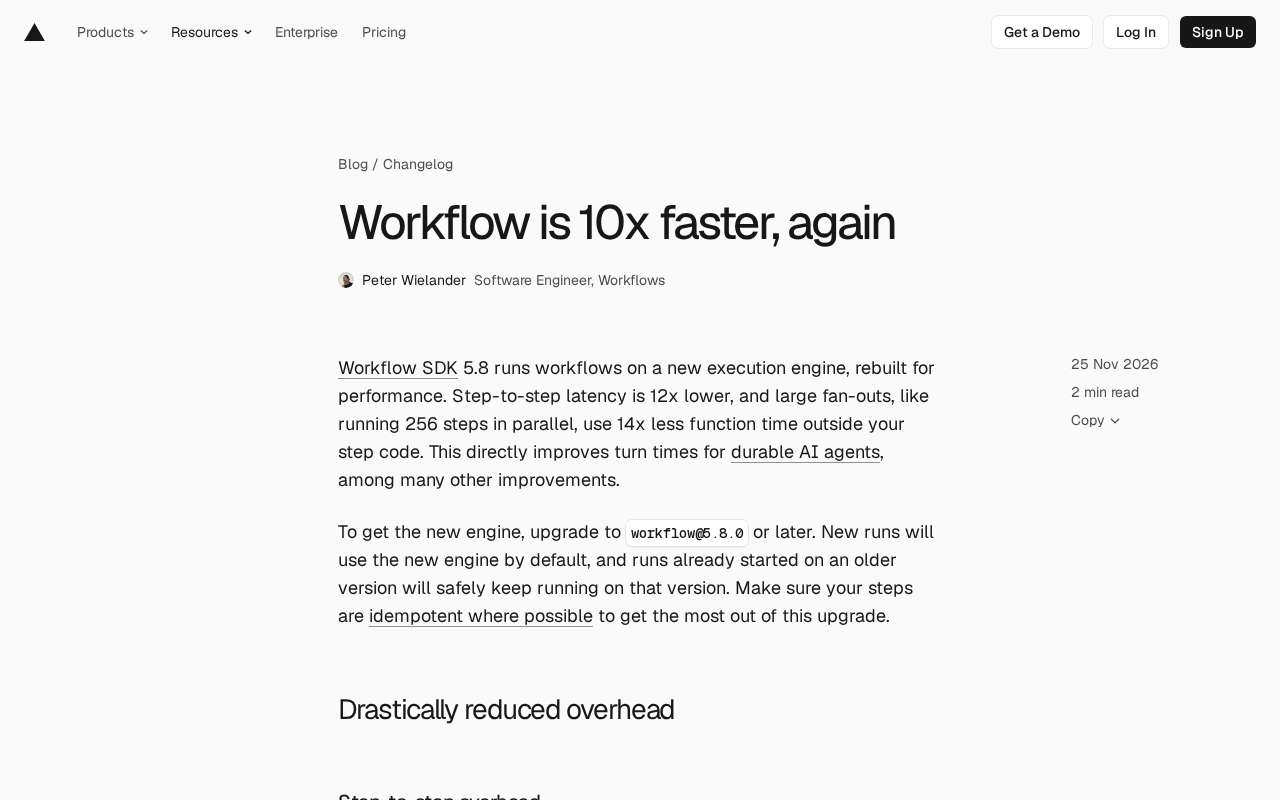
Workflow SDK 5.8 Performance Benchmark: Step Latency Reduced 12x
Workflow SDK 5.8 rebuilds its execution engine, cutting p75 inter-step latency from 85ms to 7ms and 256-way parallel fan-out overhead by 14x, improving durable AI agent turnaround.

David Fincher's New Film Accused of Being AI-Generated? The Truth Behind the Controversy
David Fincher's new film *The Further Misadventures of Cliff Booth* is accused of using AI, with a carriage shot in the trailer sparking controversy. Netflix's acquisition of Ben Affleck's AI company and Fincher's own openness to AI keep suspicions alive. This article sorts out the controversy and the views of all sides.

FCC Clears SpaceX's Space-Based AI Data Centers: A Debate Over Regulatory Boundaries
The FCC approved SpaceX's plan to deploy AI data centers in space but dismissed opponents' key concerns about scientific research impacts as beyond its regulatory authority. This article analyzes the regulatory boundary issues behind the decision, the deeper tensions of space-based AI infrastructure, and its implications for the industry.