Supacut: AI Turns Interview Footage into a Rough Cut in Minutes
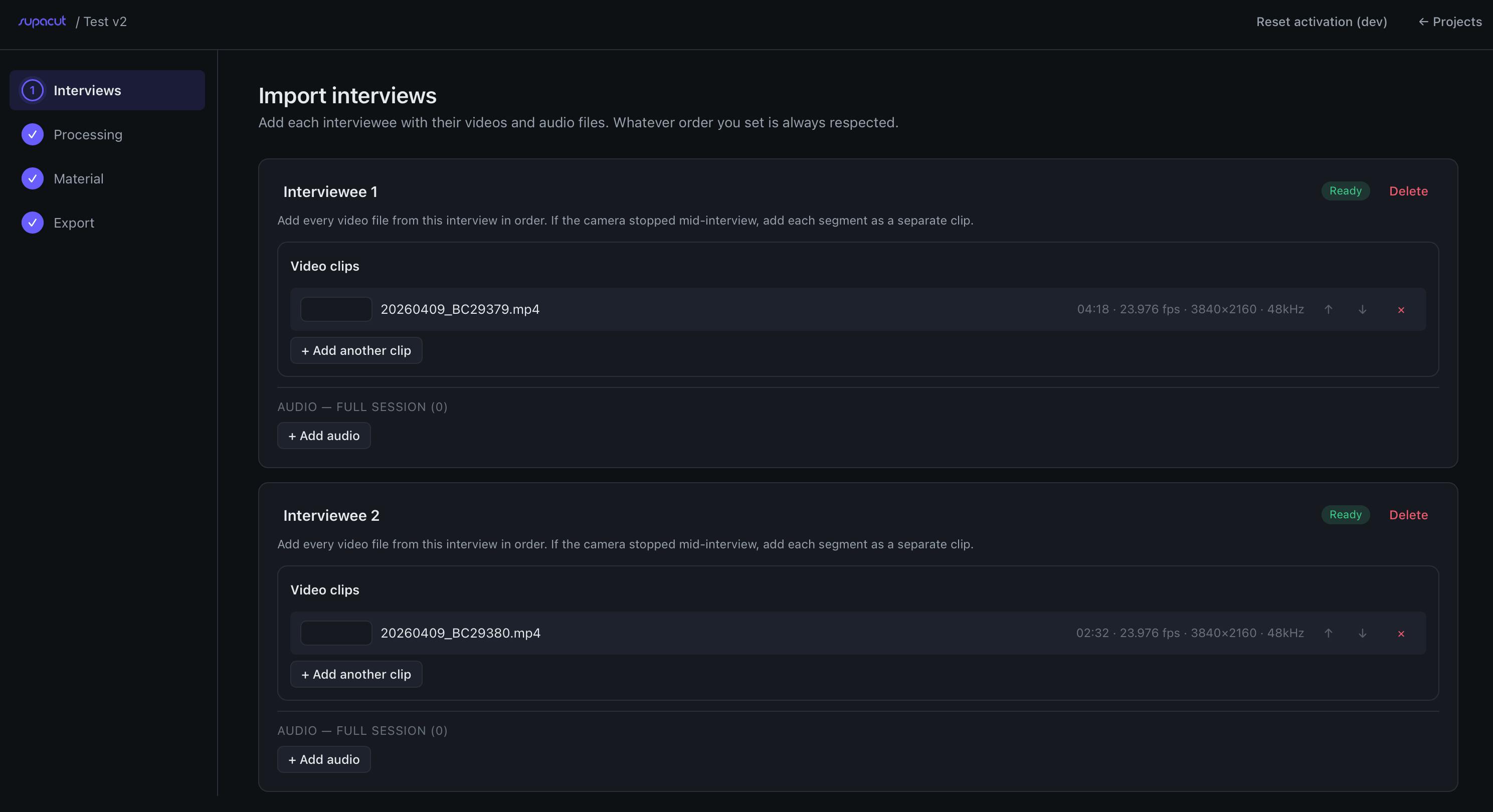
Supacut uses AI to compress hours of interview footage review into minutes and auto-generate editable rough cuts.
Supacut is an AI tool built for documentary and interview editors that compresses hours of footage review into minutes. It automatically identifies key soundbites, organizes clips by theme, compares responses across multiple interviews, and generates a shortlist of selects. It can also propose narrative directions and produce an editable rough cut directly. Crucially, it doesn't try to replace professional NLEs like Premiere or DaVinci Resolve — it handles the front-end organization and hands results back to editors for refinement in their existing workflow.
Supacut: AI Cuts Interview Editing Time from Hours to Minutes
For documentary and interview editors, the most time-consuming part of the job is rarely the editing itself — it's the hours spent rewatching footage, hunting for the best soundbites, and organizing a coherent narrative structure. That's exactly the pain point Supacut is designed to solve. It compresses "hours of footage review" down to "minutes," freeing editors to spend more time telling stories rather than searching for needles in a haystack.
The product earned 75 upvotes and 5 comments on Product Hunt, ranking 16th on its launch day under the Productivity and Video categories. It was built by Jonathan Muia.
What Supacut Actually Does
According to its official description, Supacut's core capabilities revolve around intelligently organizing interview footage. It can review hours of interview recordings in minutes, helping editors accomplish several key tasks: identifying the most compelling soundbites, organizing footage by theme, comparing responses from different subjects across multiple interviews, and compiling a shortlist of selects.
In other words, it automates the most tedious part of documentary editing — the footage organization phase. In a traditional workflow, an editor might spend days rewatching interviews, taking notes, and applying labels. Supacut aims to handle this entire "logging and pre-selection" process using AI.
From Footage Organization to Automated Rough Cuts
Supacut's ambitions go beyond just organizing footage. In addition to assisting with manual selection, it can actively analyze all available material, propose narrative directions, and generate an editable rough cut directly.
This is the product's key differentiator. It's not just a "footage search tool" — it actively participates in the creative act of storytelling. The AI produces a structured first draft, which the editor then refines and polishes. For interview-based and documentary projects, a solid rough cut often determines the efficiency and direction of everything that follows.
A rough cut is the first structural edit in a video post-production workflow, sitting between raw footage organization and the fine cut. It typically contains the full narrative skeleton — which interview clips are selected, the order they appear in, and the general pacing — but details like transitions, audio mixing, and color correction haven't yet been addressed. In documentary filmmaking, a strong rough cut is a critical communication tool between directors, producers, and editors for aligning on narrative direction, and is often a standard deliverable when applying for post-production funding or presenting to broadcasters. Traditionally, building a rough cut requires an editor to fully digest all the footage before manually constructing the structure from experience and story instinct — a process that can take days or even weeks. The core challenge for AI-generated rough cuts is semantic comprehension: it must understand the meaning behind what interviewees are saying, not just match keywords. This is the most critical capability dimension when evaluating Supacut's real-world value.
Complementing Professional Tools, Not Replacing Them
To its credit, Supacut makes no attempt to replace professional editing software. Users can export the organized footage and rough cut results back into their preferred NLE (non-linear editing system — such as Premiere Pro, DaVinci Resolve, or Final Cut Pro) for further refinement.
This positioning — handling front-end triage and handing the results back to professional tools — is refreshingly pragmatic. It acknowledges that AI currently excels at repetitive material processing, while true creative refinement still requires human hands in a mature editing environment. This product philosophy makes it far easier for professional editors to adopt, and significantly lowers the migration cost.
An NLE (Non-Linear Editing system) is the standard working environment for modern professional video post-production. Unlike traditional linear editing — where footage is processed sequentially — NLEs allow editors to randomly access any point in the footage, insert or delete clips at will, and make changes without affecting the rest of the timeline. Premiere Pro, DaVinci Resolve, and Final Cut Pro are the three most dominant NLEs today. They integrate not just video editing, but also color grading, audio mixing, subtitling, and visual effects into a complete post-production pipeline — backed by rich plugin ecosystems and deeply ingrained editor habits. This is precisely why professional editors resist being "replaced" by a single new tool. The more realistic path is integration: working as a plugin, a pre-processing step, or by exporting in compatible formats. By outputting project files or clip lists that NLEs can recognize — rather than trying to handle fine editing within its own interface — Supacut shows a clear-eyed understanding of this industry reality.
Target Users and Value Assessment
Supacut's positioning is crystal clear: it's built for documentary and interview content editors. This type of content shares a common characteristic — large volumes of footage, sparse useful information, and a need to compare and synthesize clips across multiple segments. These are precisely the scenarios where AI-powered semantic understanding and transcript analysis can deliver genuine value.
For creators who regularly handle long-form interviews, oral history projects, or podcast video conversions, Supacut's "thematic organization" and "cross-interview comparison" features could deliver real, tangible efficiency gains. The quality of features like "auto rough cut," however, will need to be validated in real-world projects — whether the AI's proposed narrative direction is actually usable will determine whether this tool saves time or just creates another round of rework.
Closing Thoughts
Supacut identifies a genuine, high-frequency pain point in interview editing, using AI to handle footage organization and preliminary narrative structuring before handing the results back to a professional NLE for further refinement. Its product logic is clear and its positioning is pragmatic — making it a noteworthy attempt in the AI-assisted video creation space. Current public information is primarily based on its Product Hunt listing, and specific details like transcription accuracy, rough cut quality, and language support still await validation from real-world user feedback.
Related articles

Cursor AI Programming in Practice: Build a Student Management System from Scratch in 30 Minutes
A Bilibili creator demonstrates Cursor AI programming: generating a student management system in 30 minutes with natural language. Details on Agent mode, Claude selection, prompt techniques, and thresholds.

Top 20 AI Coding Tools Ranking: From Rock-Solid to Lackluster, a Scored Matrix
Bilibili creator releases top 20 AI coding tools ranking, tiered T0–T4 from rock-solid to lackluster, with Claude Code and Codex tied at T0. This article details the scoring dimensions (capability, reliability, robustness, durability, cost, domestic availability) and tool performances to help developers choose the right AI coding assistant.

Vibe Coding Systematic Tutorial: Master AI-Assisted Programming from Zero
A three-month Vibe Coding tutorial from a Bilibili creator covering Codex, ClaudeCode, and Cursor, from core logic to commercial project practice for beginners.