Superdraft: Using AI to Automatically Discover Customer Email Opportunities

Superdraft uses AI to first spot email timing, then generate on-brand drafts and export HTML.
Superdraft is an AI email marketing tool that appeared on Product Hunt, positioning itself around "when to send" rather than "what to send": AI proactively identifies business moments worth reaching out about—new product launches, completed purchases, approaching anniversaries—then generates a complete draft with copy, images, and layout that users can edit, export as HTML, and send through their existing email platform. It doesn't take over sending, so migration cost is minimal for teams already using ESPs like Mailchimp or Klaviyo, positioning it closer to a lightweight "opportunity engine + content factory." The product is still early-stage, with only 71 upvotes and 4 comments on Product Hunt, and its core logic for judging opportunities hasn't been made public—its actual effectiveness remains to be verified.
In the course of running a business, many good opportunities to reach customers by email often slip away. Superdraft, a new product ranked #17 on Product Hunt, aims to solve this problem with AI: automatically identifying email marketing opportunities and generating on-brand drafts.
What Problem It Solves
One of the core challenges in email marketing isn't that you can't write copy—it's that you don't know when to send. New product launches, a customer completing a purchase, an upcoming anniversary—these are all moments worth reaching out about, but busy operators struggle to catch them all.
Superdraft's approach is to hand the "opportunity identification" step over to AI. According to the official tagline: "Good email opportunities slip by when you're busy running a business. Superdraft spots them and turns them into on-brand drafts"—it doesn't just do content generation, but covers the full chain from opportunity discovery to finished draft.
The Automated Flow from Opportunity Recognition to Finished Draft
The product description outlines three key actions:
- Discover opportunities: AI proactively identifies business moments worth sending an email about;
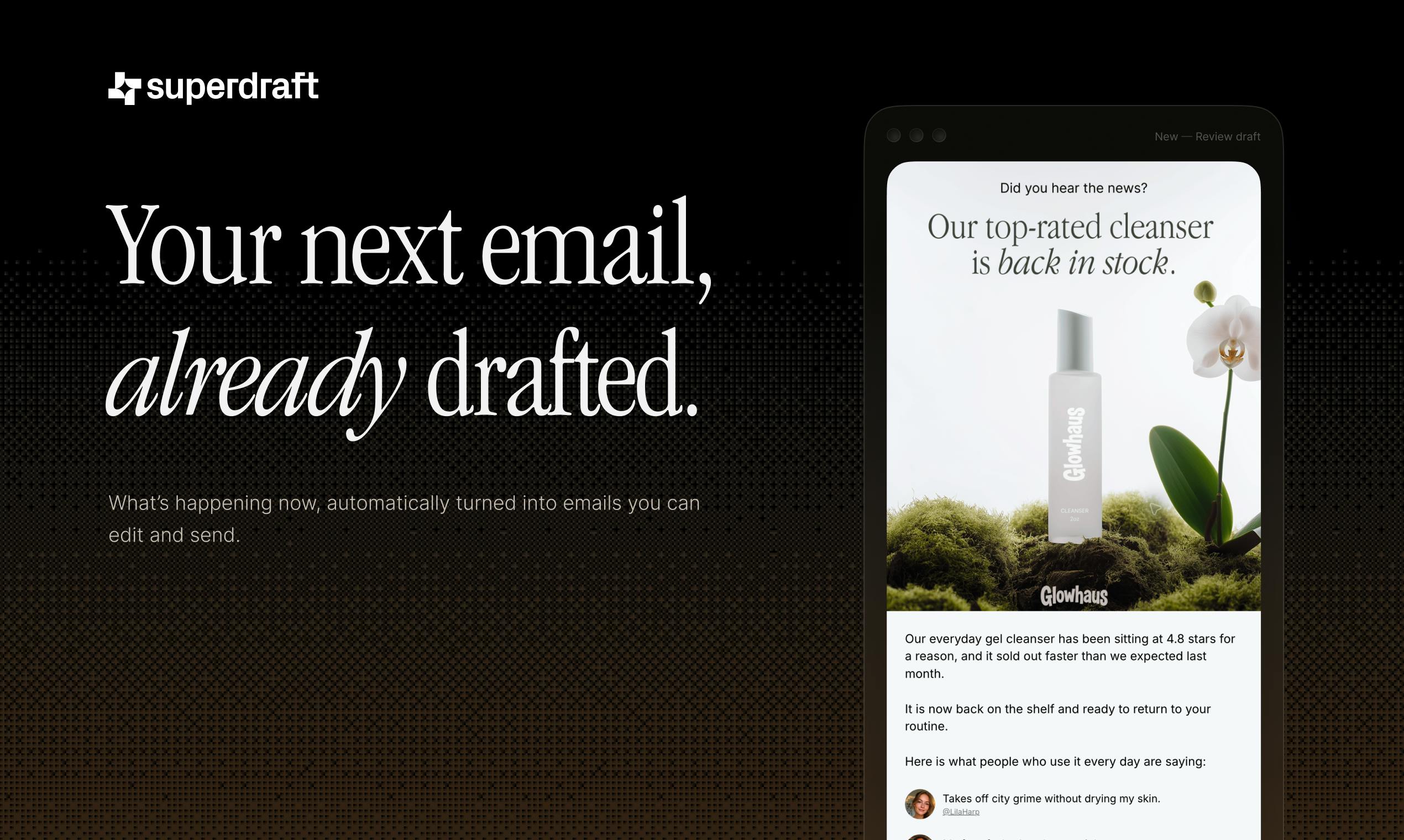
- Generate drafts: automatically produces complete drafts including copy, images, and layout;
- Deliver for use: users can edit, export HTML, and send through their existing email platform.
There's a notable design choice here: Superdraft doesn't try to take over the sending step, but lets you continue using your existing ESP (Email Service Provider). For teams already using tools like Mailchimp or Klaviyo, this means migration cost is essentially zero—it's more like an "opportunity engine + content factory" than yet another marketing platform you need to rebuild from scratch.
The "export HTML" feature also shows it takes the practical workflow into account: the generated draft isn't just for you to look at, but can be embedded directly into your existing workflow.
ESP stands for Email Service Provider, referring to third-party email sending and marketing automation platforms such as Mailchimp, Klaviyo, SendGrid, and HubSpot. These tools typically handle the underlying capabilities: contact list management, template creation, send scheduling, delivery tracking, unsubscribe compliance (e.g., CAN-SPAM, GDPR).
By choosing not to take over sending, Superdraft avoids competing with ESPs for contact data and delivery channels, and instead hands output back to the ESP. This choice has two layers of significance: first, it sidesteps the extremely high engineering and operational costs of email deliverability and anti-spam compliance; second, it lets users avoid migrating their existing subscriber lists, automation flows, and historical data, thereby minimizing adoption cost.
"Export HTML" here refers to generating HTML source code that conforms to email client rendering specifications, not a webpage screenshot or image. Email HTML differs significantly from regular web HTML: it requires heavy inline CSS, because clients like Gmail and Outlook strip out <style> tags and even <head>; it needs to be compatible with table-based layouts that Outlook depends on; and it must handle absolute URLs for image hosting, dark mode adaptation, mobile responsive breakpoints, and more.
Because of this, being able to directly produce usable email HTML is a capability with real barriers—it determines whether a draft is merely something to "look at" or something you can paste into your ESP's template editor and send to your list with one click. This is also why Superdraft emphasizes this feature.
Positioning Thoughts on AI Email Marketing Tools
The email marketing tool space is already quite crowded, and AI writing assistants are everywhere. Superdraft's differentiation lies in putting "when to send" before "what to send."
Most AI email tools start with content generation—you tell it what to write, and it writes it for you. Superdraft flips this: it first tells you "there's an opportunity here," then helps you produce the content. This reordering corresponds to a more fundamental pain point—what operators often lack isn't writing ability, but sensitivity to timing.
Of course, based on currently public information, the product is still at an early stage: 71 upvotes and 4 comments on Product Hunt, with limited information and feature details on its official site. The core question of "how to judge what constitutes an opportunity worth emailing about" isn't elaborated on in the official description—and that is precisely what will determine the product's actual effectiveness.
The email marketing tool space can typically be broken down into several layers: the bottom layer of delivery and compliance (ESP), the middle layer of automated journeys and customer segmentation (such as Klaviyo's flow engine), and the top layer of creative and content production, plus integration with CRM/e-commerce data. Most products compete in automated journeys and segmentation—that is, "who to send to, and which email in the sequence."
Superdraft targets the topmost and most easily overlooked layer—the discovery of trigger timing. This kind of capability depends on awareness of business events (purchases, add-to-cart, membership anniversaries, holidays, inventory changes), and usually requires integration with e-commerce or CRM data sources; otherwise it can only rely on manual user input or a generic calendar. Therefore, the actual effectiveness of "opportunity recognition" depends heavily on which data sources it can connect to, and whether the event judgment rules are user-configurable—this is also the question most worth asking when evaluating such products.
Who It's For
If your team is doing email marketing and your pain points center on "I forget to send" or "I don't have time to make assets," Superdraft's automated chain is worth watching. It strings together opportunity recognition, content generation, and HTML export into one line, which in theory compresses the time from "thinking of it" to "sending it."
But if your needs are deep customer segmentation or complex automated journey design, the tool's current positioning may not be enough—it's more like a lightweight opportunity catcher than a full marketing automation platform.
For small and mid-sized teams with limited budgets and tight staffing, a tool that "reminds you to send that email" is often more practical than a heavy platform that's full-featured but too hard to actually use.
One-line Summary
Superdraft uses AI to first spot email timing, then generate on-brand drafts and export HTML.
Paragraph Summary
Superdraft is an AI email marketing tool that made it onto Product Hunt, positioning itself around "when to send" rather than "what to send": AI proactively identifies business moments worth reaching out about—new product launches, completed purchases, approaching anniversaries—then generates a complete draft with copy, images, and layout that users can edit, export as HTML, and send through their existing email platform. It doesn't take over sending, so migration cost is minimal for teams already using ESPs like Mailchimp or Klaviyo, positioning it closer to a lightweight "opportunity engine + content factory." The product is still early-stage, with only 71 upvotes and 4 comments on Product Hunt, and its core logic for "how to judge whether an opportunity is worth emailing about" hasn't been made public—its actual effectiveness remains to be verified.
Related articles

Uber Deploys ChatGPT Work Company-Wide: AI in the Workplace Enters the Scaled Implementation Phase
Uber deploys ChatGPT Work to 30,000+ employees, extending it from engineering to all roles. We analyze its expert-engineer pairing, end-to-end automation, and questions of AI control and power concentration—insights for scaling AI in the workplace.

Shift at Midnight Hands-On: When "ID Verification" Becomes Alien Hunting
Shift at Midnight blends ID verification with horror survival in a four-player co-op game. We break down its inspection mechanics and chaotic humor.

Zelensky Recounts the Outbreak of War: I Need Ammunition, Not a Ride
Zelensky recalls the first day of war in a YouTube interview: farewell to family, rejecting Biden's evacuation offer with "I need ammunition, not a ride," and how Bucha shaped his stance on compromise and peace talks.