SupportMind AI: Solving AI Customer Support's Context Problem with Persistent Memory

SupportMind AI uses the Hindsight memory framework to give AI customer support persistent, cross-session memory.
SupportMind AI is an open-source proof-of-concept built by an independent developer to tackle traditional AI customer support's "amnesia" problem — the frustrating need to repeat context every new session. By integrating the Hindsight memory framework, it adds a persistent memory layer to the support agent through a four-step loop: receive a message indexed by user ID, retrieve relevant memory from that user's history, feed it as context to an LLM for a response, then save the interaction for future use. Built with Python, Flask, and Hindsight, the app even displays retrieved memories in the UI for full observability. The project's core argument is that truly useful AI agents require a memory mechanism outside the stateless LLM, and customer support — with its natural reliance on long-term context — is the perfect proving ground. The project is open-sourced on GitHub with a demo video.
The "Amnesia" Problem in AI Customer Support
Traditional AI customer support has a well-known frustration: every conversation starts from scratch. The issue a customer already described, the solutions they've already tried, the device model they're using — all of it has to be repeated in a new session. This "goldfish memory" not only degrades the experience, it makes the AI look far less intelligent than it should be.
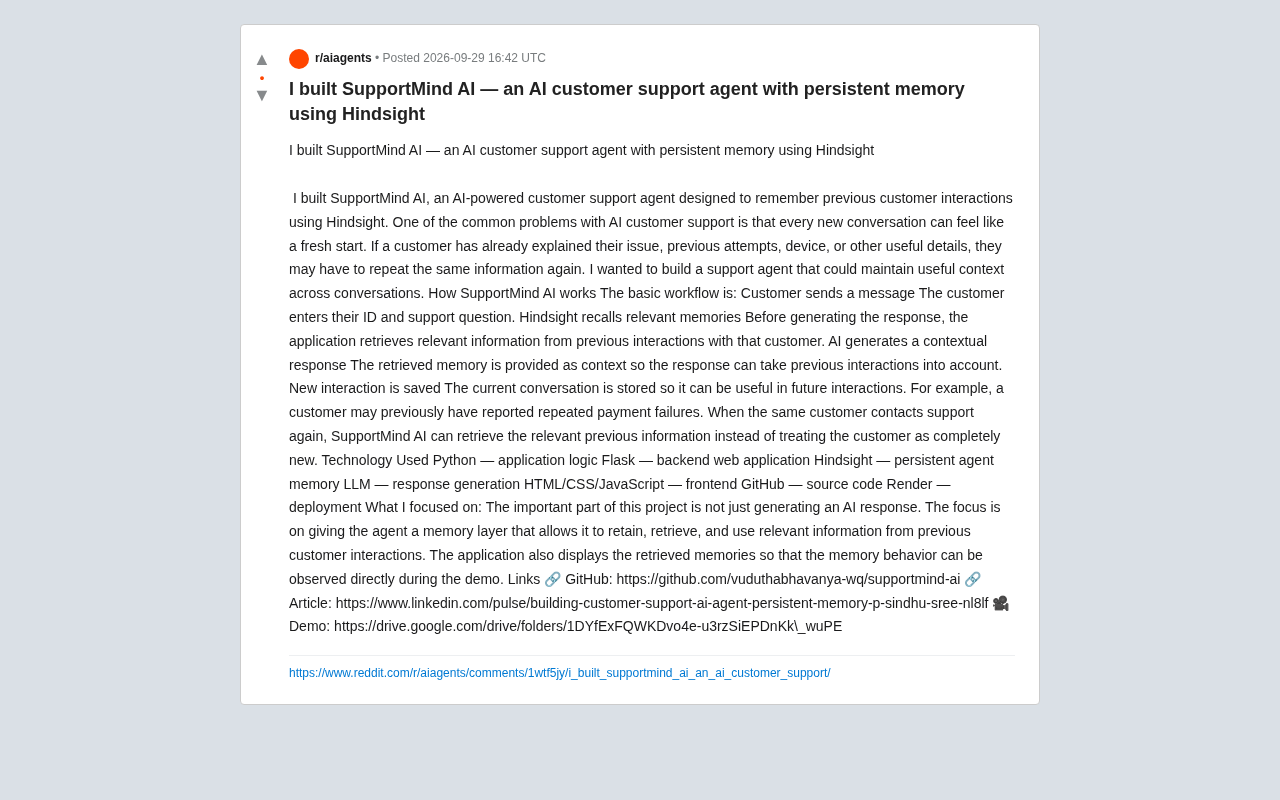
One developer shared their solution on Reddit — SupportMind AI, an AI customer support agent built on Hindsight that features persistent memory. The core goal is straightforward: enable support agents to retain and recall useful context across sessions, rather than treating every customer like a complete stranger.
How the Memory Layer Works
The project author breaks the entire workflow into four clear steps. The logic isn't complex, but it hits the key points precisely.
A Four-Step Feedback Loop
Step 1: The customer sends a message. The user inputs their ID and support issue. The ID becomes the index that links to their memory history.
Step 2: Hindsight retrieves relevant memories. Before generating a response, the application first retrieves relevant information from that customer's interaction history. This step is the soul of the entire system — it determines whether the AI actually "remembers" you.
Step 3: The LLM generates a context-aware response. The retrieved memories are fed to the language model as context, allowing the response to reference previous communications.
Step 4: The new interaction is saved. The current conversation is stored to inform future interactions, forming a continuously accumulating memory loop.
The author gives a concrete example: if a customer previously reported a recurring payment failure, when they contact support again, SupportMind AI can retrieve that history rather than treating them as a brand-new user and asking all the same questions. This kind of continuity is precisely what most AI customer support systems currently lack.
Tech Stack and Implementation Approach
From a technical standpoint, this is a pragmatic, full-stack side project:
- Python handles application logic
- Flask serves as the backend web framework
- Hindsight provides persistent agent memory capabilities
- LLM handles response generation
- HTML/CSS/JavaScript builds the frontend
- GitHub hosts the source code, Render handles deployment
What's worth noting is the author's framing: the focus of this project is not on "generating an AI response" — that's already a solved problem. The real effort is in adding a memory layer to the agent, enabling it to retain, retrieve, and use relevant information from past interactions.
To make memory behavior directly observable, the application also displays retrieved memory content in the UI. This is a thoughtful design detail: during a demo, viewers can literally see what the AI "remembers," rather than treating memory as a black box. This kind of interpretability is crucial for verifying whether the memory system is actually working.
Why Agent Memory Deserves Attention
Zooming out, SupportMind AI touches on a core issue in the current AI agent landscape: memory.
Large language models are inherently stateless — every call starts without context. To give an agent continuity, you must build a memory mechanism outside the model itself, responsible for storing history, retrieving it on demand, and injecting it back into the prompt. This is exactly the problem that memory frameworks like Hindsight aim to solve, and it represents a critical step from simple chatbots toward genuinely useful agents.
Customer support is an ideal testbed for validating memory capabilities because it naturally depends on long-term context: customer profiles, ticket history, device information, and prior solutions are all high-value data that can be reused across sessions. A support system that remembers its customers will significantly outperform one that starts from zero every time — both in efficiency and user experience.
Of course, as a personal project, SupportMind AI is closer to a proof of concept. It doesn't disclose memory retrieval accuracy, performance under high concurrency, or privacy compliance considerations that any production environment would need to address. But it uses a fully functional, observable example to clearly demonstrate the value proposition of a memory-augmented support agent.
For developers looking to get hands-on with agent memory mechanisms, this is a well-structured, approachable reference case. The project is open-sourced on GitHub with a demo video and technical writeup — well worth studying for anyone looking to get started in this space.
Agent memory is typically implemented across several layers: short-term memory (the context window of the current session), long-term memory (persistent storage across sessions), and semantic memory (retrieving relevant history through vector-based search). Frameworks like Hindsight primarily address the latter two — converting historical interactions into structured, retrievable data, then using semantic similarity matching at the start of a new conversation to inject relevant memories into the prompt, effectively working around the fundamental limitation that LLMs cannot preserve state across calls. This pattern is also described as an extension of RAG (Retrieval-Augmented Generation) in agent contexts: the difference being that traditional RAG retrieves from an external knowledge base, while agent memory retrieves from that specific user's own interaction history. This personalized retrieval is especially critical for customer support, since the right solution to the same technical problem can vary dramatically from one customer to the next.
Related articles

Free Unlimited Claude Code Solution: Agnes AI + CC Switch Setup Guide
No paid subscription needed — pair the free AI platform Agnes AI with the open-source tool CC Switch to provide a backend for Claude Code, enabling unlimited free calls to text, image, and video models. This guide covers the full setup, test results, and usage boundaries.

A Complete Zero-Cost Guide to Getting Started with Claude Code for Beginners in China
A beginner's guide to Claude Code for users in China: two installation methods (command line and IDE plugin), full configuration steps for replacing the official API with the free domestic LongCat model, and a hands-on demo of building a small tool with natural language, plus tips.

When the NSA Gets Involved: The AI Supply Chain Crisis Behind Open-Source CVEs and API Key Hijacking
Multiple open-source projects disclosed severe CVEs in one day, PHP flaws alarmed the FBI, and Railway and OpenCode were breached with API keys stolen. This article breaks down the vulnerability window, AI-accelerated exploitation, and the AI supply chain crisis behind the API key black market, with a developer defense checklist.