Supra2-IMG: A 100M-Parameter Open-Source Text-to-Image Model Trained in Under 10 Hours on a Single H100

SupraLabs open-sources a 100M-parameter DiT text-to-image model trainable on a single GPU in under 10 hours.
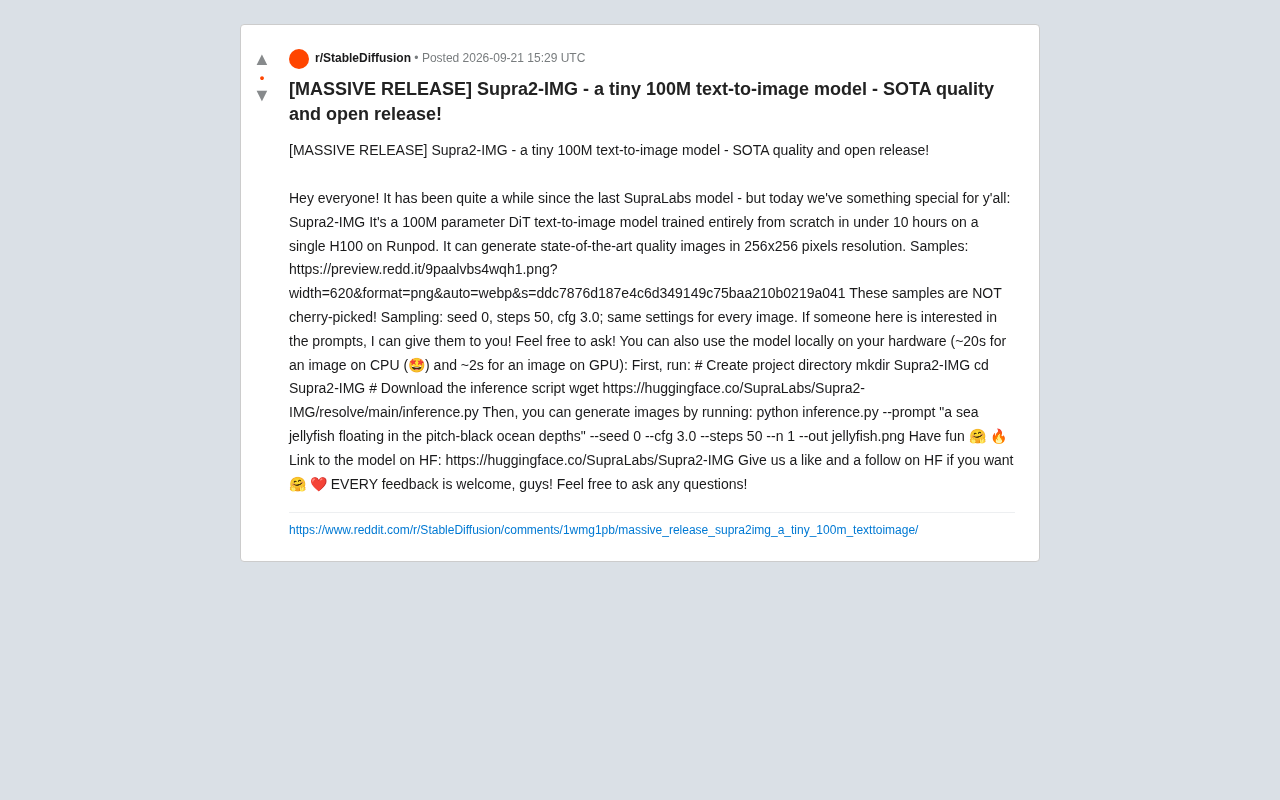
Supra2-IMG by SupraLabs is an open-source text-to-image model built around extreme efficiency — just 100M parameters, trained from scratch on a DiT architecture in under 10 hours on a single H100. It generates 256×256 images with results shown under consistent, non-cherry-picked settings (seed 0, 50 steps, CFG 3.0). Inference requires minimal hardware: ~20 seconds on CPU, ~2 seconds on GPU. Fully open on Hugging Face, it targets research, education, rapid prototyping, and edge deployment rather than replacing large-scale models.
SupraLabs has released Supra2-IMG, a lightweight text-to-image model. With just 100 million parameters and a training cost of under 10 hours on a single H100 GPU, it delivers high-quality image generation at 256×256 resolution — and it's fully open-source. For developers interested in low-cost, reproducible AI generative models, this is a project worth studying.
A Counterintuitive Scale: What Can 100M Parameters Do?
Mainstream text-to-image models routinely run into the billions of parameters — Stable Diffusion, FLUX, and similar models have local deployment requirements that remain steep for most users. Supra2-IMG takes the opposite approach, compressing the parameter count down to 100M while using a DiT (Diffusion Transformer) architecture trained entirely from scratch.
According to the developers, the entire training run completed on a single H100 on the Runpod platform in under 10 hours. What makes this figure significant is that it brings the cost of training a functional text-to-image model within reach of individuals and small teams. Compared to large models that often require hundreds of GPU-days, this "small and fast" approach opens up new possibilities for rapid experimentation and iteration.
What is DiT? DiT (Diffusion Transformer) is an architectural paradigm that brings the Transformer design into diffusion models, proposed by Peebles and Xie in 2022. Traditional diffusion models typically use U-Net as the denoising backbone, whereas DiT replaces that component with a standard Vision Transformer — serializing image patches and passing them through Transformer blocks. This swap offers two key advantages: the scaling laws for Transformers are more mature and predictable, and the unified architecture makes it easier to reuse training techniques developed in NLP. Next-generation models like FLUX and Stable Diffusion 3 both adopt DiT or its variants. Supra2-IMG's choice of DiT as a validation architecture at the 100M scale is therefore meaningful — it effectively stress-tests the lower bound of today's mainstream architecture at an extremely small scale.
Performance and Generation Quality
The model outputs images at 256×256 pixels. The developers emphasize that the sample images shown are not cherry-picked — they were all generated using identical settings: seed 0, 50 sampling steps, and CFG 3.0. This kind of transparency is commendable in the open-source model community, since curated samples often overstate a model's real-world capabilities.
The developers describe the quality as SOTA (state-of-the-art), though this claim should be understood in the context of 100M-parameter-scale models, not as a direct comparison against billion-parameter giants. Achieving strong results at this extremely small scale is the model's core selling point.
What is CFG? CFG (Classifier-Free Guidance) is the core parameter that controls how closely a text-to-image model follows the input prompt. It works by running both conditioned and unconditioned forward passes simultaneously during inference, then amplifying the difference between the two by the CFG scale factor to strengthen the model's response to the prompt. Higher CFG values produce results that adhere more closely to the prompt but may sacrifice diversity and naturalness; values that are too low cause the model to effectively "ignore" the prompt and produce more random outputs. Supra2-IMG uses CFG 3.0 as the default for its demos — lower than the 7.0–9.0 commonly used in Stable Diffusion — suggesting the model maintains semantic alignment under relatively weak guidance, and that higher CFG values may introduce saturation artifacts. The 50-step sampling count is a standard trade-off point between inference quality and speed in diffusion models.
Local Inference: Runs on CPU Too
One of Supra2-IMG's most practical features is its remarkably low inference barrier. According to official benchmarks:
- CPU inference: ~20 seconds per image
- GPU inference: ~2 seconds per image
Being able to generate an image in 20 seconds on CPU alone means users without a dedicated GPU can still run a complete text-to-image pipeline locally. This makes it highly accessible for teaching, prototyping, and resource-constrained environments.
Deployment is straightforward — just a few commands:
# Create project directory
mkdir Supra2-IMG
cd Supra2-IMG

# Download inference script
wget https://huggingface.co/SupraLabs/Supra2-IMG/resolve/main/inference.py
You can then generate images from the command line:
python inference.py --prompt "a sea jellyfish floating in the pitch-black ocean depths" --seed 0 --cfg 3.0 --steps 50 --n 1 --out jellyfish.png
The script supports customizable prompts, random seeds, CFG guidance strength, sampling steps, and output count — covering the essential tuning parameters.
Open-Source Value and Use Cases
The model is hosted on Hugging Face (SupraLabs/Supra2-IMG) and is fully available for download and use. The developers have also offered to share the prompts used for their sample images and are actively welcoming community feedback.
The value of small open-source models like this isn't to replace large models — it's to fill gaps in the ecosystem:
- Research and education: Low training and inference costs dramatically lower the barrier to learning the DiT architecture
- Rapid prototyping: GPU inference in seconds is well-suited for fast-iteration workflows
- Edge deployment: The tiny footprint makes it feasible to run on low-compute devices
The 256×256 resolution and 100M capacity mean it can't compete with large models for high-fidelity commercial image generation. But as a fully reproducible, locally runnable, extremely low-cost open-source project, it demonstrates that "small models can still produce good images" — and provides a useful reference point for future lightweight generative model research.
Summary
Supra2-IMG tells a story about efficiency through a set of striking numbers: 100M parameters, under 10 hours of single-GPU training, and image generation in 20 seconds on CPU. Rather than competing head-on with massive models, it proves viability in the ultra-lightweight category. For developers looking to get started with text-to-image generation at low cost, or those studying DiT architectures, this is an open-source project worth getting your hands on.
Related articles

Free Unlimited Claude Code Solution: Agnes AI + CC Switch Setup Guide
No paid subscription needed — pair the free AI platform Agnes AI with the open-source tool CC Switch to provide a backend for Claude Code, enabling unlimited free calls to text, image, and video models. This guide covers the full setup, test results, and usage boundaries.

A Complete Zero-Cost Guide to Getting Started with Claude Code for Beginners in China
A beginner's guide to Claude Code for users in China: two installation methods (command line and IDE plugin), full configuration steps for replacing the official API with the free domestic LongCat model, and a hands-on demo of building a small tool with natural language, plus tips.

When the NSA Gets Involved: The AI Supply Chain Crisis Behind Open-Source CVEs and API Key Hijacking
Multiple open-source projects disclosed severe CVEs in one day, PHP flaws alarmed the FBI, and Railway and OpenCode were breached with API keys stolen. This article breaks down the vulnerability window, AI-accelerated exploitation, and the AI supply chain crisis behind the API key black market, with a developer defense checklist.