Sure: An Open-Source Personal Finance App Built with Ruby
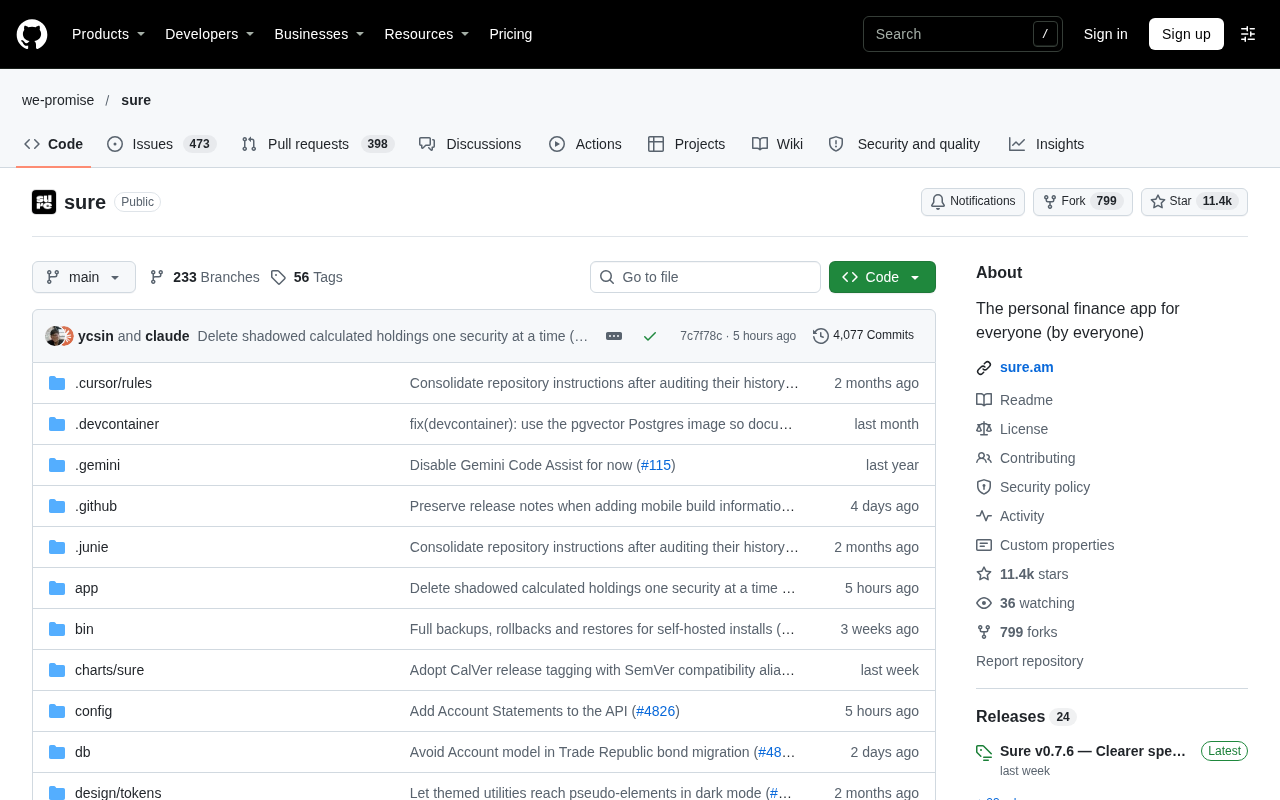
Ruby open-source personal finance app Sure surpasses 10K GitHub stars, sparking interest in the open-source finance space.
The article covers the GitHub popularity of open-source personal finance app Sure: 11,389 total stars, 184 new in a single day, and nearly 800 forks. Written in Ruby, the project aims to cover the full personal finance management chain and emphasizes a "by everyone" community co-building model. The author believes the high fork count indicates developers aren't just bookmarking but have real intent to participate or build upon it, likely due to clear architecture and universal needs. The article also analyzes the natural advantages of open-source finance tools in data privacy and user control, as well as challenges in security and continuous iteration, viewing 11,389 stars as a starting point rather than an endpoint.
Sure: An Open-Source Personal Finance App Built with Ruby
The open-source community never lacks surprises, and a project called Sure has been steadily gaining traction on GitHub recently, adding 184 stars in a single day, surpassing 11,389 total stars and approaching 800 forks. What exactly makes this Ruby-based personal finance app attract so much developer attention?
Not Just Another Bookkeeping Tool
Sure positions itself as "a personal finance app for everyone," and emphasizes "built by everyone." This isn't an empty slogan—based on the project description, Sure attempts to cover the entire chain of personal financial management rather than just providing a ledger. Traditional bookkeeping tools often stop at recording income and expenses, leaving users to analyze data, create budgets, and track asset changes on their own. Sure's approach seems to integrate these steps into a unified platform, shifting personal finance management from passive recording to proactive planning.
The project's Ruby tech stack is also worth noting. In an open-source ecosystem currently dominated by JavaScript/TypeScript and Python, choosing Ruby to build a consumer-facing finance app reflects both the team's technical preference and potentially their emphasis on development efficiency and code readability. For developers familiar with the Rails ecosystem, this undoubtedly lowers the barrier to contributing.
Ruby on Rails is the most mainstream web application framework in the Ruby ecosystem, following "convention over configuration" and MVC architecture, with built-in ORM (ActiveRecord), routing, scaffolding, and other capabilities that can build a fully functional app in a relatively short time. It once drove the development of products like GitHub, Shopify, and Basecamp, though its adoption in new projects has declined in recent years. For a finance app like Sure—where business logic is primarily data modeling and CRUD, and rapid iteration is needed—Rails' development efficiency and code readability remain clear advantages, which is the technical context behind the article's mention of "lowering the contribution barrier."
Signals Behind Community Buzz
With 11,389 stars and 184 new stars in a single day, these numbers aren't top-tier across the entire GitHub ecosystem, but for a vertical finance tool, this level of attention is quite remarkable. What you might not have noticed is the fork count approaching 800—meaning a significant number of developers aren't just "bookmarking" but intend to actively participate or build upon the project.
This depth of engagement usually points to two possibilities: first, the project itself has a clear architecture and comprehensive documentation, giving developers confidence to get started quickly; second, the problems the project solves are universal, and everyone is willing to invest effort to make it better. Judging from the "by everyone" naming suffix, the team is clearly intentional about creating an open, collaborative atmosphere—a key strategy for building community in open-source projects.
Stars and forks on GitHub reflect participation signals of different intensity: stars are closer to "bookmarking/following" with very low cost, easily driven by rankings and social media spread; forks mean users have copied the repository, typically for submitting Pull Requests, local deployment, or secondary development, with a higher participation barrier. Therefore, the fork-to-star ratio can serve as a rough indicator of a project's "willingness to act," but note that forks may also just be copies for self-deployment and don't necessarily translate into code contributions.
Open-Source Opportunities in the Personal Finance Space
Personal finance is a field heavily covered by commercial products, but precisely because of this, user dissatisfaction with data privacy, subscription fees, and feature lock-in has long existed. The value of open-source solutions lies in: users can fully control their financial data, without worrying about data being used for ad targeting or being forced to accept price increases. Sure's timing in entering this space coincides with the awakening trend of users' awareness of "data sovereignty."
Of course, open-source finance apps face obvious challenges too. The sensitivity of financial data requires the project to deliver convincing solutions for security and privacy protection, while the complexity of personal finance means feature iteration requires sustained investment. Whether Sure can translate current community buzz into long-term product vitality depends on how the team balances open collaboration with the stability of core features.
"Data sovereignty" refers to users' control over their own data, including where data is stored, who can access it, and whether it can be exported and migrated. In personal finance scenarios, this means users can choose self-hosted deployment, keeping account and transaction data on their own servers rather than centralized storage by third-party commercial platforms. Open source plus self-hosting is currently the main path to achieving data sovereignty, but it transfers security responsibilities to users: they need to handle encryption, backups, access control, and dependency updates themselves—a cost that must be considered when evaluating such projects.
Reasons to Pay Attention
For developers, Sure is a sample for observing how Ruby performs in modern application development; for ordinary users, it offers a possibility to break free from commercial finance software constraints; for the open-source community, it once again proves that vertical tool projects can still gain considerable attention as long as they find the right positioning. 11,389 stars is a starting point, not an endpoint—the real test is whether the project can find a sustainable rhythm between community participation and product refinement.
Related articles

What Happens When AI Sleeps? Anthropic Agent Memory #TechMalayalam #AgenticAI #ClaudeAI
Starting from Anthropic's Claude and Agent Memory mechanisms, this article explains how AI agents load, organize, and discard memory between sessions, and what self-evaluation loops and note-taking rules mean for developers.
Behind the Nvidia CEO Scandal: The Key Person Risk of AI Infrastructure
Jensen Huang's scandal triggers an independent Nvidia board probe as chip stocks rally and Nvidia falls alone. We break down AI infrastructure's key person risk and how real estate investors can protect deals with a three-step check.
13 Practical AI Tips: Save Money, Protect Privacy, Upgrade Your Digital Life
A roundup of 13 practical AI tips from The Explainer: AI agents for cost-saving negotiations, data deletion requests, Claude Code for computer diagnostics, local offline models, in-car voice learning, and motion pose analysis—with emphasis on human oversight and safety boundaries.