Survival LLM: An Offline Personal AI Emergency Assistant
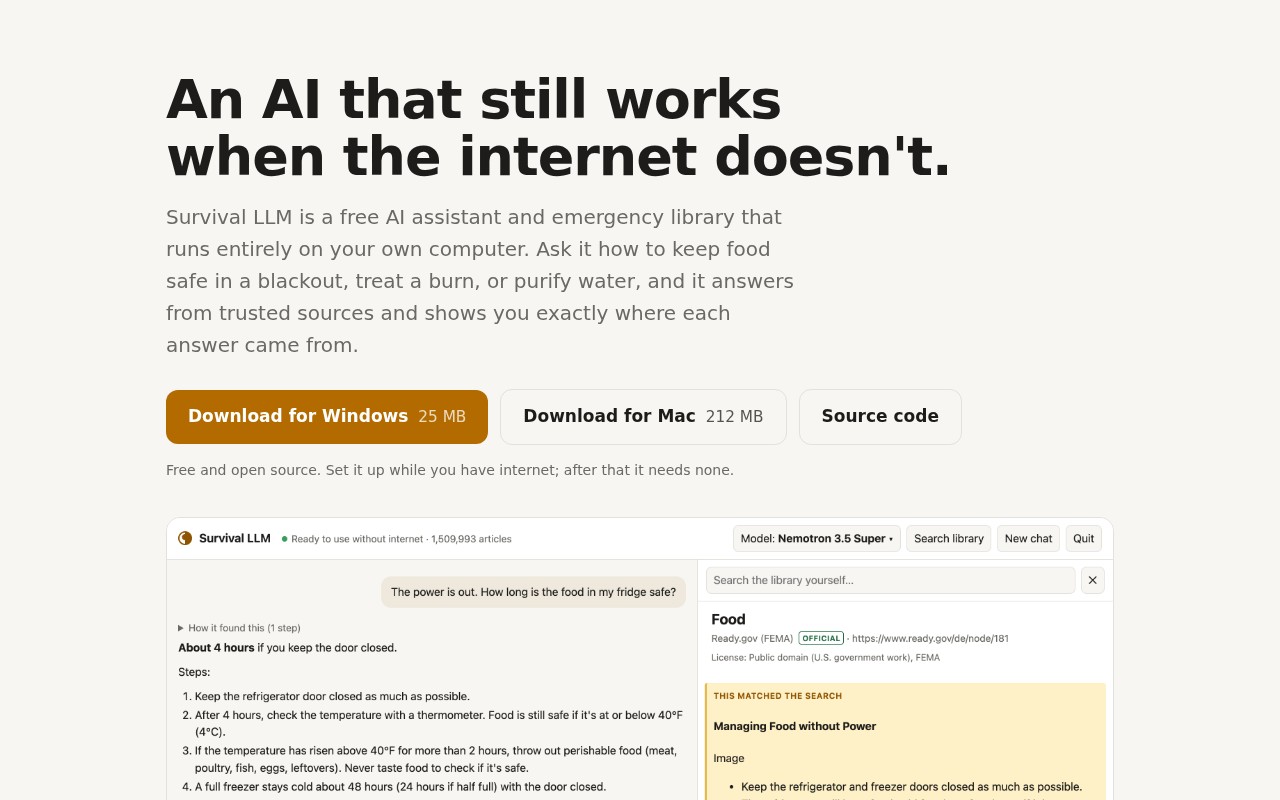
Survival LLM packs an AI assistant and emergency library into a local computer, exploring how AI can exist offline.
Survival LLM is an open-source project that combines a conversational AI assistant with an offline emergency reference library, running all inference locally without cloud APIs or constant connectivity. The article analyzes its core value in providing critical information (medical first aid, repairs, survival) when infrastructure fails, while ensuring privacy. Technically, local inference is constrained by compute and storage, requiring trade-offs between model size and quantization precision, with a capability ceiling below cloud models; the knowledge base needs structured organization for reliability. The article also notes the timeliness contradiction: offline materials can't be updated, raising doubts about long-term usability. Overall, the project reflects the macro trend of AI spreading from centralized cloud services to personally ownable tools, enhancing system resilience.
When the Network Disappears, How Long Can AI Stay With You?
A project called Survival LLM appeared on Hacker News with a rather distinctive positioning: a completely self-hosted AI assistant running entirely on your own computer, also doubling as an offline emergency reference library. It doesn't rely on cloud APIs or require a constant internet connection—even in extreme scenarios like network outages or infrastructure collapse, it can still provide information retrieval and conversational support. The project received 49 points and 29 comments on HN—not an explosive level of attention, but the direction is worth noting.
It addresses a problem that mainstream AI products deliberately ignore: the intelligent assistants we increasingly depend on are precisely the ones most likely to fail when we need them most.
What Problem Does It Actually Solve
Offline-First Design Philosophy
The core idea of Survival LLM is to pack both the model and the knowledge base onto the local machine. Users don't need to send requests to any server—all inference happens locally. This means two things: complete privacy control, and availability that isn't affected by external service status.
From the project's positioning, it's not aimed at casual chat scenarios but at "emergencies"—when power goes out, networks go down, or disasters or infrastructure failures occur, an ordinary computer can still provide critical information on medical first aid, basic repairs, survival knowledge, and more. This forms a sharp contrast with cloud-based AI assistants, which become useless the moment the network goes down.
Dual Identity: AI Assistant + Emergency Library
The project defines itself as an "AI assistant and emergency library"—a combination of a conversational assistant and a structured reference database. The problem with a pure reference library is low retrieval efficiency; it's hard for people under stress to flip through manuals. The problem with a pure conversational assistant is that it may fabricate information. Putting the two together theoretically allows a conversational interface to index trustworthy local knowledge, lowering the barrier to use.
This is also reflected in the HN discussion—one of the commenters' focal points was the reliability and verifiability of information in offline scenarios, rather than how smart the model is.
Technical Approach and Trade-offs
Real Constraints of Local Inference
Running an LLM on a personal computer inevitably runs into compute and storage limitations. Mainstream large models often require tens of GB of VRAM, which ordinary laptops simply can't handle. Therefore, such projects typically need to trade off between model size, quantization precision, and response quality. Survival LLM doesn't promise any performance metrics in its title, which is honest in itself—the value of an offline emergency assistant lies in "having it," not in "being fast" or "being powerful."
Quantization is one of the core techniques for local LLM deployment. It compresses model size by reducing the numerical precision of model weights—for example, lowering weights originally in 16-bit floating point (FP16) to 8-bit integers (INT8) or even 4-bit (INT4). A 7-billion-parameter model requires about 14GB of memory at FP16, which can be compressed to around 4GB after 4-bit quantization, making it runnable on consumer laptops. The cost is precision loss: the more aggressive the quantization, the more noticeable the degradation in reasoning coherence and factual accuracy. Common quantization schemes include GPTQ, AWQ, and the GGUF format used by llama.cpp, the latter optimized specifically for CPU and hybrid inference and a relatively mainstream choice in offline scenarios.
The compute constraint of local inference is also reflected in memory bandwidth rather than raw compute. LLM generation requires passing all weights through for each token, so memory bandwidth often determines actual speed more than FLOPS. This is also why Apple Silicon's unified memory architecture is popular in the local LLM community—CPU and GPU share high-bandwidth memory, allowing medium-sized models to achieve acceptable response speeds.
How the Knowledge Base Is Organized
An emergency reference library needs to cover several domains including medical, communications, navigation, water, and power, and the content must be curated—you can't just package up all the noise from the internet. Structured, offline-searchable knowledge organization is the key differentiator between such projects and ordinary local LLM wrappers.
Retrieval-Augmented Generation (RAG) is a common technical approach for such "conversational indexing of trustworthy materials" projects. Its basic workflow is: first split offline documents into chunks and create vector embeddings, storing them in a local vector database; when a user asks a question, the system retrieves the most relevant chunks and feeds them along with the question into the model, letting the model answer based on these chunks rather than relying solely on parametric memory. The value of RAG lies in decoupling "knowledge" from "the model"—the knowledge base can be independently replaced and audited, and the model only needs to handle language organization, significantly reducing fabrication risk.
The key difficulty of offline RAG is that the embedding model must also run locally, and the recall quality of vector retrieval directly determines answer reliability. Emergency reference libraries typically also adopt a hybrid approach combining keyword search with vector search to handle technical terminology and rare expressions.
Who Needs It, Who Doesn't
Target User Profiles
- Preppers: Those who want to retain an interactive knowledge source without network access
- Privacy-sensitive users: Those unwilling to send query content to any cloud service
- Offline environment workers: Scenarios like wilderness, ships, remote areas
- AI localization enthusiasts: Those with ongoing interest in running models on their own hardware
Unsuitable Scenarios
If what you need is the latest information, complex code generation, or high-quality long-form writing, local small models currently can't handle it. Survival LLM's positioning means it inevitably compromises on general capabilities—treating it as a replacement for your daily primary assistant will disappoint.
The Real Significance of Such Projects
The discussion Survival LLM generated on HN reflects a broader trend: AI capabilities are spreading from "centralized cloud services" to "personally ownable tools." When models can be downloaded, run locally, and carried offline, AI transforms from a rented service into a possession you can hold.
This has real value for resilience. Centralized AI services are fragile in the face of natural disasters, cyberattacks, or policy changes; offline models distributed across every personal computer have no single point of failure. The cost is a lower capability ceiling and higher maintenance burden—but for emergency scenarios, this trade-off is worthwhile.
At the same time, limitations should be recognized. Offline knowledge bases have timeliness issues: once materials are packaged, they are no longer updated, and medical advice and technical specifications may become outdated. For the project to remain usable long-term, it needs to solve the knowledge base version update mechanism, which brings us back to "needing the network." This is a contradiction that hasn't been well answered yet.
System resilience in engineering and infrastructure contexts refers to a system's ability to maintain core functions and recover quickly after disturbances. Distributed, decentralized designs are considered more resilient because they eliminate single points of failure—once a centralized service's data center goes down or the network is interrupted, all terminals depending on it fail simultaneously; when capabilities are distributed across many independent nodes, local failures don't affect the whole.
Applying this idea to AI means capabilities no longer exist only in a few vendors' data centers but can be replicated, carried, and held offline. This aligns with the "appropriate technology" movement and the offline-first software philosophy. It should be noted that resilience typically comes at the cost of efficiency: distributed redundancy means duplicated investment and lower peak capability, which is exactly the situation of offline small models relative to cloud-based large models.
Summary
Survival LLM is not a project that will impress you with its capabilities—its value lies in posing and practicing a question: when infrastructure is unreliable, how should AI exist? In an era where cloud assistants are increasingly powerful, preserving a completely local, offline-runnable path is itself a valuable redundancy design. For users concerned about privacy, resilience, and AI autonomy, this direction is worth continued observation.
One-line Summary
Survival LLM puts an AI assistant and an emergency reference library on a local computer, exploring how AI can exist when networks and power fail.
Paragraph Summary
Survival LLM is an open-source project that gained attention on Hacker News by combining a conversational AI assistant with an offline emergency reference library, with all inference done locally without relying on cloud APIs or constant connectivity. The article analyzes its core value in providing medical first aid, repair, and survival information even when infrastructure fails, while also ensuring privacy control. Technically, local inference is constrained by compute and storage, requiring trade-offs between model size and quantization precision, with a capability ceiling clearly below cloud models; the knowledge base also needs structured organization to ensure reliability. The article also points out the timeliness contradiction: offline materials cannot be updated, raising doubts about long-term usability. Overall, the project reflects the macro trend of AI spreading from centralized cloud services to personally ownable tools, enhancing system resilience.
Related articles
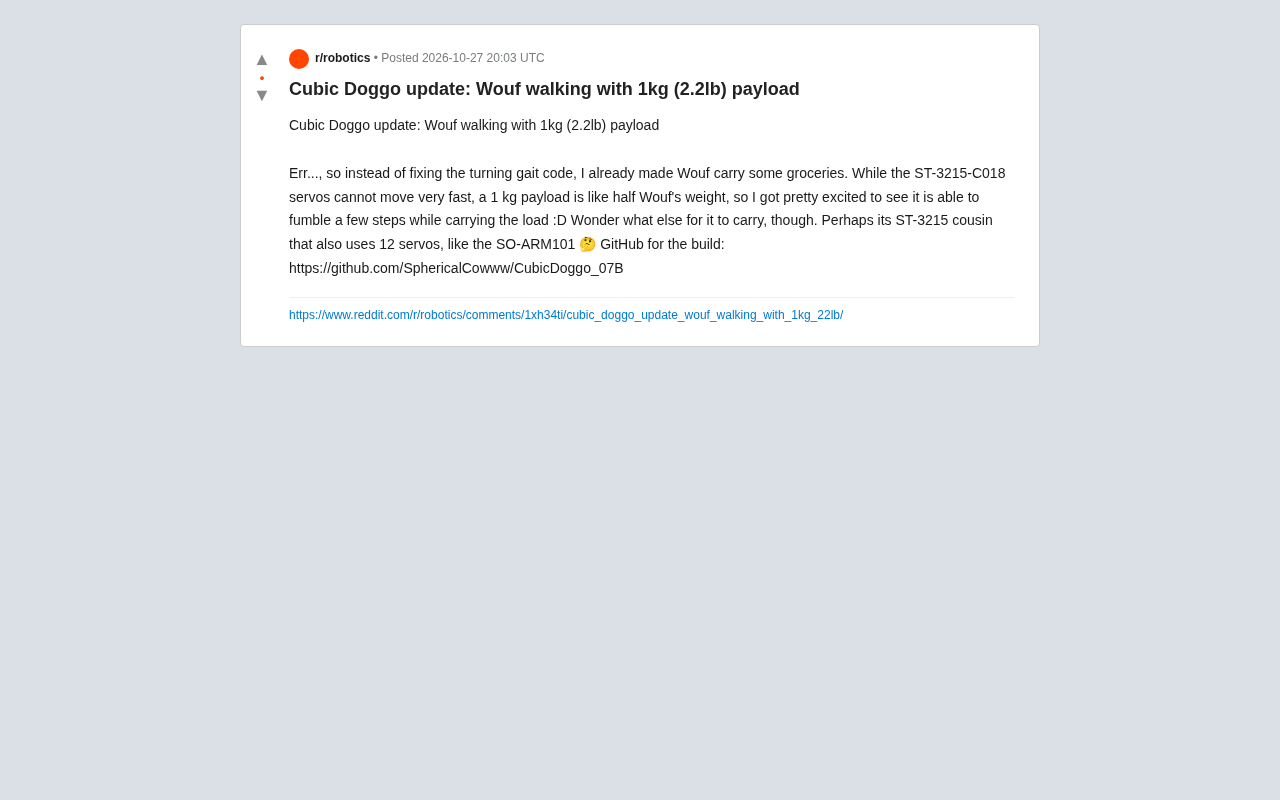
Quadruped Robot Cubic Doggo Load Test: Walking with a 1kg Payload
Open-source quadruped robot Cubic Doggo update: Wouf successfully walks while carrying 1kg, nearly half its own weight. Learn about the ST-3215-C018 servo's performance limits, gait debugging progress, and desktop-level robotics open-source practices.
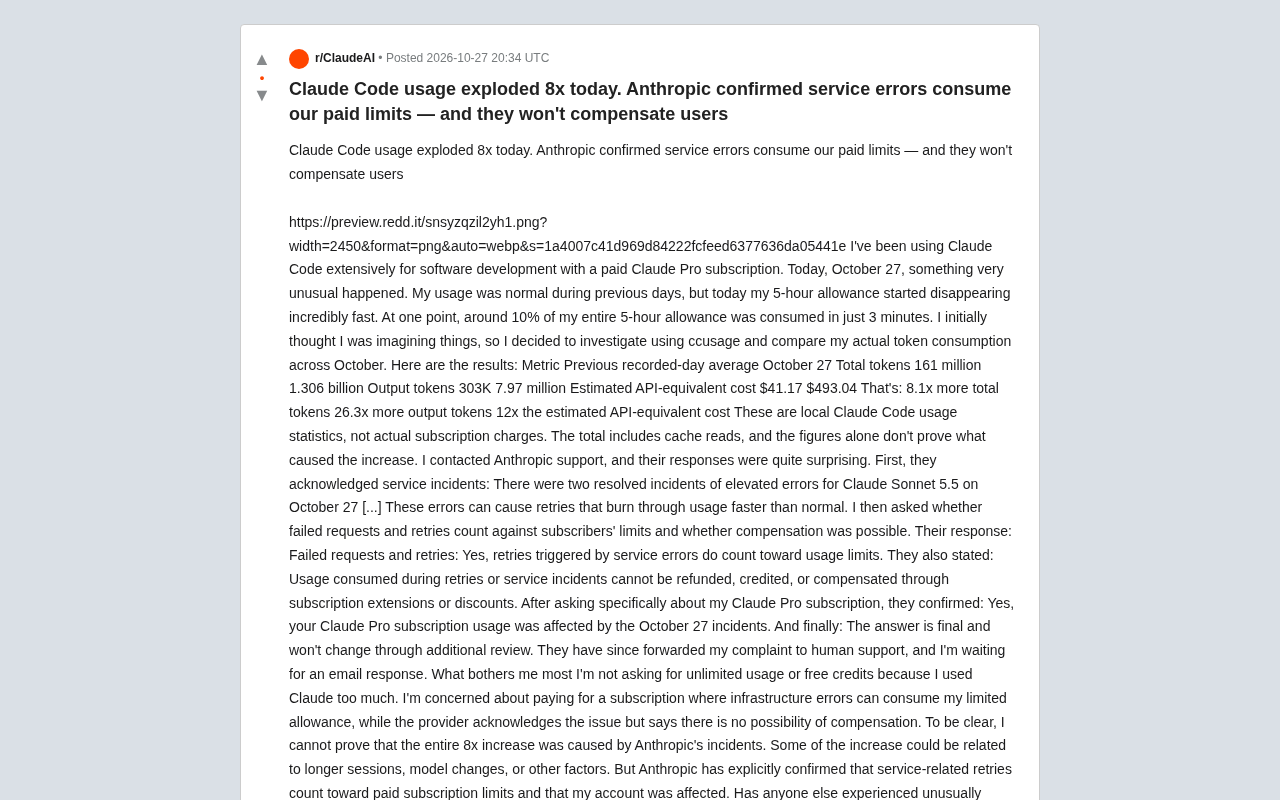
Claude Code Usage Surges 8x: Error Retries Count Against Paid Quota, Anthropic Refuses Compensation
Claude Code usage surged roughly 8x in a single day. Anthropic support confirmed that retries triggered by service errors count against paid subscription quotas and explicitly refused refunds or compensation. This article covers the incident data, the official response, and practical advice for developers.
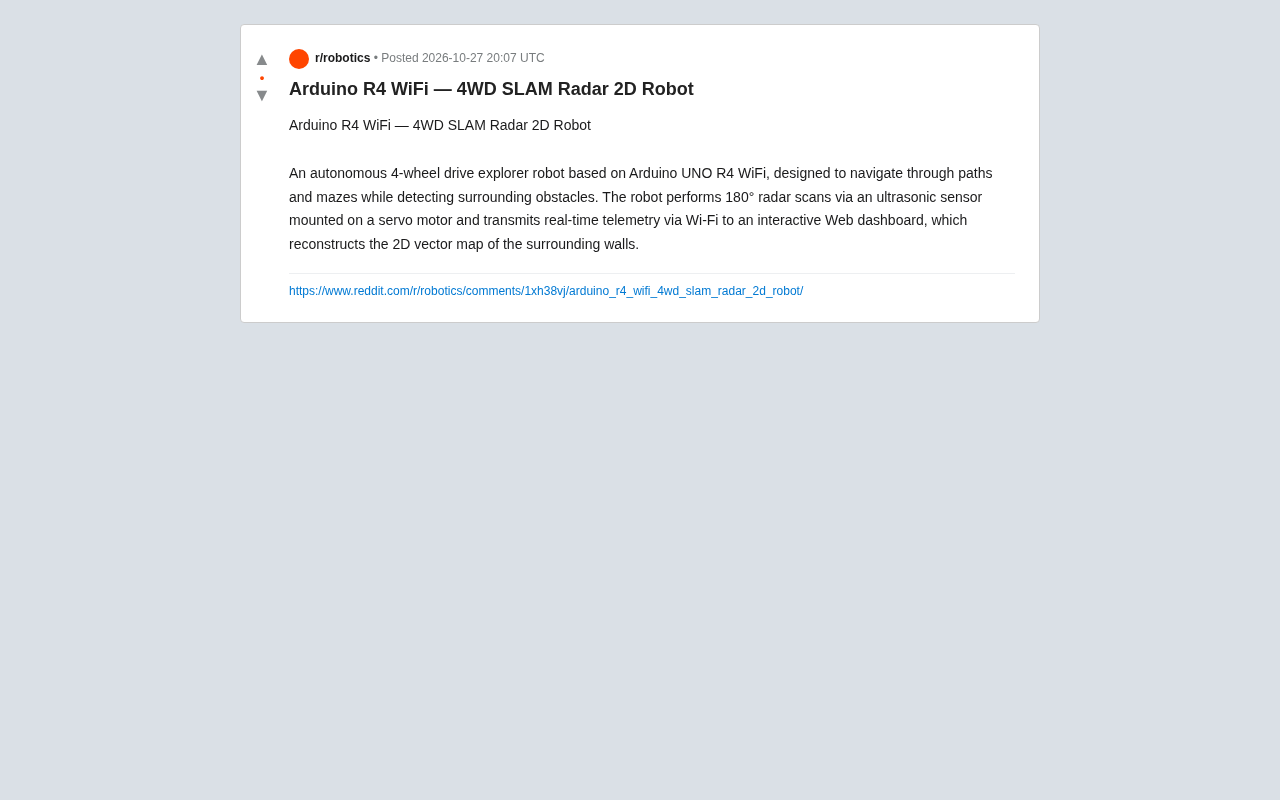
Building a 4WD SLAM Radar Robot with Arduino R4 WiFi
A Reddit maker shares a 4WD SLAM radar robot based on Arduino UNO R4 WiFi: a servo-mounted ultrasonic sensor performs 180° scanning, sends telemetry over Wi-Fi to a web dashboard, and reconstructs a 2D vector wall map in real time—a low-cost entry-level validation of simultaneous localization and mapping.