SvelteKit 3 Released: A Major Update for the Full-Stack Framework

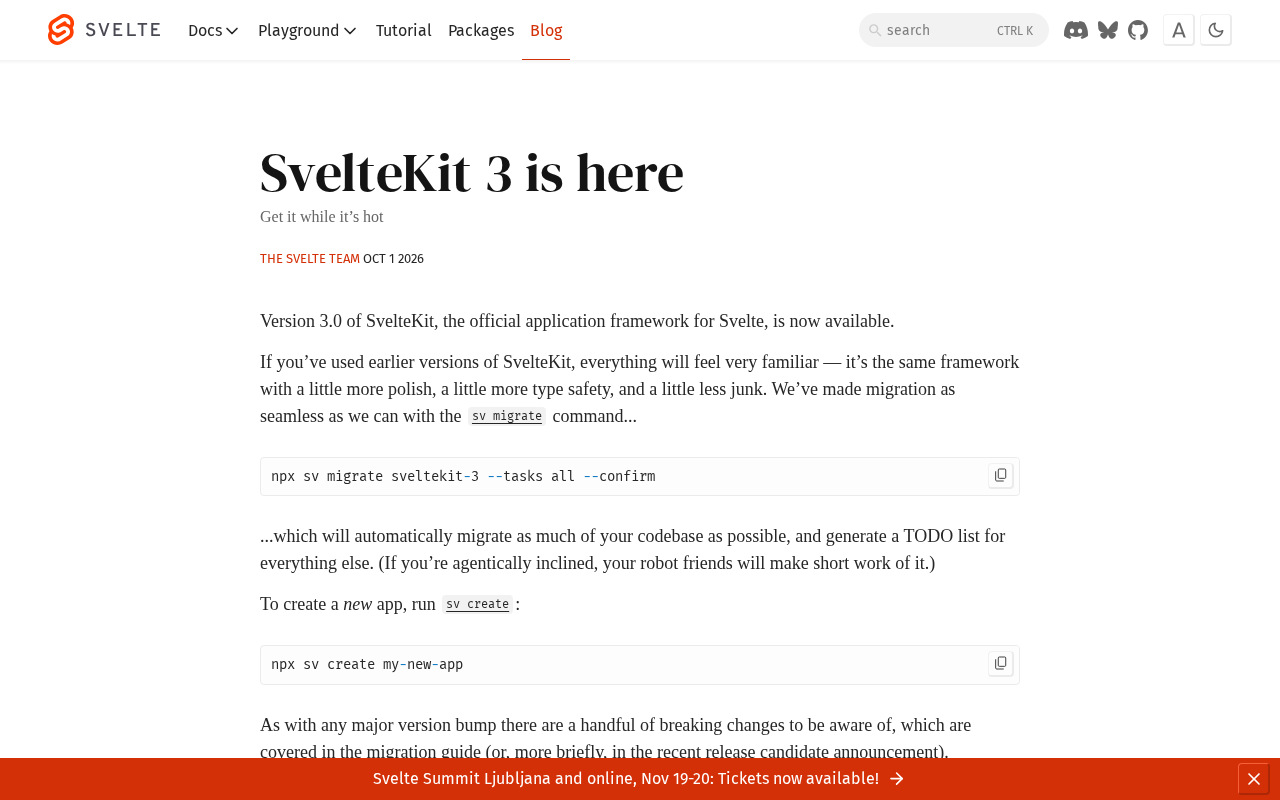
SvelteKit 3.0 launches with a major update to Svelte's full-stack framework, drawing strong developer community interest.
SvelteKit 3.0 is the latest major release of Svelte's official full-stack framework, earning over 250 upvotes and 86 comments on Hacker News. Comparable to Next.js in the React ecosystem, SvelteKit offers routing, SSR, SSG, data loading, and deployment adapters, with compile-time optimization and no virtual DOM as its core strengths. A major version bump typically signals breaking changes in the build toolchain, routing APIs, or reactivity model. Existing users should review official migration docs and verify ecosystem compatibility before upgrading, while new projects can adopt 3.0 directly.
SvelteKit, the official full-stack application framework built on Svelte, has just released version 3.0. The announcement made it to the front page of Hacker News, earning over 250 upvotes and 86 comments — a clear sign that the developer community is paying close attention to this framework's evolution.
Since the available source material is limited (consisting mainly of the release link and community engagement data), this article draws on publicly known information to provide context and analysis around the update, while noting which details readers should verify directly in the official release notes.
SvelteKit's Place in the Frontend Ecosystem
SvelteKit is an application framework built on top of the Svelte compiler — analogous to Next.js in the React ecosystem or Nuxt in the Vue ecosystem. It provides a complete toolkit including routing, server-side rendering (SSR), static site generation (SSG), data loading, form handling, and deployment adapters, all designed to let developers cover both frontend and backend logic within a single codebase.
Svelte has gained significant traction in recent years thanks to its "no virtual DOM, compile-time optimization" philosophy. Rather than shipping a runtime library, Svelte moves most of its work to the compile phase, producing smaller bundles and near-native runtime performance. SvelteKit extends this philosophy to the full application layer, making it a popular choice for small-to-medium projects and early-stage teams.
It's worth unpacking Svelte's "compile-time optimization" and "no virtual DOM" approach a bit further. Traditional runtime frameworks like React and Vue ship a runtime library to the browser, maintain a virtual DOM tree in memory, and use a diffing algorithm to compute the minimal set of DOM mutations on each state change. Svelte takes the opposite approach: at build time, it compiles component code into plain JavaScript that directly manipulates the real DOM, requiring almost no framework code at runtime. This yields two concrete advantages: significantly smaller initial JS bundle sizes (friendlier to low-bandwidth or mobile users), and no runtime diffing overhead (update performance closer to hand-written native code). Svelte 5's runes reactivity model — represented by syntax like $state and $derived — is an architectural rewrite of the original reactivity system, shifting from implicit compiler magic to a more explicit, predictable signals-based mechanism. SvelteKit 3 includes deep integration with this new model.
What a Major Version Bump Signals
From SvelteKit 1.0's general availability to the release of 3.0, consecutive major version increments typically indicate breaking changes in API design, the build toolchain, or the runtime model. For frameworks, major version updates commonly involve changes such as:
- Build and bundling tool upgrades: For example, a major version bump in the underlying Vite dependency.
- Routing or data loading API changes: To improve developer experience or align with new web standards.
- Adaptation to new Svelte features (e.g., the runes reactivity model): Keeping the framework in sync with the core library.
- Enhanced deployment adapters and edge runtime support: Better support for Serverless and Edge environments.
It's important to note that the above points are general inferences based on typical framework evolution patterns. For specifics on new features, breaking changes, and migration paths, the authoritative source is the official SvelteKit 3 announcement on the Svelte blog.
SvelteKit relies on Vite as its dev server and build tool, and this tight coupling directly influences the framework's versioning cadence. Vite is known for its extremely fast cold start times — its core approach is to leverage native ES Modules in the browser during development to load source files on demand, avoiding the performance cost of full bundling in dev mode that traditional tools incur. Whenever Vite releases a new major version (e.g., Vite 4 → 5 → 6), it typically brings plugin API changes or internal configuration restructuring, and upstream frameworks that depend on it (SvelteKit, Nuxt, Remix, etc.) usually need to follow suit. Meanwhile, "deployment adapters" are another key architectural concept in SvelteKit: since different deployment targets (Vercel, Cloudflare Workers, Node.js servers, static CDNs, etc.) have significantly different runtime environments, SvelteKit uses a pluggable adapter layer to abstract away these differences, allowing the same application code to produce optimized output for each platform. Major version releases are often an opportunity to standardize and refine the adapter API as well.
Community Response and Discussion
The release earned 250 points and 86 comments on Hacker News — a notably high engagement level for a technical release announcement. Community discussions like this tend to center on a few recurring themes: whether the migration cost is manageable, whether the new version brings meaningful improvements to performance or developer experience, and how it stacks up against competing frameworks like Next.js, Remix, Astro, and Nuxt.
For developers responsible for real-world projects, the most pressing questions around a major version upgrade aren't usually about flashy new features — they're about whether the migration is smooth, whether ecosystem plugins have caught up, and whether the documentation is solid. Whether the framework team provides clear migration guides and automated tooling at the time of a major release has a direct impact on how quickly the community adopts it.
How Developers Should Respond
For teams already using SvelteKit, a measured approach to the 3.0 upgrade makes sense:
- Start by reading the official migration docs to identify breaking changes and assess the scope of required updates.
- Test the upgrade on a non-production branch and verify your existing test suite passes before moving forward.
- Check ecosystem compatibility, confirming that the adapters, UI libraries, and plugins you rely on already support the new version.
- For new projects, adopt 3.0 from the start to benefit from the latest toolchain and default configuration.
For developers who haven't yet explored the Svelte ecosystem, major version releases like this are a good opportunity to assess framework maturity. A framework that can sustain continuous major version releases while maintaining an active community is generally a signal of a reliable long-term maintenance commitment.
Conclusion
The release of SvelteKit 3 marks another significant step forward for the Svelte full-stack ecosystem. The strong community response reflects the growing influence of this compile-time-first framework. That said, since the available source material covers only the release link and engagement metrics, readers who want specifics on new features and breaking changes should go directly to the official release announcement for authoritative details.
Related articles

Free Unlimited Claude Code Solution: Agnes AI + CC Switch Setup Guide
No paid subscription needed — pair the free AI platform Agnes AI with the open-source tool CC Switch to provide a backend for Claude Code, enabling unlimited free calls to text, image, and video models. This guide covers the full setup, test results, and usage boundaries.

A Complete Zero-Cost Guide to Getting Started with Claude Code for Beginners in China
A beginner's guide to Claude Code for users in China: two installation methods (command line and IDE plugin), full configuration steps for replacing the official API with the free domestic LongCat model, and a hands-on demo of building a small tool with natural language, plus tips.

When the NSA Gets Involved: The AI Supply Chain Crisis Behind Open-Source CVEs and API Key Hijacking
Multiple open-source projects disclosed severe CVEs in one day, PHP flaws alarmed the FBI, and Railway and OpenCode were breached with API keys stolen. This article breaks down the vulnerability window, AI-accelerated exploitation, and the AI supply chain crisis behind the API key black market, with a developer defense checklist.