Swedish Government Bans ChatGPT and Claude: A Turning Point for AI Tool Governance

Sweden bans ChatGPT and Claude on employee computers, citing information security.
The Swedish Government Offices announced a ban starting Monday on using ChatGPT and Claude on government-issued employee computers. The ban applies only to work devices, not personal ones, and is primarily aimed at preventing sensitive information from leaking through external AI services. This makes Sweden one of the earlier countries to explicitly ban specific generative AI products. The article argues that the decision reflects deep-seated anxiety in the European public sector over data sovereignty, involving the legal jurisdiction risks of the U.S. CLOUD Act and the accountability challenges posed by unpredictable AI output. The ban names only two products rather than imposing a blanket prohibition, leaving policy space for other AI tools. Reddit community reactions are divided, highlighting the fracture in societal trust in AI.
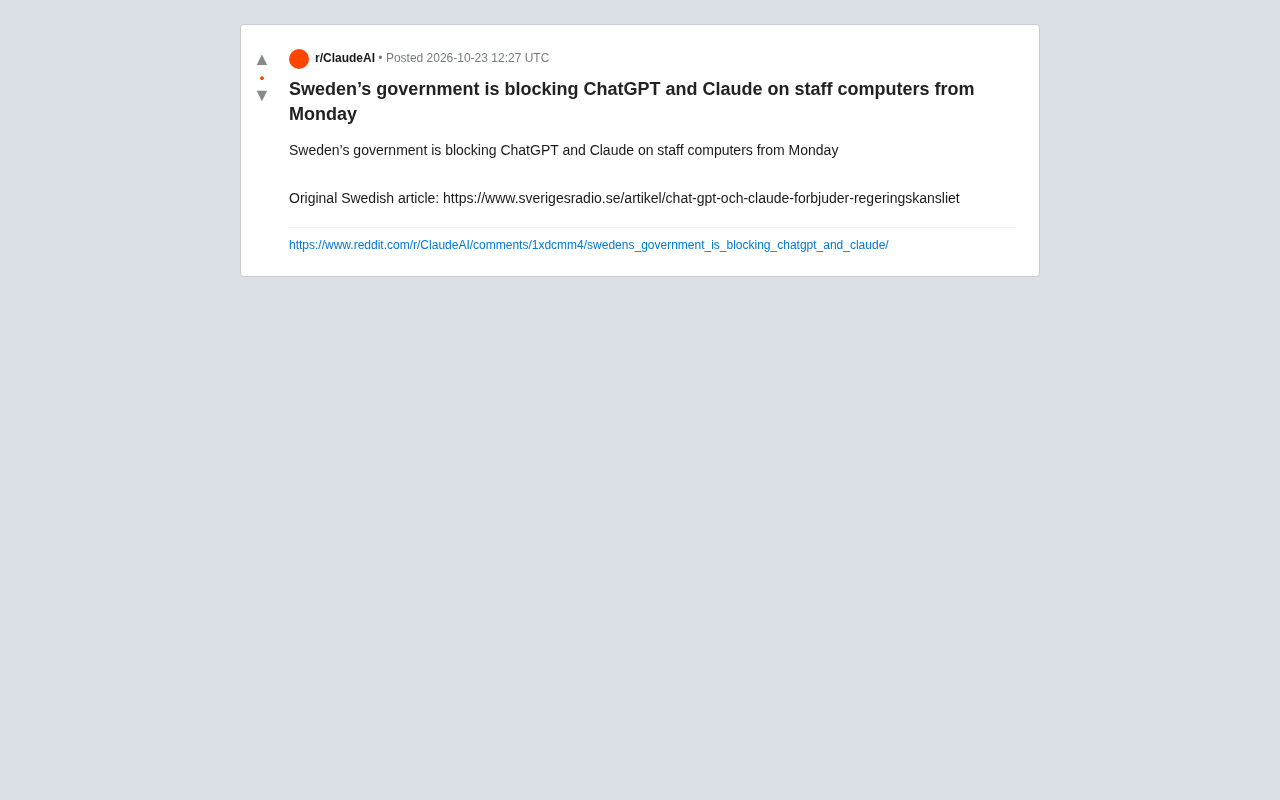
The Swedish government has announced a ban on using ChatGPT and Claude on employee computers, citing information security concerns. This decision was first reported by Sveriges Radio and subsequently sparked widespread discussion in communities such as Reddit. As one of the first countries globally to explicitly ban specific generative AI products on government office devices, Sweden's move is not only about data security but also reflects the cautious stance of the public sector amid the AI wave.
Details of the Ban: Scope and Enforcement
According to the original report, the Swedish Government Offices (Regeringskansliet) have decided to prohibit the use of ChatGPT and Claude on government-issued employee computers starting Monday. This ban covers all staff but does not apply to personal devices. It remains unclear whether the ban is permanent or temporary, nor whether similar measures will be taken against other AI tools.
The Sveriges Radio report noted that the government's move is primarily driven by information security considerations. Government office computers may contain sensitive information, and entering such information into external AI services poses a leakage risk. Although OpenAI and Anthropic, the developers of ChatGPT and Claude, both offer enterprise-level privacy protections, government agencies evidently consider the risk unacceptable.
It is worth noting that the ban names only two specific products rather than imposing a blanket prohibition on all generative AI tools. This may indicate that the government is open to other AI tools internally (such as Microsoft Copilot or locally deployed models), or it may simply reflect regulation lagging behind technological development.
Regeringskansliet (Swedish Government Offices) is the core administrative body of Sweden's central government, responsible for providing administrative support and policy coordination to the Prime Minister's Office and various government departments. It is not a single department but a joint office system encompassing about 10 ministries with thousands of employees. The agency handles a large volume of sensitive documents related to national security, diplomacy, and citizen privacy, so its IT equipment security standards have historically been strict. Understanding the functions and scale of this institution helps assess the actual coverage of the ban: it affects the central nervous system of Sweden's administrative system, not peripheral departments.
Enterprise-level privacy terms of Claude and ChatGPT are also a prerequisite for understanding the controversy. Both OpenAI and Anthropic offer enterprise-facing APIs or team versions that promise not to use customer data for model training and provide Data Processing Agreements (DPAs). However, government agencies typically require additional safeguards, such as data residency options, third-party audit reports, and explicit legal jurisdiction clauses. These enterprise-level commitments may be sufficient from a commercial client's perspective, but in the eyes of a sovereign government, they still cannot fully eliminate the legal risks of cross-border data flows.
Data Sovereignty and Public Sector AI Anxiety
The Swedish government's decision is not an isolated event. In recent years, many European countries have taken an increasingly conservative stance on the use of generative AI in the public sector. Regulators in Germany, France, and Italy have investigated or temporarily restricted ChatGPT. Sweden's ban further demonstrates that even in highly digitized countries, government agencies remain wary of cloud-based AI services.
The core of this anxiety lies in data sovereignty. Government data involves citizen privacy, national security, and diplomatic secrets. Once transmitted to overseas servers via API, it may be subject to foreign laws (such as the U.S. CLOUD Act). Although OpenAI and Anthropic promise not to use API data for model training, government agencies often demand greater transparency and control.
Another key factor is the unpredictability of AI output. If government employees rely on ChatGPT to generate official documents or analytical reports, they may introduce factual errors or biases, and accountability becomes difficult to define. Sweden's ban may be intended to push internal development of stricter AI usage guidelines rather than simply rejecting the technology.
The U.S. CLOUD Act is key background for understanding government data sovereignty anxiety. Passed in 2018, the Clarifying Lawful Overseas Use of Data Act allows U.S. law enforcement agencies to require American tech companies to hand over data stored on overseas servers through search warrants. This means that even if the Swedish government's data is physically stored in European data centers, as long as the service provider is an American company (such as OpenAI or Anthropic), it could theoretically be subject to U.S. law. For government agencies handling citizen privacy and national security information, this legal uncertainty constitutes a substantive risk. This is also one of the important motivations behind the EU's push for the General Data Protection Regulation (GDPR) and subsequent data localization legislation.
The EU AI Act provides the regulatory framework context for this event. The Act, which formally took effect in 2024, adopts a risk-based classification approach, categorizing AI applications into four tiers: unacceptable risk, high risk, limited risk, and minimal risk. AI tools used by government agencies that involve public service decisions, law enforcement, or border management are likely to be classified as high-risk, requiring stricter data governance, transparency, and human oversight requirements. Although Sweden's ban does not directly cite the Act, it reflects the trend of member states proactively tightening internal AI use on the eve of the Act's implementation.
Impact on the AI Industry and the Workplace
From an industry perspective, Sweden's ban sends a contradictory signal. On the one hand, government agencies will become more cautious in procuring and using AI tools, which may push AI vendors to strengthen privacy protections and localized deployment solutions; on the other hand, the ban may also slow the pace of efficiency improvements in the public sector, given that AI's advantages in document processing, translation, and data analysis are obvious.
For professionals, this event reminds us that the boundary of AI tool usage is shifting from "can we use it" to "should we use it." When entering work content into AI, employees need to assess data sensitivity and compliance risks. Sweden's approach may become a reference template for other public institutions, especially as the EU AI Act is gradually implemented.
Reddit community discussions on the matter also show divergence. Some users believe the government is overreacting and missing opportunities to boost productivity; others support the ban, emphasizing that the consequences of government data leakage would be catastrophic. This divergence precisely reflects the fracture in society's trust in AI.
Localized deployment and Privacy-Enhancing Technologies (PETs) are the technical foundation for the "more balanced path" mentioned at the end of the article. Localized deployment refers to running AI models on an organization's own servers or private cloud, keeping data within borders and thereby avoiding the legal risks associated with third-party services. Privacy-enhancing technologies include differential privacy, federated learning, and homomorphic encryption, which allow model training or inference without exposing raw data. For government agencies, while these solutions have higher costs and operational complexity, they can meet data sovereignty requirements while retaining AI's efficiency advantages. The long-term effect of Sweden's ban may well be to accelerate the adoption of such compliant AI infrastructure in the public sector.
Conclusion: Caution Is Not the Endpoint
The Swedish government's ban is a landmark event in public sector AI governance. It is neither a wholesale rejection of AI nor a simple technological exclusion, but a trade-off among data security, compliance, and efficiency. In the future, as localized AI solutions and privacy-enhancing technologies mature, government agencies may find a more balanced path. Until then, the absence of ChatGPT and Claude on Swedish government computers will remain a case worth continued observation.
One-line Summary
The Swedish government has banned the use of ChatGPT and Claude on employee computers, citing information security concerns.
Paragraph Summary
The Swedish Government Offices announced a ban starting Monday on using ChatGPT and Claude on government-issued employee computers. The ban applies only to work devices, not personal ones, and is primarily aimed at preventing sensitive information from leaking through external AI services. This makes Sweden one of the earlier countries to explicitly ban specific generative AI products. The article argues that the decision reflects deep-seated anxiety in the European public sector over data sovereignty, involving the legal jurisdiction risks of the U.S. CLOUD Act and the accountability challenges posed by unpredictable AI output. The ban names only two products rather than imposing a blanket prohibition, leaving policy space for other AI tools. Reddit community reactions are divided, highlighting the fracture in societal trust in AI.
Related articles

LLaMA-Factory in Practice: A Complete No-Code Guide to Fine-Tuning Large Models
An introduction to LLaMA-Factory, the open-source fine-tuning tool: its 60.1K-star background, supported models and algorithms, local vs. cloud deployment, and CUDA setup steps.

Zeng Ming's Deep Retrospective: Why OpenAI May Not Be the Ultimate Winner — and Why the Corporate System Will Disappear
Zeng Ming's deep retrospective on the AI endgame: model companies are just infrastructure, OpenAI and Anthropic won't be the final winners; the next battle is the Agent entry point standard; the corporate system will disappear as AI restructures collaboration, and only mission-driven companies can survive the cycle.

OpenHands v1.28.0: OpenCode and PI Added as Built-in Agents, API Keys Requestable In-Conversation
OpenHands ships 5 releases in 21 days: v1.27.0 adds OpenCode and PI as built-in agents, v1.28.0 enables in-chat key requests. ACP integration, credential reuse, model list changes, and upgrade advice.