Syllaby AI Avatar 2.0: Generate Your Custom AI Avatar Video in Seconds

Syllaby AI Avatar 2.0 converts scripts into complete AI avatar videos with voice, B-roll, and captions in seconds.
Syllaby AI Avatar 2.0 is an AI video generation tool for content creators and marketing teams that automatically transforms text scripts into complete talking-head videos featuring AI avatars, synthesized voiceover, B-roll footage, and captions — no actors or cameras needed. The 2.0 update focuses on custom avatar creation and faster generation speeds, letting users build their own AI likeness rather than relying on preset templates. It debuted at #10 on Product Hunt with 89 upvotes, though user feedback remains limited and its "hyper-realistic" avatar claims still need real-world validation. Its main competitive advantage lies in end-to-end workflow integration, making it best suited for budget-conscious SMBs and individual creators looking to produce video content at scale.
Turn a Script into a Talking-Head Video in One Step
Syllaby AI Avatar 2.0 debuted at #10 on Product Hunt's daily rankings, earning 89 upvotes. Its core promise is straightforward: take a script or a simple idea and transform it into a polished video featuring a hyper-realistic AI avatar — complete with natural voiceover, B-roll footage, and captions — no actors, no studio rental, no camera equipment required.
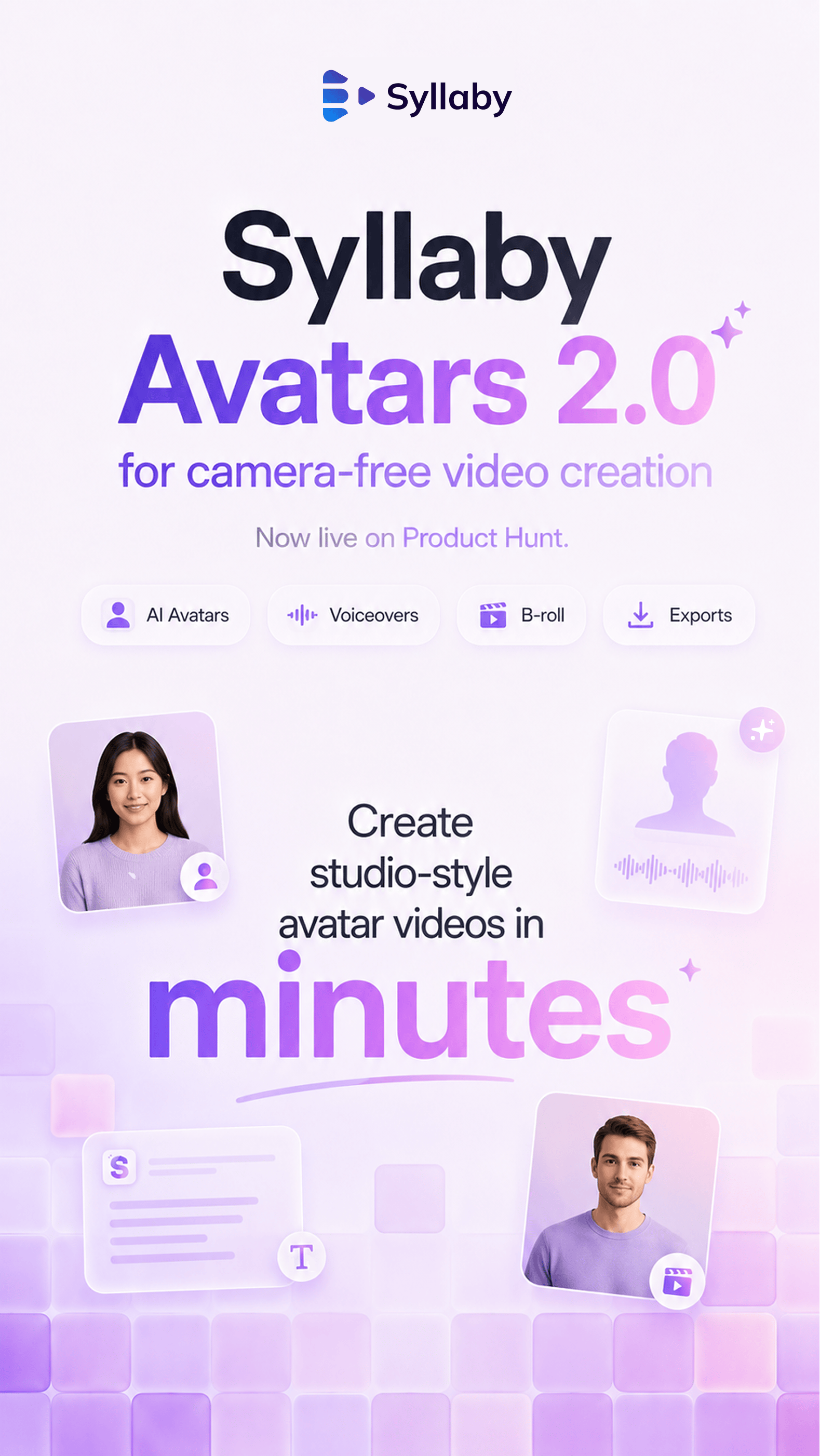
For individual creators and small-to-medium business marketing teams, video production has always carried a high barrier to entry: casting talent, setting up scenes, and handling post-production all eat into time and budget. Syllaby compresses that entire pipeline into a single text input — and that's precisely the underlying logic driving the rapid rise of AI talking-head tools over the past two years.
What Problem Does It Actually Solve
End-to-End Automation from Script to Finished Video
Syllaby sits at the intersection of Marketing, SaaS, and Artificial Intelligence. Unlike tools that focus solely on AI voiceover or standalone avatar generation, it aims to close the full loop: text → voice → avatar video → B-roll → captions.
That means users don't have to shuttle assets between multiple tools. Write a script, pick an AI avatar, and the system automatically synthesizes the talking-head footage, matches background B-roll, and generates captions. For teams that need to churn out marketing shorts, product explainers, or social media content at scale, this all-in-one experience can significantly cut production costs.
What the 2.0 Upgrade Signals
The "2.0" branding and the headline feature "Create Your Own Avatar In Seconds" suggest this iteration is focused on two things: custom avatar creation and generation speed. Letting users build their own AI likeness — rather than just picking from preset templates — is a critical capability for differentiation and brand consistency. And delivering that in seconds directly impacts how efficient the tool feels in real-world use.
The core technical challenge behind custom AI avatars is extracting a user's facial features, skin tone, and expression patterns from a small set of reference images or videos, then binding those characteristics to a drivable 2D or 3D character model. Early players in this space (like HeyGen and Synthesia) typically required users to record a several-minute consent video as training material, with generation times ranging from minutes to hours. Syllaby's claim of "seconds" suggests it may be using a lighter-weight feature extraction approach or a heavily pre-trained base model — trading some degree of personalization precision for speed. In marketing contexts, that's often a reasonable tradeoff: brands need something that "looks human and aligns with the brand," not a pixel-perfect recreation of a real person.
Who It's For — and Who It's Not
Based on the feature set, Syllaby's target audience includes:
- Content creators who need to produce talking-head videos frequently but prefer not to appear on camera;
- Marketing and growth teams producing product demos, ad creatives, and social media clips at scale;
- Small and medium-sized businesses without dedicated video teams who want a low-cost path to branded content.
For projects that demand high production value, authentic emotional expression, or complex cinematography — think brand documentaries or emotionally driven ads — AI avatars still can't fully replace human talent. That's a ceiling the entire AI talking-head category faces, and Syllaby is no exception.
Positioning Within the Competitive Landscape
AI avatar video generation isn't a new category — there are already several established players in the market. Syllaby's competitive edge lies more in workflow integration: by folding B-roll matching and caption generation into the automated pipeline, it reduces the post-production burden on users. In a space where differentiation is increasingly difficult, whoever can shorten and smooth the path from "idea to finished video" will have an easier time retaining non-professional users.
That said, some perspective is warranted: the product had only 1 comment on Product Hunt at the time of writing, meaning real user feedback is still sparse. Claims like "hyper-realistic avatars" and "natural voiceover" still need hands-on validation — lip-sync accuracy, prosody naturalness, and B-roll relevance are the kinds of details that ultimately determine whether a finished video is actually usable.
Competitors in the AI talking-head space generally fall into two camps. The first — Synthesia and HeyGen — emphasizes enterprise-grade avatar customization and multilingual dubbing, with higher price points targeting teams with real budgets. The second — D-ID and Runway — leans toward creative generation and dynamic visual effects. Syllaby's differentiating angle is bundling automatic B-roll matching and caption generation into the product itself, making it feel more like a "complete video production tool" than a pure "avatar generator." B-roll refers to supplementary footage intercut with the main presenter shot, used to add visual variety and reduce viewer fatigue from a single talking head. Auto-generated captions directly affect watchability in the silent-autoplay environments common on social platforms. Whether these two capabilities truly deliver out-of-the-box, with accurate relevance, is the key metric for judging Syllaby's workflow integration value.
Takeaway
Syllaby AI Avatar 2.0 represents a snapshot of how AI video generation tools are evolving toward full end-to-end automation. It's not just generating a face that talks — it's attempting to deliver a complete, publish-ready video. For content teams working with limited budgets and a need for efficiency, tools like this offer a genuinely viable alternative path. But its real-world performance, the flexibility of avatar customization, and the consistency of output quality still need more user case studies to support a definitive judgment.
This article is based on publicly available information from the Product Hunt product page. Actual feature performance should be verified through official hands-on testing.
Related articles

M&M's Spent Millions Replacing Artificial Blue Dye — Why Is It So Hard?
Mars spent millions trying to replace artificial blue dye in M&M's with spirulina, but thick material clogs pipes and residue risks mold, forcing a full production-line rebuild. Here's the engineering behind the reformulation.
Teammate Wanted for Meta Global AI Developer Hackathon: Computer Vision & Medical AI
A Reddit developer seeks teammates for the Meta Global AI Developer Hackathon, focusing on computer vision and medical AI. This article analyzes the track logic, skills-complementarity needs, and topic selection strategy behind this teaming signal.
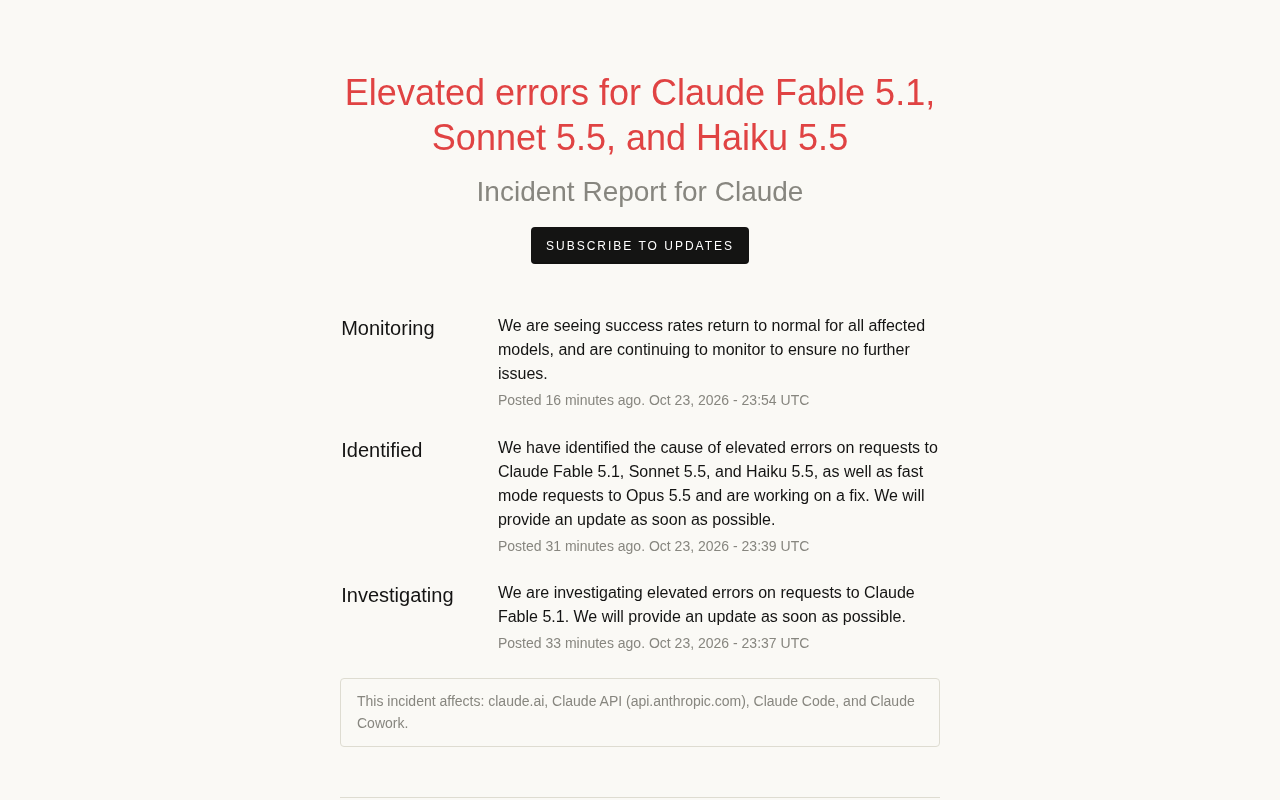
Multiple Claude Models Hit by Errors: A Postmortem of Fable 5.1, Sonnet 5.5, and Haiku 5.5
Claude Fable 5.1, Sonnet 5.5, Haiku 5.5, and Opus 5.5 fast mode saw elevated errors; Anthropic identified and resolved the issue in 17 minutes. This postmortem covers the timeline, the technical reasons for the multi-model cascading failure, and practical lessons for retry and degradation strategies.