SynthID Bio: A New Attempt at Watermarking AI-Generated Proteins
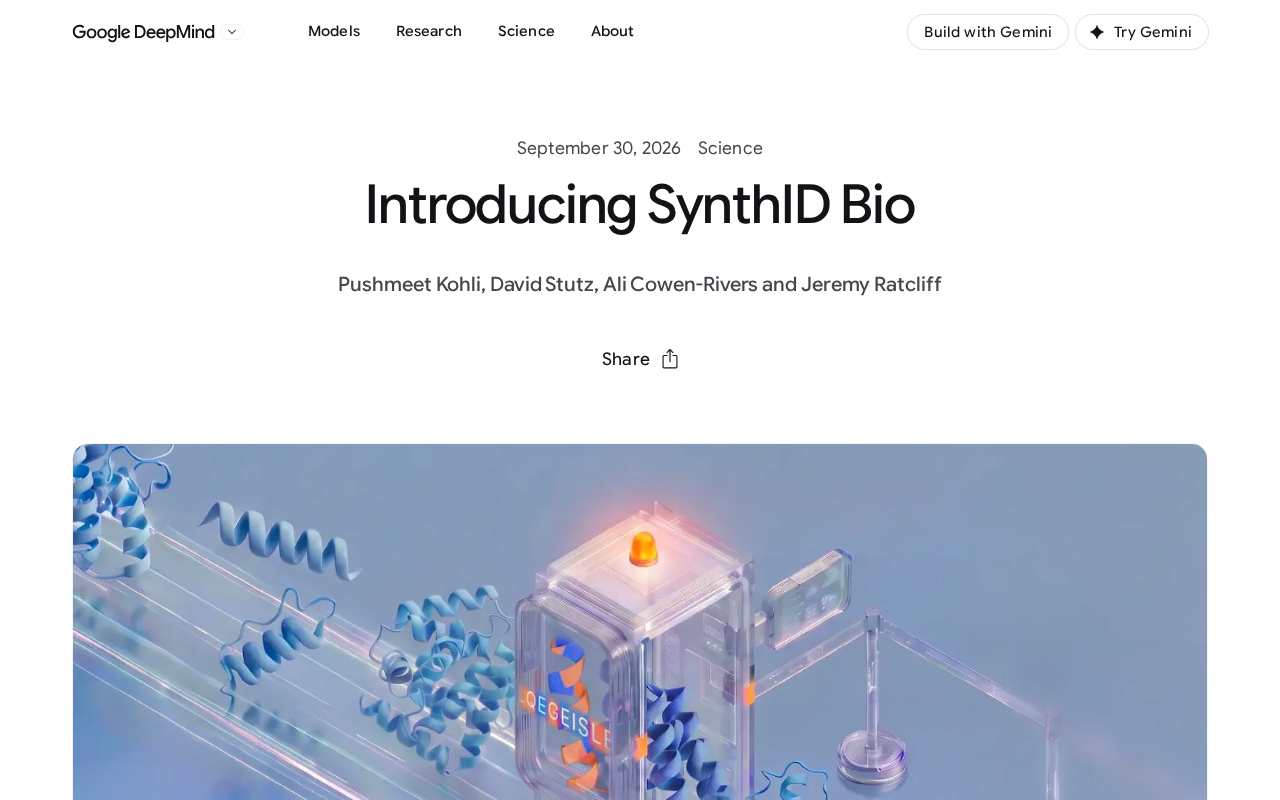
Google's SynthID Bio embeds detectable watermarks in AI-designed proteins without compromising their biological function.
SynthID Bio is Google's proof-of-concept technology for tracing AI-generated proteins, extending watermarking from digital content into the life sciences. Its central technical challenge is that a protein's amino acid sequence directly determines its 3D structure and biological function — making sequence modifications far more consequential than watermarking text or images. SynthID Bio's key contribution is demonstrating a path that preserves both watermark detectability and protein functionality. More broadly, it sits at the intersection of AI, synthetic biology, and security governance, reflecting the need for content traceability mechanisms to evolve as generative AI enters the physical and biological world. Detection robustness, watermark capacity, and cross-model generalizability remain open challenges.
AI-Designed Proteins Enter the Watermarking Era
Artificial intelligence is rewriting the rules of protein design. From AlphaFold to a growing range of protein generative models, AI can now design entirely novel protein structures that have never existed in nature. But as these capabilities advance rapidly, a critical question emerges: how do we tell whether a protein sequence was produced naturally or generated by AI?
SynthID Bio is a proposed solution to exactly this problem. It is a proof-of-concept technology aimed at embedding watermarks into AI-generated proteins while preserving their original biological function. The approach builds on the earlier SynthID work applied to text, images, and audio — only this time, the domain has shifted to the life sciences.
Why Proteins Need Watermarks Too
Content watermarking is already well-established in the text and image space — it's primarily used to identify AI-generated content and help detect misinformation or unauthorized synthetic media. But bringing watermarking to protein design is motivated by something far more consequential.
AI is rapidly pushing the boundaries of synthetic biology. When models can design proteins with specific functions on demand, biosecurity concerns follow: if someone uses AI to design potentially harmful biomolecules, do we have any way to trace their origin? Embedding a recognizable marker in AI-generated proteins becomes a technical mechanism for establishing accountability and traceability.
In other words, the core question SynthID Bio tries to answer is this: in an era of increasingly automated biological design, can we leave a verifiable "fingerprint" on AI outputs — without compromising their ability to function as biological molecules?
The Core Challenge: Balancing Watermarks with Biological Function
There is a fundamental technical tension here. Watermarks in text or images can be embedded by subtly adjusting pixels or word choices, with limited impact on usability. Proteins are different — their sequence directly determines their three-dimensional folded structure, and structure determines function. Any change to the amino acid sequence could affect whether the protein folds correctly and whether it can carry out its catalytic, binding, or signaling roles.
As a proof of concept, SynthID Bio demonstrates precisely this: that it is possible to embed a detectable watermark signal while still preserving biological function. This means the watermark is not achieved at the expense of the protein's usability — a path has been found that satisfies both requirements.
Synthetic Biology is a discipline that applies engineering principles to the design of biological systems — the core idea being to combine genetic components like building blocks to construct biomolecules or cellular systems with specific functions. Traditional synthetic biology relies on manual design and experimental screening, which is slow and laborious. The emergence of AI protein design tools (such as DeepMind's AlphaFold and the University of Washington's RFdiffusion) has allowed researchers to complete sequence design work in hours that once took years. While this efficiency leap accelerates positive applications like drug development and enzyme engineering, it also dramatically lowers the barrier for biological risk — potentially malicious actors could use the same tools to design harmful or toxic proteins. This is why the traceability question — "who designed this molecule and which model was used?" — has evolved from academic curiosity into a real-world security need.
Proteins are made up of 20 types of amino acids linked in a specific order. This linear sequence spontaneously folds into a defined three-dimensional conformation in the cellular environment, governed by physicochemical rules. Protein function — whether enzymatic catalysis, antibody recognition, or cellular signaling — is highly dependent on the precision of this 3D structure, following the central logic of "sequence → structure → function." The challenge of watermark embedding lies here: changing any critical amino acid can disrupt local hydrogen bond networks or hydrophobic cores, causing misfolding or complete loss of activity. By contrast, changing a few pixels in a digital image barely affects its appearance, while the protein sequence space is far less forgiving. The technical value of SynthID Bio lies in identifying "redundant" positions in sequence space — ones that minimally affect function yet are sufficient to carry a detectable signal — achieving labeling without disturbing structural stability.
What "Proof of Concept" Actually Means
It's worth being clear-eyed: SynthID Bio is currently positioned as a proof of concept, not a mature production-ready tool. The value of a proof of concept lies in validating a technical approach — demonstrating that "watermarking a protein without harming its function" is achievable in principle, and laying the groundwork for further research and standardization.
From an industry perspective, this kind of work often forms the technical foundation of a broader biosafety governance framework. As AI-assisted protein design becomes widespread, the field will need matching tools for traceability, detection, and oversight. SynthID Bio provides exactly one such piece of the puzzle — even if significant distance remains before large-scale practical deployment.
A Direction Worth Watching
The space SynthID Bio touches sits at the intersection of AI, synthetic biology, and security governance. It reflects a broader trend: as generative AI moves from digital content into the physical and biological world, the technologies for content traceability and safety marking must evolve alongside it.
For researchers and policymakers, the maturation of technologies like this will directly affect the operability of future biosafety regulation. For AI practitioners, it also points to a broader proposition — responsible AI isn't just a question of text and images. In principle, anything AI can generate may eventually require corresponding traceability and governance mechanisms.
As an early-stage exploration, SynthID Bio's value lies more in opening up a direction than in providing a definitive answer. Whether it can move from proof of concept to practical tool will depend on future progress in detection robustness, watermark capacity, and cross-model generalizability.
Detection robustness is a core metric for whether a watermarking technology can be practically deployed — it refers to the ability to detect a watermark even after the sequence has undergone mutation, evolutionary optimization, or deliberate tampering. For protein watermarks, this challenge is particularly severe: directed evolution experiments or computational optimization can introduce large numbers of substitutions into a sequence, potentially erasing watermark signals unintentionally. Cross-model generalizability raises a related question — can different AI protein design platforms recognize each other's watermarks, or does each system form an isolated silo? Meanwhile, watermark capacity (the amount of information that can be encoded in a single sequence) determines whether it's possible to simultaneously track metadata like model version, user identity, and generation timestamp. Progress across all three dimensions will collectively determine whether proof-of-concept work like SynthID Bio can ultimately be translated into practical tools fit for regulatory frameworks.
Related articles

Apple HomeView Hands-On Review: Is the $300 Smart Home Hub Worth It?
Apple HomeView hands-on: a $300 smart home hub with facial recognition for quick account switching, but no App Store or voice recognition. Is the wall-mounted version worth it? Should you buy the first generation?

Meta Muse Wonder Launch: What It Means for Meta's Return to the Frontier AI Race
Meta releases Muse Wonder and WonderFull, benchmarks reach the frontier, community feedback is polarized. An in-depth look at Meta's return to the frontier AI race, its personal agent strategy, and Zuckerberg's different path.

Apple Home Smart Home Lineup Leaked: LG and Schneider Team Up, UWB Door Lock on Board
Apple Home ecosystem gains new LG and Schneider devices: UWB smart lock with proximity unlock, 2.5K dual-camera doorbell, privacy indoor camera, and AirPods-like seamless pairing.