SynthID Bio: A New Biosecurity Frontier for Watermarking AI-Designed Proteins

Google DeepMind extends AI watermarking to protein sequences with SynthID Bio for biosecurity and traceability.
Google DeepMind has released SynthID Bio, extending its SynthID watermarking approach — previously applied to digital content like text and images — to AI-designed protein sequences, enabling identifiable provenance markers. The technology holds potential value for scientific integrity and biosecurity by supporting traceability and complementing synthesis screening workflows. However, only an official announcement has been published so far, leaving key technical details — including algorithmic implementation, robustness to sequence mutation, and false-positive rates — undisclosed. Given the functional constraints of protein sequences and the limitations of a single-vendor approach, independent verification and broad ecosystem adoption will be essential before SynthID Bio can serve as a meaningful biosecurity standard.
What SynthID Bio Is Designed to Solve
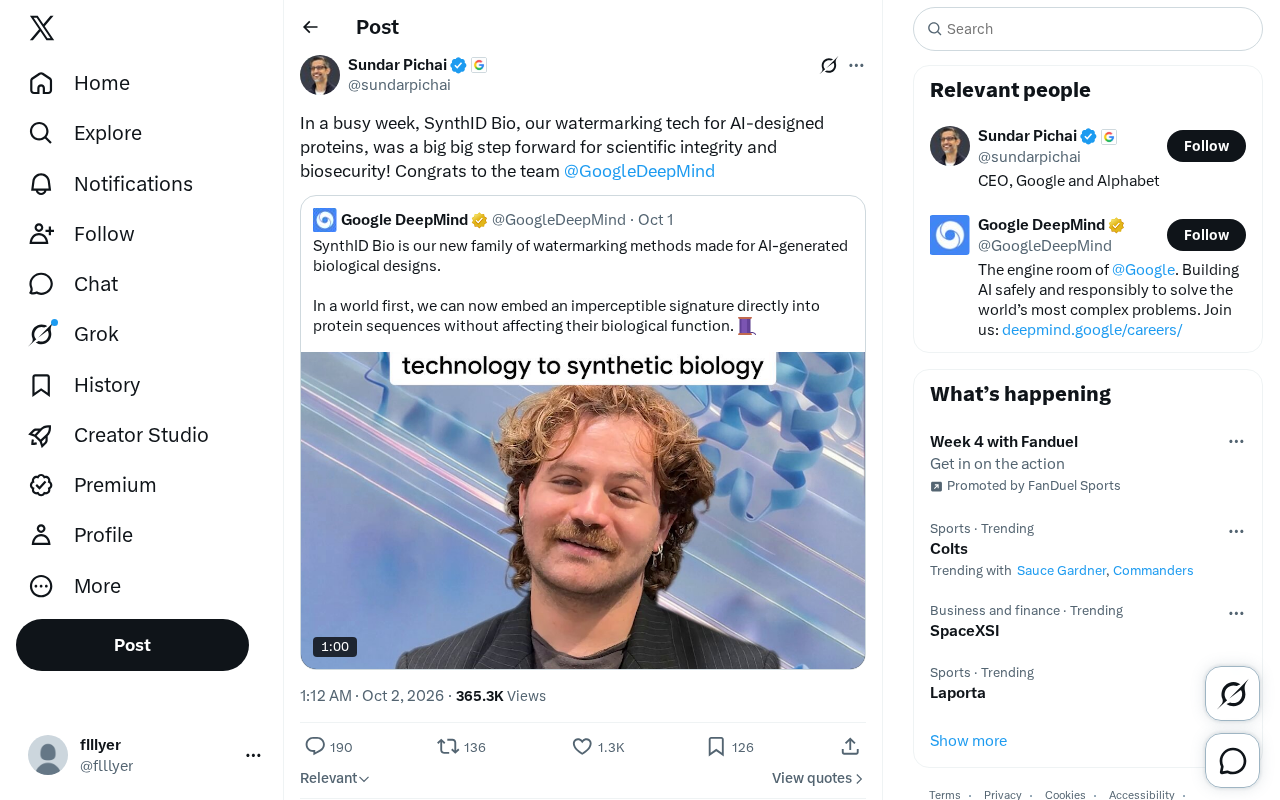
Google DeepMind has introduced SynthID Bio, a watermarking technology for AI-designed proteins. According to the team, it represents a meaningful step forward on two fronts: scientific integrity and biosecurity.
As AI-powered protein design tools — including structure prediction and de novo design models — grow rapidly more capable, an unavoidable question has emerged: when a protein sequence is generated by AI, can we trace its origin? In the context of rapidly advancing synthetic biology, the ability to attribute sequences is no longer just an academic curiosity — it is becoming foundational infrastructure for safety governance.
Extending Watermarking from Content to Biomolecules
The SynthID brand was previously associated with embedding invisible watermarks into AI-generated text, images, audio, and video — helping determine whether content was produced by AI. SynthID Bio extends that same "provenance" concept into the biological domain, embedding identifiable markers into AI-designed protein sequences.
This extension is significant. Digital content watermarking addresses questions of informational authenticity, while biomolecular watermarking touches on security in the physical world. If an AI-designed protein sequence can be marked and traced, regulators, research institutions, and gene synthesis service providers would theoretically have a way to determine "who designed this and with what tool."
From a technical standpoint, protein sequence watermarking faces fundamentally different constraints than digital content watermarking. Digital watermarks can encode information in pixels, audio samples, or token distributions, whereas protein sequences are composed of just 20 amino acids — and substituting any residue risks altering the protein's folding structure or biological function. Protein watermarking must therefore operate within a "functionally neutral substitution space," identifying amino acid positions where substitutions neither disrupt three-dimensional conformation nor compromise activity, and hiding encoded information there. This approach echoes existing research in genomic watermarking, but protein design sequences are shorter and offer fewer operable sites, placing stricter demands on information capacity and robustness.
Why the Biosecurity Dimension Deserves Attention
The dual-use nature of synthetic biology has been widely discussed. Powerful protein design capabilities can accelerate drug development, enzyme engineering, and vaccine design — but they also potentially lower the barrier to misuse. The value of a watermarking mechanism lies in providing a technical handle for the "chain of responsibility":
- Traceability: Makes it easier to confirm whether a sequence originated from a specific AI system
- Deterrence: Raises the cost of potential misuse by making AI-designed sequences identifiable
- Governance alignment: Provides an interfaceable standard for future regulatory frameworks and synthesis screening workflows
It should be noted that the original information is only a brief launch announcement and does not disclose technical details regarding SynthID Bio's algorithmic implementation, robustness (e.g., whether watermarks survive sequence mutation or deliberate modification), or false-positive rates. These are precisely the factors critical to evaluating the real-world effectiveness of any biological watermarking technology.
Synthesis screening is currently one of the key safeguards in biosecurity. Gene synthesis companies typically screen customer-submitted sequences against databases to identify known dangerous pathogen- or toxin-related sequences and decide whether to fulfill orders. However, existing screening systems rely primarily on matching against known sequence databases and have limited ability to recognize entirely novel AI-designed protein sequences — a gap sometimes called the "novelty blind spot." If SynthID Bio could integrate with synthesis providers' screening workflows, it would theoretically complement existing systems: not just identifying "does this resemble a known dangerous sequence," but also flagging "was this produced by an AI design tool" — adding another layer of accountability. Industry organizations such as the International Gene Synthesis Consortium (IGSC) are already advancing standardized screening protocols, and for AI provenance markers to have practical impact, they will need to evolve in alignment with such frameworks.
Open Questions Worth Watching
Starting from a single announcement, several directions are worth tracking. First is reliability: protein sequences have far less freedom than text or images, so stably embedding and detecting watermarks without disrupting function is the central technical challenge. Second is adversarial robustness: if someone deliberately attempts to remove or tamper with a watermark, can the system withstand it? Third is ecosystem adoption: a watermark only forms a meaningful defense when widely accepted by design tools and the synthetic supply chain — a single vendor's solution cannot independently build a complete biosecurity barrier.
Overall, SynthID Bio represents a clear signal that AI safety governance is expanding from digital content into the biological domain. Whether it becomes an industry standard will depend on subsequent peer-reviewed publications, independent verification, and the depth of collaboration with regulatory bodies.
Protein sequences face a natural risk of "watermark erosion" during laboratory use: directed evolution, rational design optimization, and random mutations introduced by PCR amplification could all inadvertently destroy embedded watermark information. Furthermore, if the watermarking mechanism is made public, adversaries could systematically scan for single-point mutations to locate and remove markers — requiring the watermarking algorithm to be sufficiently diffuse and redundant. Academic literature on digital watermarking already offers mature research frameworks for adversarial attacks of this kind, but the discrete nature and limited length of biological sequences make the trade-off between "watermark capacity" and "adversarial robustness" considerably harder to calibrate. Whether SynthID Bio will publish peer-reviewed papers disclosing its adversarial experiment results will be an important indicator of the technology's maturity.
Related articles

Apple HomeView Hands-On Review: Is the $300 Smart Home Hub Worth It?
Apple HomeView hands-on: a $300 smart home hub with facial recognition for quick account switching, but no App Store or voice recognition. Is the wall-mounted version worth it? Should you buy the first generation?

Meta Muse Wonder Launch: What It Means for Meta's Return to the Frontier AI Race
Meta releases Muse Wonder and WonderFull, benchmarks reach the frontier, community feedback is polarized. An in-depth look at Meta's return to the frontier AI race, its personal agent strategy, and Zuckerberg's different path.

Apple Home Smart Home Lineup Leaked: LG and Schneider Team Up, UWB Door Lock on Board
Apple Home ecosystem gains new LG and Schneider devices: UWB smart lock with proximity unlock, 2.5K dual-camera doorbell, privacy indoor camera, and AirPods-like seamless pairing.