T2-Z: Test-Time Optimization of Environment Latents for Robotic World Models

T2-Z optimizes environment latents at test time, letting robotic world models adapt to new environments from a single interaction.
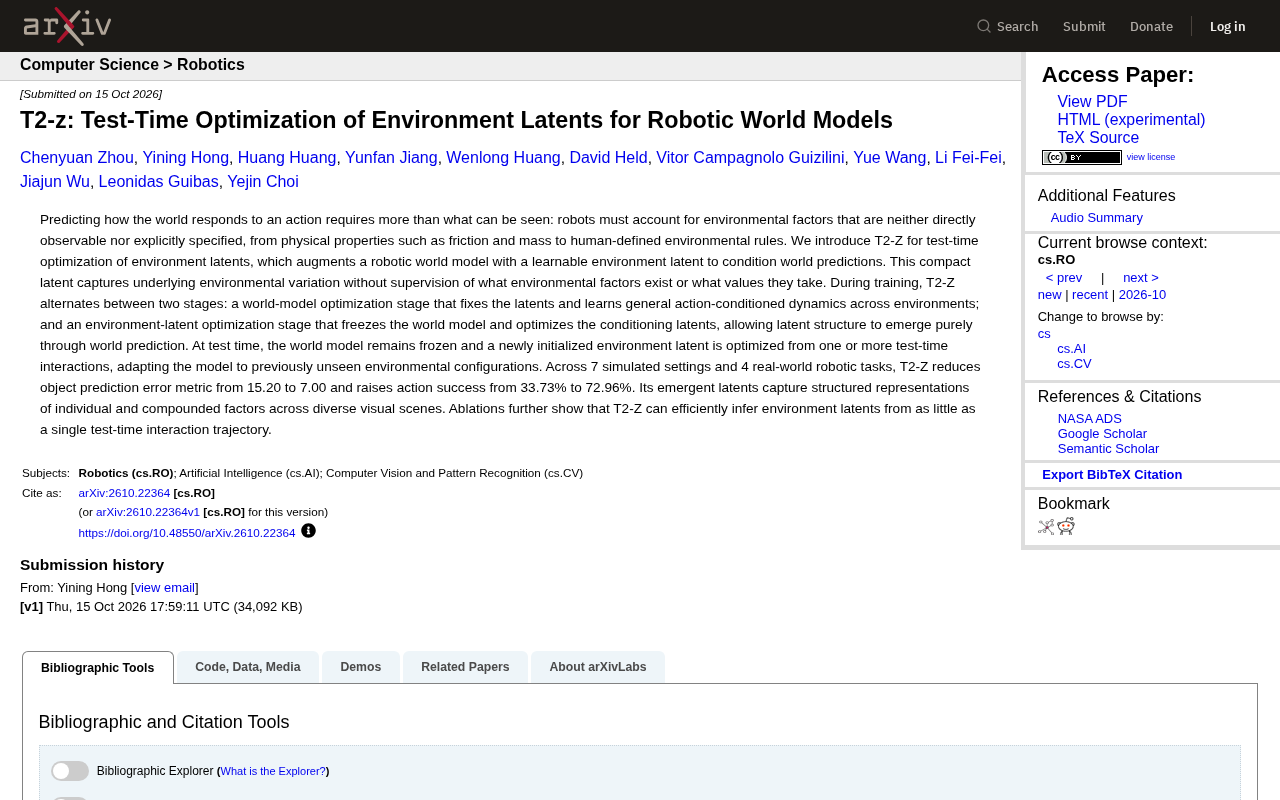
T2-Z addresses the difficulty of generalizing robotic world models under unobservable environmental factors (such as friction and mass) by adding a compact environment latent on top of the standard world model to condition world predictions. Training uses alternating optimization: the world model learns general dynamics across environments, while the environment latent captures the specificity of the current environment, with the two decoupled. At deployment, the world model is frozen, and only the newly initialized latent needs to be optimized from a single test-time interaction trajectory for rapid calibration. Experiments validate on 7 simulated settings and 4 real tasks, with prediction error dropping from 15.20 to 7.00 and action success rate rising from 33.73% to 72.96%. The emerged latent can also structurally represent single and composite environmental factors, providing direction for subsequent semantic decoding and environmental property editing.
For a robot to predict the consequences of its own actions, simply "seeing" is far from enough. Physical properties such as friction and mass, along with environment rules set by humans, are often neither directly observable nor explicitly annotated. This paper, sourced from rss, proposes T2-Z, which optimizes environment latents at test time to enable world models to adapt to previously unseen environment configurations.
The Core Problem: Unobservable Environmental Factors
A World Model attempts to learn the dynamic relationship between "action—environment—outcome," providing predictive capability for robot planning. But real environments are full of latent variables: the same grasping action yields completely different results on a smooth tabletop versus a rough carpet; the same pushing force has vastly different effects on a lightweight cardboard box versus a metal block.
These factors cannot be directly read from vision, nor can they be exhaustively enumerated during training. Traditional approaches either rely on large amounts of training data covering various environments, or perform expensive fine-tuning at deployment time. T2-Z's starting point is straightforward: rather than hardcoding environmental information during training, let the model "infer on the spot" at test time what the current environment is like.
World Model is an umbrella term for a class of methods in reinforcement learning and robotics, whose core idea is to let an agent learn an internal simulator: given the current state and an upcoming action, predict the next state or observation. Typical representatives include Dreamer, PlaNet, and video-prediction-based Genie, among others. With a world model, a robot can plan in "imagination" without repeatedly trial-and-erroring in the real environment, greatly reducing sampling costs. However, a world model's prediction accuracy depends heavily on its understanding of the environment—once the physical properties of the deployment environment (such as friction coefficients, object mass, material stiffness) deviate from the training distribution, predictions will shift systematically, leading to planning failures. T2-Z targets precisely this "training-environment vs. test-environment mismatch" generalization challenge, and the Test-Time Adaptation (TTA) paradigm that has emerged in recent years—adjusting the model at inference time rather than training time—provides a new perspective for solving such problems.
T2-Z's Method Design
T2-Z adds a learnable environment latent on top of the standard world model, used to condition world predictions. This compact latent requires no supervision signal about "which environmental factors exist" or "what values they take," but instead naturally emerges structure purely through the prediction task.
The training process alternates between two stages:
- World model optimization stage: fix the environment latent, learn general action-conditioned dynamics across environments;
- Environment latent optimization stage: freeze the world model, optimize only the conditioning latent, letting the latent structure be driven entirely by the accuracy of world prediction.
The elegance of this alternating design lies in decoupling—what the world model learns is "general physical laws," while what the latent carries is "the specificity of the current environment." The two have clear division of labor and do not interfere with each other.
Latent Variable in machine learning refers to hidden factors that cannot be directly observed but are believed to influence observable data. In generative models such as Variational Autoencoders (VAEs), a latent variable is typically a low-dimensional vector used to compress and represent the essential structure behind high-dimensional observations. T2-Z's environment latent follows this idea: it is not bound to any predefined semantic dimension (such as "dimension 3 represents friction"), but instead participates in the prediction task as a free vector. When the model is required to minimize prediction error, the latent passively absorbs residual information that cannot be explained by actions and observations, thereby "emerging" an encoding of environmental properties. The key to this kind of unsupervised representation learning is that the task objective (accurate prediction) itself constitutes an implicit constraint on the latent, yielding meaningful representations without additional annotation.
Test-Time Adaptation: Inference from a Single Interaction
At deployment, the world model remains frozen, and the system initializes a fresh environment latent, optimizing it through one or more test-time interactions.
According to the paper, T2-Z can efficiently infer the environment latent from a single test-time interaction trajectory. Ablation experiments further validate this, meaning that after entering a new environment, the robot only needs to execute one action and observe one outcome to rapidly calibrate its understanding of the current environment.
This is significant in practical applications: the model can adapt without collecting data for the new environment or retraining.
Ablation Study is a common validation method in machine learning papers, referring to removing or replacing a component in a complete system in turn and observing performance changes to judge the component's contribution. Ablation dimensions potentially involved in T2-Z include: whether to use test-time optimization, the number of trajectories used for optimization (1 vs. multiple), latent dimension size, whether to freeze the world model, etc. If performance drops sharply after removing test-time optimization, it indicates that the environment latent indeed plays a key role in adapting to new environments; if a single trajectory can already approach the effect of multiple trajectories, it indicates that environmental information can be compressed extremely efficiently. The value of ablation studies lies in decomposing the general conclusion "the method works" into an attributable causal chain.
Experimental Data: Prediction Error Halved, Success Rate Doubled
The paper evaluates on 7 simulated settings and 4 real robot tasks, with significant improvements in core metrics:
- Object prediction error metric dropped from 15.20 to 7.00, a reduction of more than half;
- Action success rate increased from 33.73% to 72.96%, nearly doubling.
More noteworthy is the interpretability of the latent. The paper points out that the emerged latent can capture structured representations of single and composite factors across diverse visual scenes. In other words, the latent space is not black-box noise, but spontaneously organizes meaningful encodings of environmental factors.
This characteristic provides direction for future research: if the semantics of these latents can be decoded, explicit reading and editing of environmental properties may become possible.
Potential Impact and Limitations
T2-Z's approach belongs to the broader "test-time adaptation" paradigm. It avoids the high cost of full-model fine-tuning for each new environment, compressing adaptation capability into a low-dimensional latent.
From an engineering perspective, this solution is deployment-friendly: the world model can be pretrained and frozen, and latent optimization is computationally light and fast.
However, the paper abstract does not disclose the specific dimensions of the latent, the computational overhead required for optimization, or the distribution of interaction counts in real tasks. Whether the efficiency advantage of inference from a single trajectory can cover all task types still requires more experimental validation. Additionally, if environmental factors change dynamically during interaction (rather than being static configurations), the latent's online tracking capability is also an open question.
Overall, T2-Z provides a concise and effective path for environment adaptation of robotic world models, and its "general dynamics + environment specialization" decoupling approach is worth attention.
Online Tracking refers to a model's ability to continuously update its internal state estimate during task execution, as opposed to offline adaptation that "infers once and then fixes." Under T2-Z's framework, the environment latent is currently inferred once through initial interaction upon entering a new environment, then held fixed. But if the environment itself changes—for example, an object deforms during grasping, a tabletop becomes slippery due to spilled water, or the mass distribution of an object being carried changes—the fixed latent will fail. To handle such dynamic scenarios, the latent needs to be incrementally updated after each interaction step, which places higher demands on optimization speed, stability (avoiding latent drift or oscillation), and computational budget, and is also a direction that future work can extend.
One-line Summary
T2-Z enables robotic world models to adapt to new environments from a single interaction by optimizing environment latents at test time.
Paragraph Summary
T2-Z addresses the difficulty of generalizing robotic world models under unobservable environmental factors (such as friction and mass) by adding a compact environment latent on top of the standard world model to condition world predictions. Training uses alternating optimization: the world model learns general dynamics across environments, while the environment latent captures the specificity of the current environment, with the two decoupled. At deployment, the world model is frozen, and only the newly initialized latent needs to be optimized from a single test-time interaction trajectory for rapid calibration. Experiments validate on 7 simulated settings and 4 real tasks, with prediction error dropping from 15.20 to 7.00 and action success rate rising from 33.73% to 72.96%. The emerged latent can also structurally represent single and composite environmental factors, providing direction for subsequent semantic decoding and environmental property editing.
Related articles

Amphibious Transforming Drone: Beyond 100x Power Savings, What Are the Real Needs?
Is the amphibious transforming drone just a gimmick? Starting from the 100x power difference of the M4 Morphobot, explore real application scenarios and thesis topic ideas, analyzing boundary conditions where pure drones and pure ground robots both fail.

Warhound Raises $200 Million: Genetically Engineered "War Dogs" Paired with Anduril Gear
Warhound raises $200M, backed by Ben Lamm and Palmer Luckey, to genetically engineer dogs for military and law enforcement use and equip them with Anduril gear. This article analyzes its technology direction, funding logic, and ethical controversy.

Claude API Comes to Google Cloud: IAM Integration and SDK Access Guide
Anthropic hosts the full Claude API on Google Cloud with IAM-controlled permissions and unified billing. This guide covers the Vertex AI and Anthropic-hosted entry points, IAM role configuration, and SDK access.