Talorys: A Self-Hosted AI Assistant Running on Cloudflare's Free Tier

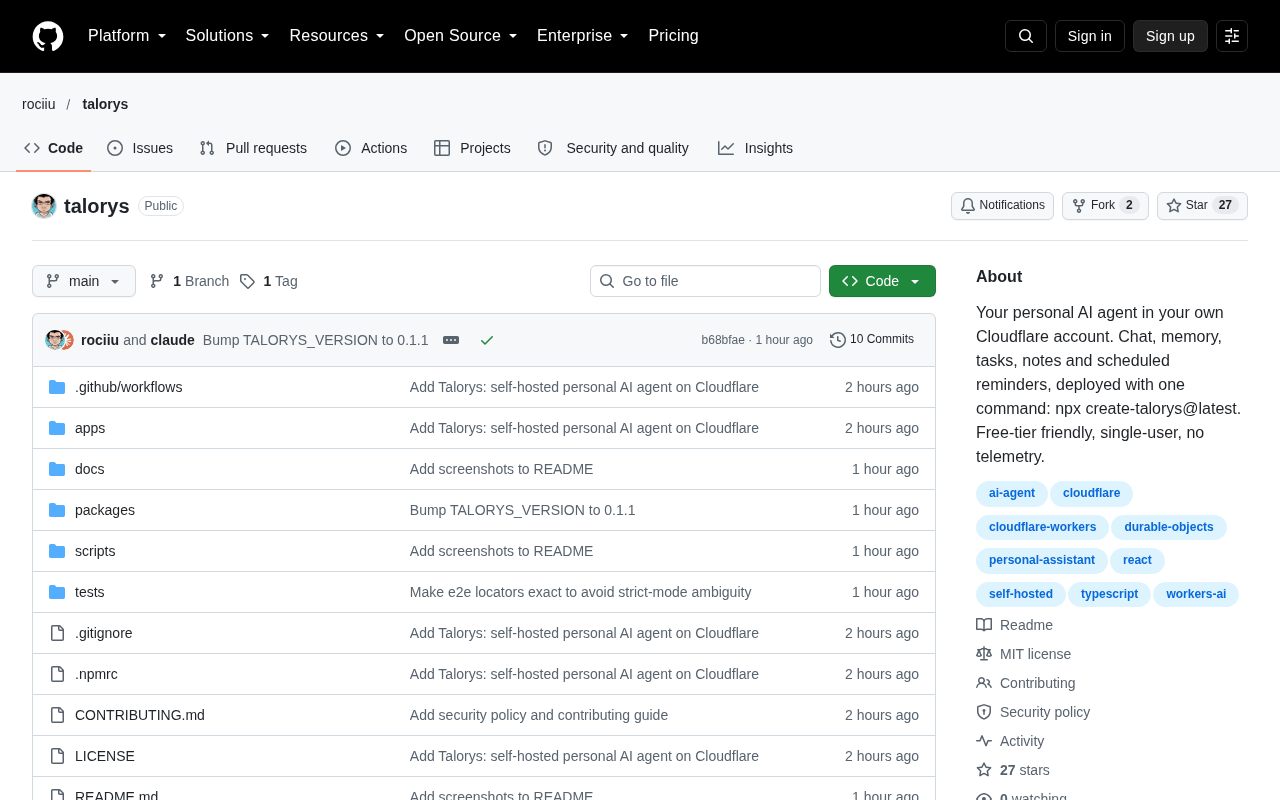
Talorys is an open-source self-hosted personal AI agent built to run on Cloudflare's free tier at near-zero cost.
Talorys is a self-hosted personal AI agent project that runs on Cloudflare's free tier, drawing early attention on Hacker News. It combines self-hosting, personalization, and low cost to let developers run their own AI assistant without cloud subscriptions or third-party data dependencies. Leveraging Cloudflare Workers and Workers KV, it achieves near-zero server costs — though free-tier CPU and memory limits require a lightweight architecture. The project is still in early stages with limited public information, making it best suited as a prototype reference for technically inclined users who prioritize data sovereignty.
An Open-Source Experiment Worth Watching
In a world overflowing with AI assistants, most solutions rely on cloud subscriptions, API billing, and third-party service dependencies. Talorys takes a different path — it's a self-hosted personal AI agent that runs entirely on Cloudflare's free tier. The project earned 32 upvotes and 11 comments on Hacker News, not an explosive debut, but one that touches on a persistent pain point: how to own a personal AI assistant without paying for it or surrendering control of your data.
At its core, Talorys bundles three key ideas together: self-hosted, personal, and low-cost (via Cloudflare's free tier). That combination speaks directly to developers who want AI capabilities but are wary of both the bill and the privacy trade-offs.
Why Cloudflare's Free Tier
Deploying an AI agent on Cloudflare's free tier is the project's most headline-worthy design decision. Cloudflare Workers, Workers KV, and Cloudflare's edge computing network provide a near-zero-cost runtime environment that's well-suited for lightweight, event-driven application logic.
For individual users, this means no server to purchase, no long-running backend processes to maintain, and no ongoing costs from idle resources. Edge deployment also brings built-in global distribution and lower latency as added bonuses. Of course, the free tier comes with constraints on CPU time, request quotas, and memory — so an AI agent running in this environment must make deliberate architectural trade-offs to stay lightweight. That tension is precisely where the real design challenge lies.
Cloudflare Workers is a serverless runtime built on the V8 engine, executing code across Cloudflare's globally distributed edge nodes rather than in centralized data centers. The free tier provides approximately 100,000 requests per day, a maximum of 10ms CPU time per request (with a 30-second wall-clock limit), and a 128MB memory cap. Workers KV, the companion distributed key-value store, supports 100,000 reads and 1,000 writes per day on the free plan and can be used to persist agent state, conversation history, or configuration. These limits mean any AI agent running here must be stateless or near-stateless — it can't support long-running inference loops, and the model itself must call an external API (such as OpenAI, Anthropic, or Cloudflare's own Workers AI) rather than running a large model locally at the edge.
The Privacy Logic Behind Self-Hosting
"Self-hosted" has increasingly become a statement of values in the AI ecosystem. Mainstream AI assistant products typically funnel users' conversations, task histories, and personal data back to the vendor's servers. For a subset of developers and privacy-conscious users, that's an unacceptable trade-off.
Talorys's self-hosted positioning returns data and control to the user. You decide where the agent runs, where data is stored, and which models or services it connects to. This approach sacrifices out-of-the-box convenience in exchange for transparency and autonomy — a philosophy that aligns with the broader wave of local and decentralized AI tools gaining traction in recent years.
A "personal AI agent" refers to an AI system capable of executing multi-step tasks on behalf of a user, managing memory and context, and calling external tools or APIs — as opposed to a single-turn question-and-answer assistant. These systems typically require persistent storage to save user preferences, history, and task state, which is exactly why data custody becomes sensitive: the more personal information an agent holds, the greater the privacy risk of storing it on third-party servers. Tools like PrivateGPT, Jan, and Ollama, along with AI integrations in the Home Assistant ecosystem, all represent the same underlying demand: AI capabilities that run in environments the user controls, rather than trading personal data to the cloud in exchange for "convenience."
Who Is This For
Based on what's publicly available, Talorys reads more like a project for technical users than a consumer-facing product. The typical user profile is a developer willing to navigate a deployment process, comfortable with the Cloudflare ecosystem, and motivated by concerns around data sovereignty.
If you're looking for a personal AI agent prototype that you can fully control and run at near-zero cost, Talorys offers an interesting reference point. It demonstrates a real possibility: an AI assistant doesn't have to be tied to a big-tech paid subscription — an individual developer can build their own setup on free infrastructure.
A Grounded Assessment
It's worth being clear: public information about Talorys is quite limited at this stage, and any judgment must be based primarily on its stated positioning and community interest. Its actual feature completeness, model integration approach, and real-world performance within free-tier constraints all remain to be verified. The 11-comment discussion on Hacker News also signals that this is still in its early exposure phase.
The right attitude toward early-stage open-source projects like this is curious but measured — start by understanding what problem it solves, evaluating code quality, and checking whether the community is active, before deciding whether it's worth your time to deploy and use.
Related articles

Free Unlimited Claude Code Solution: Agnes AI + CC Switch Setup Guide
No paid subscription needed — pair the free AI platform Agnes AI with the open-source tool CC Switch to provide a backend for Claude Code, enabling unlimited free calls to text, image, and video models. This guide covers the full setup, test results, and usage boundaries.

A Complete Zero-Cost Guide to Getting Started with Claude Code for Beginners in China
A beginner's guide to Claude Code for users in China: two installation methods (command line and IDE plugin), full configuration steps for replacing the official API with the free domestic LongCat model, and a hands-on demo of building a small tool with natural language, plus tips.

When the NSA Gets Involved: The AI Supply Chain Crisis Behind Open-Source CVEs and API Key Hijacking
Multiple open-source projects disclosed severe CVEs in one day, PHP flaws alarmed the FBI, and Railway and OpenCode were breached with API keys stolen. This article breaks down the vulnerability window, AI-accelerated exploitation, and the AI supply chain crisis behind the API key black market, with a developer defense checklist.