Teaching AI to Have "Taste": Exploring Multi-Agent Design with Open-Source Skill Taste

An open-source multi-agent pipeline that reverse-engineers website design taste into verifiable principles.
Designer SEN open-sourced a Skill project called Taste that addresses why AI-generated interfaces default to the same blue-purple aesthetic. Using a four-agent pipeline — Measurer, Detector, Critic, and Skeptic — it reverse-engineers a website's design decisions into structured "Taste DNA": verifiable principles backed by evidence, going far beyond surface-level style scraping.
It Starts With "AI Blue-Purple"
If you've ever done vibe coding with tools like Cursor or Claude Code, you've probably noticed something: AI-generated interfaces all look strangely alike, almost universally drenched in a blue-purple gradient. This color has practically become the default visual signature of AI-generated UI.
According to SEN, a designer based in the Netherlands who shared this analysis on Bilibili, there's a very specific technical reason behind this. The color is called Indigo 500 — the default button color in early versions of the Tailwind CSS framework.
Why did Tailwind's default color leave such a deep imprint on AI? Tailwind CSS is a "utility-first" CSS framework that quickly became one of the most dominant styling tools in front-end development after its release in 2019. It provides a large set of atomic, preset class names (like bg-indigo-500), letting developers build interfaces rapidly without writing raw CSS. Unlike component-based frameworks such as Bootstrap, Tailwind encodes all styling decisions directly in the class attributes of HTML tags. This highly visible code structure makes it exceptionally "dense" training data for AI — models can read the correspondence between design intent and implementation directly from HTML structure. Between 2021 and 2023, Tailwind's npm weekly downloads exploded from a few million to tens of millions, and it ranked at the top of StackOverflow's developer satisfaction surveys for CSS frameworks year after year. Code repositories and tutorials built with Tailwind proliferated across the internet. As a result, millions of projects use Tailwind, and their code and UI screenshots appear abundantly in AI model training corpora. When models scrape data at scale from the web, indigo-500 (the hex value #6366F1) appears far more frequently than any other color scheme. During training, models implicitly equate "high-frequency choices" with "safe/correct" — a statistical bias, not genuine aesthetic understanding. Notably, this phenomenon reveals a structural characteristic of large language model training: a model's output is essentially a weighted mapping of its training data distribution. When a particular technical choice dominates the corpus, the model internalizes it as the "default correct answer," even when that choice is entirely neutral from a design aesthetics perspective.
Because so many products use Tailwind, this color is disproportionately represented in training data. After ingesting enormous amounts of it, AI naturally treats it as the "safe default."
This observation points to a deeper problem: AI excels at reproducing the "average," but struggles to capture what's truly rare in design — taste.
Why "Reading Styles" Isn't Enough
The concept of "vibe coding" was coined by OpenAI co-founder Andrej Karpathy in early 2025 to describe a new paradigm of software development that leans heavily on AI code generation, where developers drive the process purely through natural language. This dramatically lowers the barrier for non-programmers to build software products — but it also introduces a new limitation: AI outputs are heavily dependent on the "mode" of their training data. For code logic, this dependency is usually fine. But for interface design, the "mode" of training data means mediocrity — it reflects the most common design choices on the internet, not the best design judgment.
For creators with a design background, the solution is simple: sketch the interface yourself and let AI implement it. But for most people without design training, the most direct path is imitation — browsing Pinterest for inspiration or referencing a beloved brand's website.
Many tools on the market today claim to "quickly read a website's front-end style" — they can scrape colors, fonts, icons, and similar data. But SEN argues these tools remain superficial.
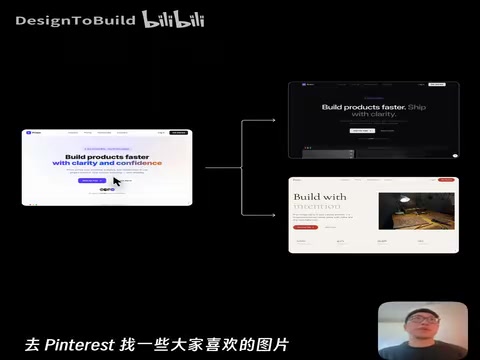
He ran a comparison experiment: on the left, the Linear product page he wanted to imitate; on the right, the result generated using existing style plugins. The gap was stark:
- The original site's Call to Action button was pill-shaped, but the imitation version made it a square;
- The original site used left-aligned text, but the imitation version centered it;
- The original site never used its brand color, but the imitation version used it twice.
In other words, the tools copied the "parameters" but missed the "essence." This touches on the concept of "tacit knowledge" in cognitive science — philosopher Michael Polanyi described it in his 1966 book The Tacit Dimension with the central proposition: "We can know more than we can tell." Take riding a bicycle: a cyclist maintains balance but cannot verbally describe every physical adjustment they make. Design taste is highly analogous — an experienced designer can instantly judge whether a button's border radius "feels right," yet often cannot fully translate that intuition into quantifiable rules. Color codes and font names are the explicit knowledge of design; the judgment logic hidden behind every trade-off decision is the tacit knowledge that's truly difficult to replicate — and this is precisely the structural bottleneck of existing AI tools. The ineffability of tacit knowledge is especially pronounced in design: a complete design system can be documented as Figma files and spec sheets, but if two designers work independently under the same spec, the results will often diverge significantly — the difference comes from those accumulated judgments that exist outside the spec, impossible to fully encode.
Taste = Trade-offs + Decisions
So what exactly is the "essence" of design? SEN offers a remarkably insightful definition:
Taste = Trade-offs + Decisions
When you build a website or create a design, you decide what to do and what not to do, and why you're making those choices. These individual decisions, layered on top of each other, ultimately produce the visual result you see.

This definition aligns closely with Simon Sinek's "Golden Circle" framework in Design Thinking: the real driver of great design comes from "Why," not just "What." A true style isn't a collection of colors and font sizes — it's an internally consistent logic of decisions. This led him to a bold idea: could AI use a pipeline to reverse engineer the taste of a website?
"Reverse engineering design systems" as a methodology has a long history in the design world: designers deconstruct the visual decisions of benchmark products to extract the underlying design language — a core part of professional design education. Linear builds its "engineering aesthetic" through dark backgrounds, high-contrast typography, and minimal geometric forms. Stripe's recent redesign shifted toward more expressive multi-color gradients, deliberately breaking the "blue monotony" of tech products. What both have in common is that every visual decision carries a clear brand narrative — and that's precisely what the Taste project attempts to extract algorithmically.
This is how his open-source Skill project was born. He called it Taste.
A Four-Agent Collaborative Pipeline
At the core of Taste is a pipeline composed of four subagents (similar to splitting out four specialized agents in Claude Code), each doing exactly one thing:
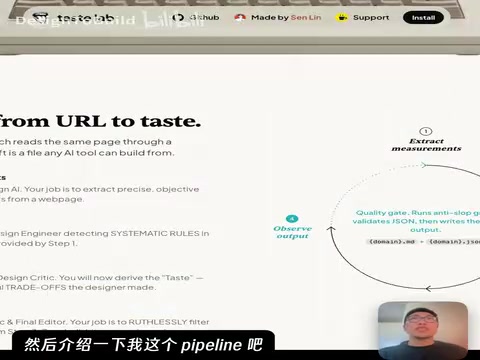
This multi-agent architecture draws on the software engineering principle of "Separation of Concerns," and also echoes the "Dual Process Theory" from cognitive science — human decision-making relies on both fast intuition (System 1) and slow analytical reasoning (System 2). In large language model practice, asking a single prompt to simultaneously handle data collection, pattern discovery, critical validation, and conclusion synthesis tends to produce compounding hallucinations. Splitting tasks among specialized subagents, with adversarial roles forming internal quality gates, is a strategy the academic community calls "Multi-Agent Debate (MAD)." A 2023 joint study from MIT and Google found that having multiple LLM instances debate the same question effectively reduces factual errors and reasoning biases — the mechanism is similar to academic peer review: a single model tends toward "self-confirmation" when generating answers, while introducing a dissenting adversarial role forces the model to expose and examine its reasoning gaps. Additionally, each agent's more focused context window helps reduce the "context drift" and attention scattering that can occur when processing complex design systems. From an engineering perspective, this pipeline architecture also offers a practical advantage: each agent's output can be independently audited and debugged. When the final Taste DNA shows errors, you can pinpoint exactly whether the Measurer missed critical data, the Detector's pattern recognition went off-track, or the Critic's standards were too lenient — rather than facing an opaque monolithic model output with no way forward.
1. Measurer
The first agent acts like a surveyor, entering the target website and indiscriminately collecting all front-end data: fonts, font sizes, colors, spacing, and more. It performs no analysis — only collection. This strict role isolation ensures raw observations aren't contaminated by analytical preconceptions, mirroring the scientific methodology of separating data collection from hypothesis generation.
2. Detector
The second agent receives the raw data and is responsible for connecting the dots — discovering latent patterns within the massive dataset. It corresponds to System 2's slow analytical thinking, synthesizing discrete measurements into preliminary design hypotheses.
3. Critic
The third agent plays the role of a demanding reviewer, scrutinizing each pattern proposed by the Detector: Do these patterns make sense? Are they backed by data? It challenges conclusions that don't hold up, ultimately retaining only three or four of the most solid ones. This role triggers the core mechanism of multi-agent debate — adversarial review that forces reasoning gaps into the open.
4. Skeptic
The final agent performs further convergence and "pruning," distilling the layer-by-layer filtered conclusions into a final taste document.
This "collect → discover → challenge → converge" multi-agent collaboration is essentially engineering a simulation of what a senior designer does when they deconstruct, reason through, and render judgment on a reference website — while using algorithmic mechanisms to forcibly convert implicit design intuition into a verifiable chain of explicit reasoning.
Key Outputs: Design Map and Taste DNA
The document generated by the entire pipeline contains two components.

Design Map
This part resembles the output of traditional tools — relatively objective data and tokens: what colors the site uses, what fonts, what spacing rules.
Taste DNA (The Core)
This is where the real differentiation happens. Taste DNA reads more like a set of design principles, and each principle must pass through four layers of validation before it stands — this is the key mechanism for making design's "tacit knowledge explicit," and what fundamentally distinguishes it from ordinary style-scraping tools:
- Top-level principle: For example, when analyzing the Esopic website, the extracted principle was "warmth equals credibility" — using warm tones to build user trust in the brand, creating a humanistic, caring perspective;
- Specific decisions: Under this principle, what design choices would be made;
- Reasoning: Why those choices are made;
- Evidence: Which data points the Measurer originally collected that support this conclusion.
Only when all four layers hold can a valid design principle be formed. Each Taste DNA document typically contains three to four such principles. This "data-to-principle" traceable structure aligns closely with the academic paradigm of Design Criticism — it's concerned not just with "what was designed" but with the intent and logic behind "why it was designed this way." The four-layer validation system is essentially building a "traceable evidence chain" for tacit knowledge, enabling judgment logic that once existed only in a designer's intuition to be transmitted to AI coding agents in structured form. From a broader perspective, this structure also echoes the core demands of the "Explainable AI (XAI)" field — not just outputting conclusions, but outputting the reasoning paths that support them, enabling human reviewers to verify, challenge, and correct the machine's judgment.
Real-World Results and Open-Source Ecosystem
With this packaged document in hand, users can hand it off to their AI coding agent of choice — whether Cursor, Claude Code, Antigravity, or other tools. Currently about nine mainstream coding agents are supported, allowing users to apply the desired design style to their websites.
Based on the demos, Taste learned the styles of three distinct websites — Linear, Stripe (whose recent redesign became much more colorful), and Esopic — and the generated results are noticeably closer to the original "spirit" compared to previous approaches that simply read styles.
The project is now open-sourced on GitHub and supports installation via Claude Code and Gemini CLI.
A Final Reflection
The most valuable thing about the Taste project may not be how many websites it can replicate, but the approach it offers: decomposing abstract "taste" into a verifiable chain of decisions.
While the industry is still discussing "style," Taste is already asking "what trade-offs lie behind the style." This is also a reminder that for AI-assisted creation to truly transcend the "average," the key may not be feeding it more parameters — but teaching it to understand "why." That's precisely the hardest part of human professional judgment to replicate, and the gap between tacit and explicit knowledge that will always exist. As Polanyi said, we always know more than we can tell. What Taste attempts to do is build an engineered bridge across that gap.
Related articles
What Is Vibe Coding? The AI Programming Skill Every Developer Needs
What is Vibe Coding? Learn how AI programming is reshaping dev teams, why traditional programmers face displacement, and why Cursor & Claude Code matter.
Making Rocks Think: A Philosophical Exploration of Generative AI and Information Compression
From a viral Reddit post to deep AI theory: why compression equals understanding, the Library of Babel thought experiment, semantic compression, and the Hutter Prize.
Irregular Warns: Four AI Lab Security Breaches Traced to the Same Root Cause
Irregular reveals four AI lab security breaches share a single root cause, exposing systemic risks from technology stack homogeneity across the AI industry.