Teaflask: Inject a Self-Improving AI Copilot into Your SaaS Without Backend Changes
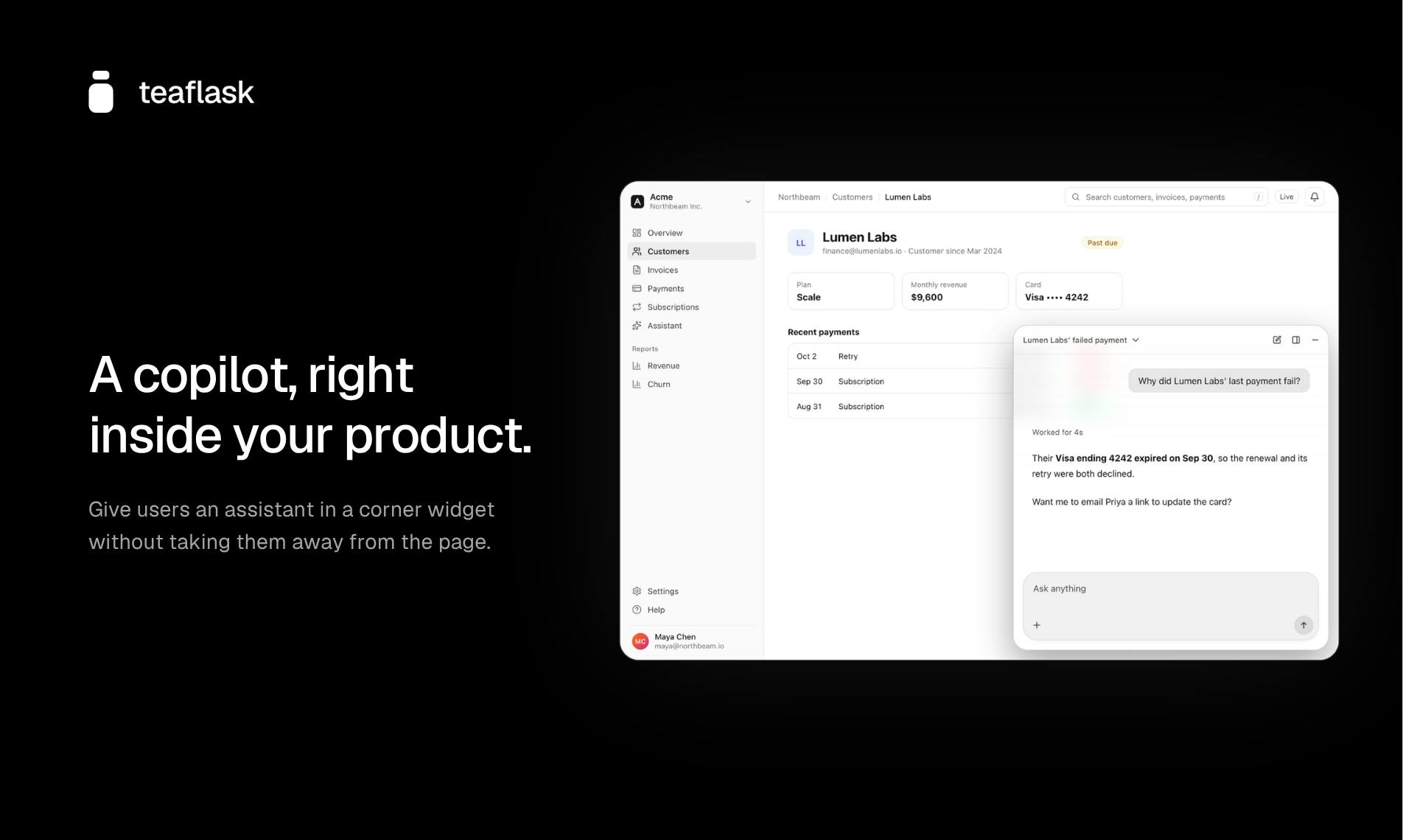
Teaflask adds a self-improving AI copilot to SaaS via frontend-only integration, live in a day.
Teaflask is a hosted AI copilot on Product Hunt that adds natural language interaction and task execution to existing SaaS products through frontend-only integration, with no backend changes and a claimed one-day launch. Its self-improvement relies on codebase-grounded product knowledge and real usage feedback. It earned 105 votes and ranked 6th on day one, signaling real demand for lightweight AI integration.
Why Does Your SaaS Need an AI Copilot?
With AI-native applications sweeping the market, traditional SaaS products face an awkward choice: either invest massive engineering resources to rebuild the backend and embrace LLM capabilities, or watch users get siphoned off by smarter competitors. Teaflask, newly launched on Product Hunt, attempts to offer a third path—without touching the backend, it adds an AI copilot to existing SaaS products purely through frontend integration, one that can understand user intent and directly complete tasks.
According to its Product Hunt page, Teaflask received 105 votes on launch day, ranking 6th on the daily leaderboard, categorized at the intersection of SaaS, developer tools, and artificial intelligence. This result isn't explosive, but it's enough to show that the pain point of "lightweight AI integration" is real.
Teaflask's Core Selling Point: Live in a Day, Frontend Is All You Need
Teaflask's positioning is crystal clear: let existing SaaS products become AI-native experiences without rebuilding the backend. Specifically, it provides a hosted AI copilot where users simply ask questions in natural language, and the copilot helps complete the operations.
The integration path is deliberately narrowed to the frontend: developers use their own UI components and connect to Teaflask's service through frontend integration, with the company claiming you can go live within a day. This means teams don't need to modify API gateways, database permission models, or core business logic, lowering both the psychological barrier and engineering risk of introducing AI capabilities.
For small and mid-sized SaaS teams, this "frontend is all you need" approach is quite appealing—AI capabilities are encapsulated as a callable external service, and the business system only needs to handle presentation and triggering.
Frontend integration vs. backend integration are two paths for landing AI capabilities. Backend integration requires embedding model calls, tool orchestration, and permission checks into API gateways and business logic layers, which is a heavy engineering effort involving data security audits; frontend integration has the browser or client directly calling a hosted AI service, with the business backend only responsible for existing interfaces, and the AI layer existing as a bypass. The advantage of the frontend is fast deployment and minimal intrusion into existing systems; the cost is that capabilities are limited to already-exposed APIs, and authentication, data boundaries, and call chains need additional design on the frontend side.
Where Does Self-Improvement Come From: Product Knowledge Rooted in Code
Teaflask touts "self-improving," and its implementation rests on two pillars.
The first pillar is knowledge grounding. Teaflask anchors product knowledge in the developer's codebase rather than relying on large amounts of manually written FAQ documents or prompts. This means the copilot's understanding of product capabilities is closer to the actual implementation, reducing the room for "AI hallucination."
The second pillar is real usage feedback. The page description mentions that Teaflask learns from real usage and allows teams to test changes before release. This forms a closed loop: interaction data between users and the copilot flows back to improve the copilot's performance, and the improvements can be verified before official release.
As a side note, the company has not disclosed the specific learning mechanisms, model architecture, or data isolation strategies, so the actual effectiveness of "self-improvement" still needs to be tested in real-world scenarios.
Knowledge grounding refers to having a large language model first retrieve and cite external trusted knowledge sources before generating answers, constraining output to factual foundations and thereby reducing content "fabricated" from the model's training memory. Common approaches include retrieval-augmented generation (RAG) and injecting structured documents or codebases as context into prompts. The quality of grounding depends on the freshness and coverage of the knowledge source: the closer the knowledge source is to the product's actual implementation, the less likely the model is to give outdated or incorrect operational guidance. Teaflask's choice to use the codebase rather than manually written FAQs as the grounding source essentially moves the "source of truth for product capabilities" forward from operational documentation to engineering implementation.
Who Should Use It, and Who Should Wait
From its product positioning, Teaflask is best suited for three types of teams: first, teams with mature SaaS products who want to quickly add an AI interaction layer but have severe backend coupling; second, startups with limited engineering resources who don't want to build RAG pipelines and agent frameworks from scratch; third, product teams who want to do an AI feature proof of concept first before deciding whether to invest deeply.
But limitations should also be noted. Frontend integration means the copilot's capability boundary is constrained by existing APIs—if the product itself doesn't expose enough operational interfaces, what the copilot can do is limited. Additionally, while code-level knowledge grounding reduces hallucinations, when the product iterates rapidly, the timeliness of knowledge synchronization is a potential challenge.
Agent frameworks and RAG pipelines are the two foundational components when building an AI copilot from scratch. The RAG pipeline handles document chunking, vectorization, retrieval, and context assembly, solving the problem of "the model doesn't know your product"; the agent framework handles intent recognition, tool (function) calling, multi-step task orchestration, and result validation, solving the problem of "the model can only talk but not act." Building these two components yourself typically takes weeks to months, with ongoing investment in evaluation, monitoring, and iteration—which is exactly the part that hosted copilot services try to save teams from.
Industry Signal of Lightweight AI Integration
Teaflask's emergence reflects a broader trend: AI capabilities are moving from "rebuilding products" to "enhancing products." Not every team needs to build its own large models or rewrite its backend; intermediate-layer services like hosted copilots may become a shortcut for SaaS products to become AI-powered.
Of course, the 105-vote first-day performance shows it hasn't yet entered the mainstream spotlight. For tools like this, the real test isn't how fast the integration is, but whether the copilot can consistently deliver reliable answers and operations after launch—after all, users won't tolerate an AI assistant that gets in the way just because it "went live in a day."
One-line Summary
Teaflask adds a self-improving AI copilot to existing SaaS through pure frontend integration, live in a day.
Paragraph Summary
Teaflask is a hosted AI copilot service launched on Product Hunt that adds natural language interaction and task execution capabilities to existing SaaS products without modifying the backend—purely through frontend integration—with the company claiming it can go live within a day. Its "self-improvement" rests on two pillars: product knowledge rooted in the developer's codebase to reduce hallucinations, and learning from real usage feedback with support for testing changes before release. It received 105 votes and ranked 6th on its first day, showing that demand for lightweight AI integration is real but not yet mainstream. The article also notes that its capabilities are limited by existing API boundaries and questions the timeliness of code knowledge synchronization, viewing it as an industry signal of AI moving from "rebuilding products" to "enhancing products."
Related articles

The Safety Blind Spot in Multimodal Image Editing: Text-Sensitive, Visually Blind
EditSafetyBench benchmarks image editing systems like Gemini, GPT, and Qwen, revealing a text-visual safety mismatch: high rejection of unsafe prompts but lax handling of unsafe images, calling for joint multimodal safety guardrails.

GLiDE: Fast, Calibrated Decision Models Distilled from Reasoning Teachers
GLiDE is a family of decision models distilled from reasoning teachers, ranging from 0.4B to 27B, achieving fast calibrated decisions in a single forward pass by removing causal masks and using soft-target distillation. The 27B model scores 71.52 on the hidden set with 2.0% calibration error and 92.9ms latency.

Build a Professional Website with Claude Code in Minutes: A Five-Step Practical Guide
Learn how to build a professional website with Claude Code in minutes: the complete five-step process from planning prompts and precise iteration to MCP image generation, design redos from reference images, and one-click deployment.