Teamily AI: Collaborating with Agents and Real People in the Same Messenger

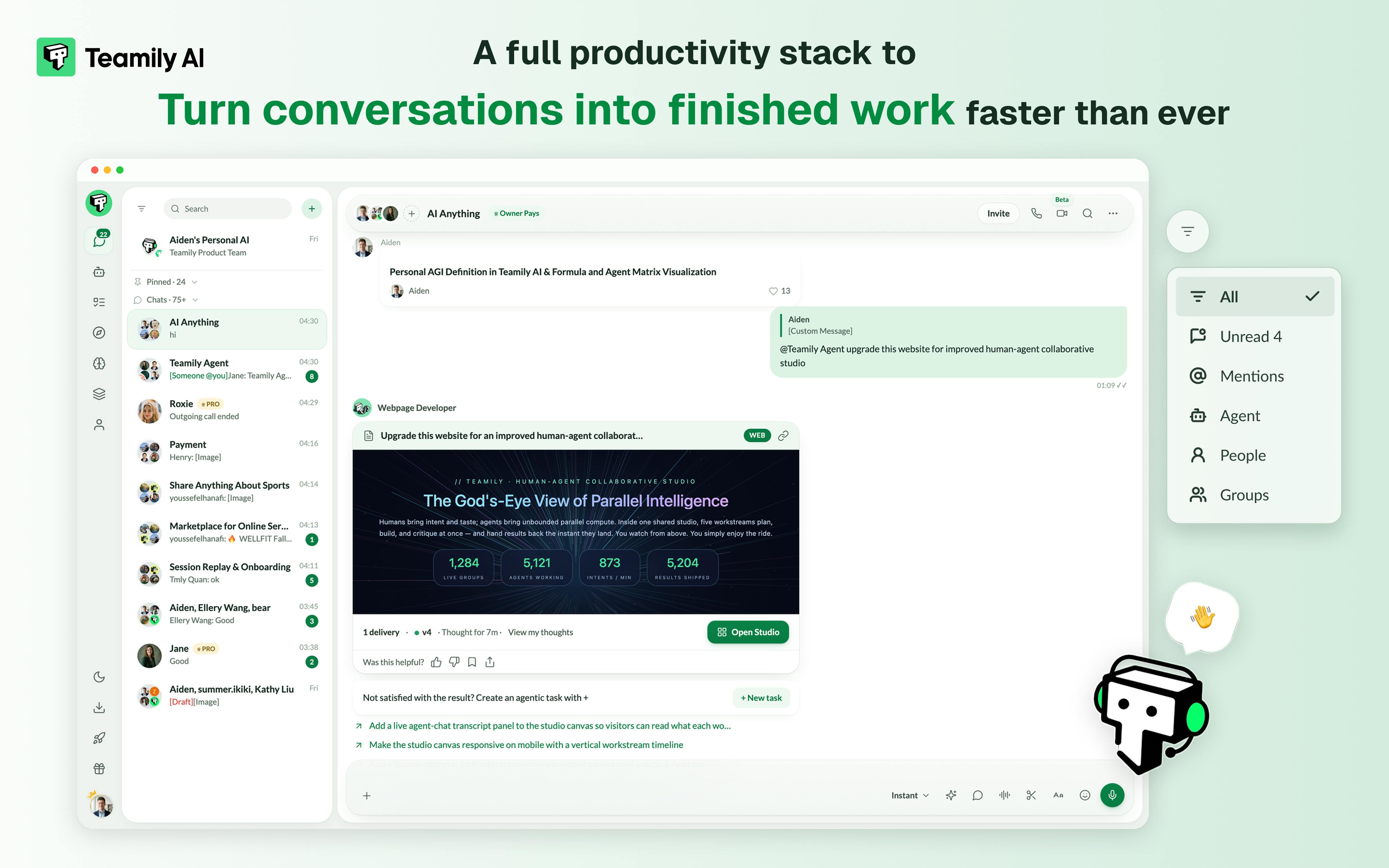
Teamily AI uses an AI-native messenger to bring multi-agent teams and real people into one collaborative space.
Teamily AI received 151 upvotes and 54 comments on Product Hunt, ranking second for the day. Unlike mainstream single-user AI assistants, it places personal agents, agent teams, and real people in the same messenger interface. The product connects documents, meetings, calls, workflows, and business systems, with agents featuring persistent memory, proactive intelligence, and continuous self-improvement. The article notes that this multi-user, multi-agent model is far more challenging than single-user assistants in context management and permission boundaries, and that proactive-intelligence intrusion and multi-person reliability remain key questions to verify.
On Product Hunt, a product called Teamily AI received 151 upvotes and 54 comments, ranking second for the day. Its positioning is straightforward: put personal agents, agent teams, and real people into the same messenger to work together. This approach stands in clear contrast to the current mainstream of "single-user agent assistants," and it's worth unpacking.
From "One Person's Assistant" to "A Team of Agents for a Group"
Most AI assistants today are designed around a single user: you ask, it answers, and its memory is built around you alone. Teamily AI starts from multi-user, multi-agent collaboration. According to its official description, it is "a unified, context-aware space where people and always-on agents get work done together."
There are two key phrases here. First, "always-on" — meaning agents aren't invoked only when called but persist within the team space. Second, "context-aware" — it needs to understand not just a single conversation but the documents, meetings, calls, and workflows the team is actively advancing. This is a level more difficult than context management for a single-user assistant, because it must handle shared state and permission boundaries across multiple people.
Multi-Agent System is a classic concept in distributed artificial intelligence, referring to architectures in which multiple agents jointly solve problems through communication, negotiation, and task allocation. Compared with traditional single agents, the core challenge of a multi-agent system isn't the capability of any individual agent but the coordination mechanism: how to avoid redundant work, how to handle conflicting goals, and how to remain collectively available when some agents fail. In the LLM era, this concept has been reactivated — multiple agents driven by large models can each play different roles (such as retriever, reviewer, executor) and collaborate through message passing to complete complex tasks. Teamily AI moves this architecture from the experimental environment into enterprise collaboration scenarios, which means it must solve the problems of identity differentiation, permission isolation, and state synchronization among agents — issues that simply don't exist in single-user assistant scenarios.
Product Form: An Office Platform Entered Through a Messenger
Teamily AI defines itself as an "AI-native messenger." This choice of starting point is intriguing. The entry point for enterprise collaboration has historically been chat tools — from Slack to Feishu, the chat window is the interface where employees spend the most time. Embedding agents into a messenger eliminates the friction of users switching apps.
According to the product introduction, this space connects people, agents, documents, meetings, calls, workflows, and business systems. The scenarios it targets include office automation and customer service. In other words, it isn't building a smarter chatbot but attempting to let agents "do work" directly within business processes — for example, picking up a customer service ticket in a group chat or automatically advancing document updates based on meeting discussions.
This integrated positioning also brings a practical problem: the more business systems connected, the higher the deployment and configuration complexity. The product emphasizes "start for free," but enterprise-grade integration is usually where the real cost lies.
Persistent Memory and Proactive Intelligence: Why Agents Feel Like "Teammates"
Teamily AI describes its agents as "true teammates," backed by three capabilities: persistent memory, proactive intelligence, and continuous self-improvement.
Persistent memory means agents retain their understanding of the team and tasks across sessions, without needing background re-explained each time. Proactive intelligence implies agents take action without being triggered — such as flagging progress or proactively supplementing information. Continuous self-improvement points to agents adjusting their behavior based on collaboration feedback.
Together, these three capabilities do bring the working style closer to that of human teammates. But the boundaries of proactive intelligence need to be designed carefully — an agent that frequently speaks up unprompted in a group chat can easily become a source of noise. How the product balances "proactive" and "intrusive" is a key experience point in actual use.
Persistent Memory in agent systems generally refers to the ability to retain information across sessions and tasks, typically implemented through mechanisms such as vector database retrieval, structured memory slots, and summary compression. Unlike single-user scenarios, team-shared memory faces three additional challenges: first, memory ownership and visibility — which information is visible to which members and agents; second, memory timeliness — whether outdated team decisions should be automatically down-weighted; third, memory conflicts — how to arbitrate when information provided by different members is inconsistent. Proactive intelligence relies on event-triggering mechanisms and priority judgment, and its design difficulty lies in setting an "action threshold": agents need to intervene proactively only when information is sufficiently complete, otherwise frequent low-value proactive behavior will quickly erode team trust.
Signals Worth Noting and Questions to Be Verified
From community feedback, 151 upvotes and 54 comments indicate the product received some attention at launch. The comment count is relatively high compared with the vote count, which usually means users had specific questions to ask or specific experiences to report — not just passing likes.
It should be noted honestly that the currently available public information is mainly the product's own account, lacking third-party reviews or long-term usage reports from independent users. The actual effectiveness of multi-agent collaboration, the accuracy of persistent memory, and the false-trigger frequency of proactive intelligence all need to be tested in real scenarios. For teams considering a trial, it's advisable to start with a single well-defined scenario — such as customer service Q&A or meeting-notes handoff — rather than connecting all business systems at once.
Teamily AI represents a product direction that is taking shape: AI is no longer a personal tool but a formal member of the team structure. Whether this direction holds ultimately depends on the reliability and collaboration etiquette of agents in multi-person environments, not just model capability.
One-line Summary
Teamily AI uses an AI-native messenger as its vehicle to bring multi-agent teams and real people into the same collaborative space.
Paragraph Summary
Teamily AI received 151 upvotes and 54 comments on Product Hunt, ranking second for the day. Its positioning differs from mainstream single-user AI assistants: it places personal agents, agent teams, and real people into the same messenger interface to collaborate. Using a chat tool as the entry point, the product connects documents, meetings, calls, workflows, and business systems. Its agents have persistent memory, proactive intelligence, and continuous self-improvement capabilities, aiming to become "always-on" formal members of the team. The article notes that this multi-user, multi-agent collaboration model is significantly more difficult than single-user assistants in terms of context management and permission boundaries, and that the intrusion boundary of proactive intelligence and reliability in multi-person environments are key points to be verified in actual use. Currently, public information is mainly the product's own account, lacking third-party long-term evaluation, and teams are advised to start trials with a single well-defined scenario.
Related articles

9 AI Subscription Plans Compared: The Real Cost Per 100M Tokens Revealed
Bilibili creator tests 9 AI subscription plans from Volcano, Alibaba, Tencent, Baidu, Zhipu, Xiaomi, MiniMax and more, converting them all to real cost per 100M tokens, breaking down fixed-quota vs. three-tier coefficient billing and how caching, time-of-day discounts, and window limits affect actual quota.
Vibe Coding for Beginners: Expressing Intent Instead of Handwriting Code
What is Vibe Coding? A 137-episode Bilibili course defines it: the core is expressing intent, not writing code. This article analyzes Vibe Coding's productivity logic, target audience, and entry expectations to help beginners decide if it's worth learning.

LangChain Beginner's Guide: An Agent Development Roadmap from LangGraph to Deep Agents
Clarify the encapsulation relationship among LangChain, LangGraph, and Deep Agents, and master the learning path and selection logic for agent development frameworks—suitable for beginners in large model development.