TechCrunch Disrupt 2026 Booth Registration Countdown: Last 24 Hours
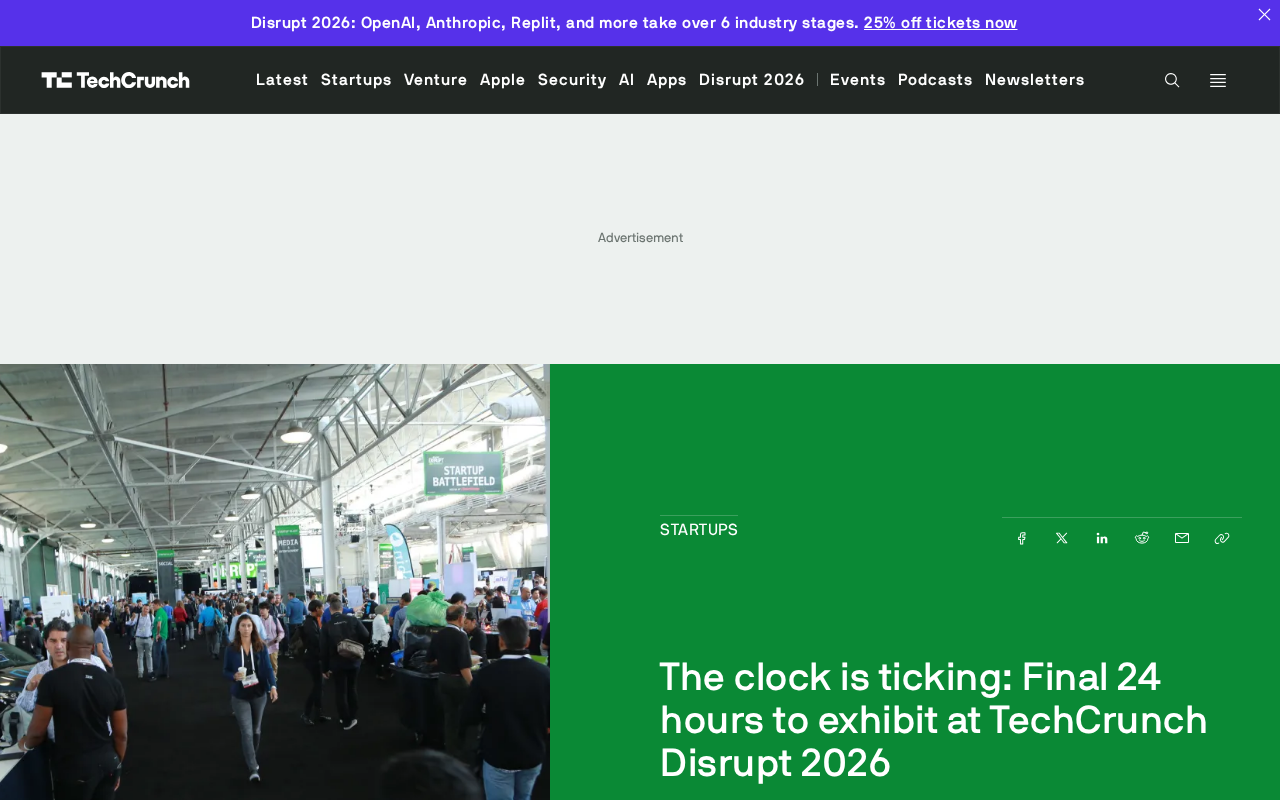
Only 24 hours left to book a booth at TechCrunch Disrupt 2026, happening this October.
TechCrunch Disrupt 2026 booth registration closes on September 18, leaving startups just 24 hours to secure a spot. The conference runs October 13–15 and is expected to attract over 10,000 founders, investors, and tech leaders. With booth supply nearly exhausted, teams still on the fence are urged to decide quickly — the concentrated exposure Disrupt offers is hard to replicate anywhere else.
TechCrunch Disrupt 2026 Booth Registration Enters Final Stage
TechCrunch Disrupt is one of the most influential annual events in the tech startup world, and the booth registration window for 2026 is closing fast. According to official announcements, the deadline for booth registration is September 18 — meaning startups have just 24 hours left.
For early-stage companies hoping to set up a presence at the conference, this is a critical moment. Missing the registration window means losing a direct shot at visibility on one of the industry's top stages.
Conference Scale and Exposure Value
Disrupt 2026 will take place from October 13–15. According to official figures, this year's event is expected to draw over 10,000 attendees, including founders, investors, operators, and tech industry leaders.
For early-stage startups, events like this offer several key advantages: direct product demos to potential investors, networking with peers and industry veterans, and real-time validation of products and market fit with actual users and customers. A booth isn't just a physical space — it's a window to put your product directly in front of your target audience.
Since its founding in 2011, TechCrunch Disrupt has become a landmark event in Silicon Valley and the broader global startup ecosystem. The conference is best known for its "Startup Battlefield" competition, where companies pitch live before judges and audiences. Past participants include Dropbox, Mint, and Yammer — some of which secured their first major funding rounds on stage. The Expo Hall runs as a parallel track, giving startups that aren't competing in Battlefield sustained visibility throughout the event, drawing passing investors, journalists, and potential partners. It's widely regarded as a cost-effective way to build brand awareness and develop business relationships.
Why the Deadline Matters
Booth space is limited, and available slots dwindle quickly as the conference approaches. The official "countdown" framing is essentially a signal: supply is nearly exhausted, and the longer teams wait, the fewer options they'll have.
For teams still weighing whether to attend, deadlines like this demand fast decision-making. The balance between participation costs, team bandwidth, and expected return needs to be assessed within a tight window. For startups whose target customers and investors are concentrated in the tech sector, the kind of concentrated exposure that Disrupt offers is difficult to replicate through any other channel.
Closing Thoughts
As a flagship event for the global startup ecosystem, TechCrunch Disrupt serves each year as a critical venue for product launches, fundraising connections, and reading industry trends. For teams considering participation, securing a booth before the deadline is the first step to capturing this rare concentration of exposure.
Related articles

Gemini 4 Neon Review: Benchmark Scores Rival Carbon, API Pricing and Quota Breakdown
Google Gemini 4 Neon is now live, benchmark scores closely tracking Carbon, API pricing 3/15 at twice Hydrogen's rate. This article compiles Bilibili creator testing: Neon can replace 90% of Carbon scenarios, AntiGravity quota consumption is only one-third of Carbon, plus subscription channel restrictions and 2API ban risks.

Gemini 4 Helium Coming Soon? Signals of Google Loosening Subscription Restrictions
Google team member hints releases will continue; community speculates Gemini 4 Helium (Flash Lite) may be next. Subscription ban controversy gets a response as product lead says "Soon," suggesting restrictions may be lifted. This article covers Gemini developments, OpenAI Coding Agent and risk management, Doubao real-time audio-video API, and compute business dynamics.

AI-Assisted React Development in Practice: Optimizing a Video App and Handling Errors
A 14-year veteran developer demonstrates AI-assisted React video app optimization: compressing video from 80MB to 5MB (~94%) via ImageKit, plus reliable error handling and retry mechanisms. Includes planning, code understanding, and verification methods for working with AI.