TechCrunch Disrupt 2026 Day 2: AI Takes Over the Agenda
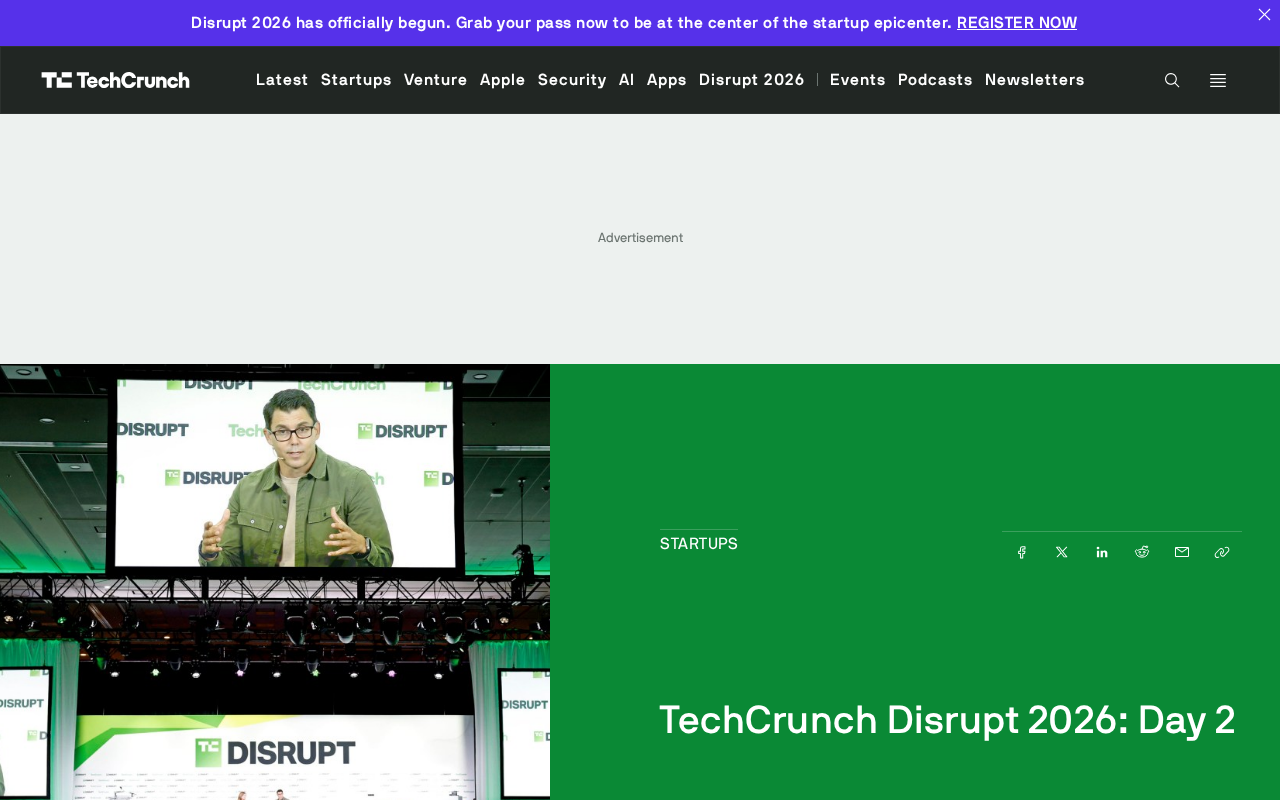
TechCrunch Disrupt 2026 Day 2 centered on AI, boosting investor connections and roundtables, with 50% off passes.
TechCrunch Disrupt 2026 Day 2 continued a high-density agenda dominated by AI, which permeated investor conversations, startup showcases, and industry discussions as the default tech foundation rather than a separate track. The day included investor-only closed-door sessions reinforcing the conference's capital-project connection role, and multiple small-scale, high-interaction roundtables on unresolved issues like model cost sharing and data compliance. Organizers kept pushing 50% off passes amid tech conference season competition. Overall, Disrupt is shifting from a media-run conference toward industry infrastructure, with its key challenge being to balance scale and depth of exchange.
TechCrunch Disrupt 2026 entered its second day, sustaining the high-density agenda of the opening day. According to RSS source information, the day's programming centered on AI, spanning investor-only sessions, multiple roundtables, and other segments, while organizers continued to push a 50% off pass registration offer.
AI Runs Through Everything: From Main Stage to Roundtables
The defining feature of Day 2's agenda was the full penetration of AI as a theme. Rather than isolating AI into a single breakout track, this year's Disrupt embedded AI threads across multiple segments, making it the common backdrop linking investor conversations, startup showcases, and industry discussions.
This arrangement itself signals something: in today's tech startup ecosystem, AI is no longer a "new category" that needs to be labeled separately — it's the default technological foundation. Whether a team is building enterprise services, consumer products, or infrastructure, it can't escape the shifts in cost structure and competitive logic that AI brings.
Investor-Only Sessions: The Value of Closed-Door Conversations
The day featured investor-only sessions. These closed-door segments are typically not livestreamed, designed to let LPs, VCs, and a limited number of founders engage in more direct exchange.
From a conference design perspective, the existence of investor-only sessions shows Disrupt is still reinforcing its platform identity as a connector between capital and projects. Public talks convey trend judgments, while closed-door sessions carry the actual matchmaking function. For attendees, whether they can access these sessions often depends on their pass tier.
The Role Difference Between LPs (Limited Partners) and VCs (Venture Capitalists)
An LP is the funding source — typically pension funds, university endowments, family offices, or fund-of-funds — that gives money to a GP (General Partner, i.e., the fund management team) to invest in projects, without directly participating in investment decisions. A VC is the institution actually making investment decisions, which may be the GP team itself or an independent venture capital firm. In Disrupt's investor-only sessions, the two roles have different priorities: LPs focus on overall fund returns, asset allocation, and exit cycles, while VCs focus on deal flow, valuation, and the competitive landscape of specific sectors. This explains why closed-door sessions tend to invite by identity tier — putting LPs and VCs at the same table easily derails the conversation. For founders, access to LPs has limited value; what's truly valuable is establishing direct contact with VCs who have capital to deploy.
Roundtables: The Small-Scale, High-Interaction Format Continues
Day 2 scheduled multiple roundtables. Compared to main-stage talks, roundtables emphasize peer-to-peer exchange among participants, with topics that are usually more focused and discussions that go deeper.
On AI-related topics, the roundtable format is especially suited to exploring questions that have no standard answers yet — such as how to split model costs, where the boundaries of data compliance lie, and how small teams can find openings under pressure from big tech. These topics are hard to fully address through one-way presentations; they require multi-party collision.
50% Off Passes: The Organizer's Registration Incentive
One detail that appears repeatedly in event information is a 50% off pass discount for registration. This is both a standard ticketing strategy and a reflection of a layer of competition beyond the agenda for large tech conferences: how to attract attendees to lock in their plans early during a dense conference season.
For those considering attending, the existence of a discount window lowers the decision cost, but the real value still depends on whether the agenda matches their needs — whether they're looking for investment, customers, or simply industry information.
Scheduling Competition in Tech Conference Season
North American tech conferences are highly concentrated in the fall each year. Beyond TechCrunch Disrupt, there are Web Summit, SaaStr Annual, AWS re:Invent, and industry summits across various verticals, most clustered from September to November. Attendees' budgets, travel time, and team capacity are all limited resources. Once a conference is locked in, it's difficult to fit others into the schedule. Therefore, early-bird discounts and 50% off offers are essentially a lock-in strategy: trading a price difference for attendees making an exclusive decision early. For organizers, early registration also means earlier confirmation of cash flow and exhibitor scale, making it easier to arrange venues and sponsorship rights. For attendees, the real value of a discount depends on how well the agenda matches their goals; signing up purely to save money often isn't worth it.
Observation: Disrupt's Positioning Is Shifting
Looking at Day 2's information together, TechCrunch Disrupt is moving from being purely a "media-run conference" toward "industry infrastructure": using AI themes to guarantee topical heat on one hand, while maintaining actual connection efficiency through investor sessions and roundtables on the other.
Whether this dual positioning can continue to work depends on whether it can find a balance between scale expansion and depth of exchange. Judging from Day 2's arrangements, the organizers have at least made a formal attempt to address both.
(Note: This article is based on RSS source summaries; specific agenda details are subject to official announcements.)
The Evolution of the Media-Run Conference Model
TechCrunch has held Disrupt since 2007. Early on, its core was the Startup Battlefield and product launches, with a strong media identity — the conference content itself was newsworthy material. As tech media advertising revenue declined, running conferences gradually shifted from a content derivative business to one of the main revenue sources, giving organizers an incentive to move from "covering the industry" to "serving the industry." A typical marker of this transformation is the rising proportion of investor sessions, closed-door matchmaking, and paid matching, because these segments can directly create commercial value rather than merely producing coverage. The cost is that media independence may be diluted: when sponsors and paying attendees become core customers, agenda-setting inevitably tilts toward commercial needs. Disrupt's positioning shift is, in effect, a microcosm of the broader business model restructuring across the tech media industry.
One-line Summary
TechCrunch Disrupt 2026 Day 2 put AI at the center, strengthened investor connections and roundtable interaction, and pushed 50% off ticketing.
Paragraph Summary
TechCrunch Disrupt 2026 Day 2 continued a high-density agenda, with AI fully permeating the program — no longer confined to a separate track but embedded across investor conversations, startup showcases, and industry discussions as the default technological foundation. The day featured investor-only closed-door sessions, reinforcing the conference's platform identity as a connector between capital and projects; multiple roundtables used a small-scale, high-interaction format to focus on unresolved questions such as model cost sharing, data compliance boundaries, and entry points for small teams. Organizers continued to offer a 50% off pass discount, reflecting registration competition during tech conference season. Overall, Disrupt is moving from a purely media-run conference toward industry infrastructure, and whether it can balance scale expansion with depth of exchange is key to its positioning transformation.
Related articles

AI Compute Is the New Oil, But the Market Mechanism Has Yet to Take Shape
Hacker News compares AI compute to the new oil, noting the lack of price discovery, concentrated supply, and no hedging tools. The article analyzes structural issues in compute trading and explores a possible three-tier market of spot, contracts, and derivatives, plus the real impact on AI practitioners' cost management.

Running Full iOS 16.5 Firmware on Android Devices: Technical Demo or Marketing Gimmick?
A Hacker News post claims full iOS 16.5 firmware can run on Android, with 315 upvotes. This analysis argues it is more likely a web UI simulation than a true firmware port, and explores the value and risks of such projects.

Etsy Cracks Down on AI Slop: Addressing Buyer and Seller Anxieties
Etsy introduces stricter rules limiting AI-generated content in listings, addressing buyer confusion over AI products and seller fears of original work being diluted by AI slop.