TechCrunch Disrupt 2026 Day 2: The Wave of AI and Hardware Startups

TechCrunch Disrupt 2026 Day 2 spotlights AI deployment, robotics, and public safety, drawing 10,000+ attendees in San Francisco.
TechCrunch Disrupt 2026 Day 2 at Moscone West in San Francisco drew over 10,000 founders and developers. The agenda focused on AI, robotics, hardware innovation, and public safety, featuring Nvidia, Waabi, Benchmark, Flock Safety, and Recursive Intelligence. Over 300 startups exhibited, with AI matching tools facilitating meetings. Startup Battlefield 200 continued, offering $100K non-dilutive funding to winners, with projects spanning healthcare, life sciences, commerce, and security. Overall, AI is shifting from general capabilities to vertical deployment, hardware and robotics startups are surging, and non-dilutive funding is increasingly common.
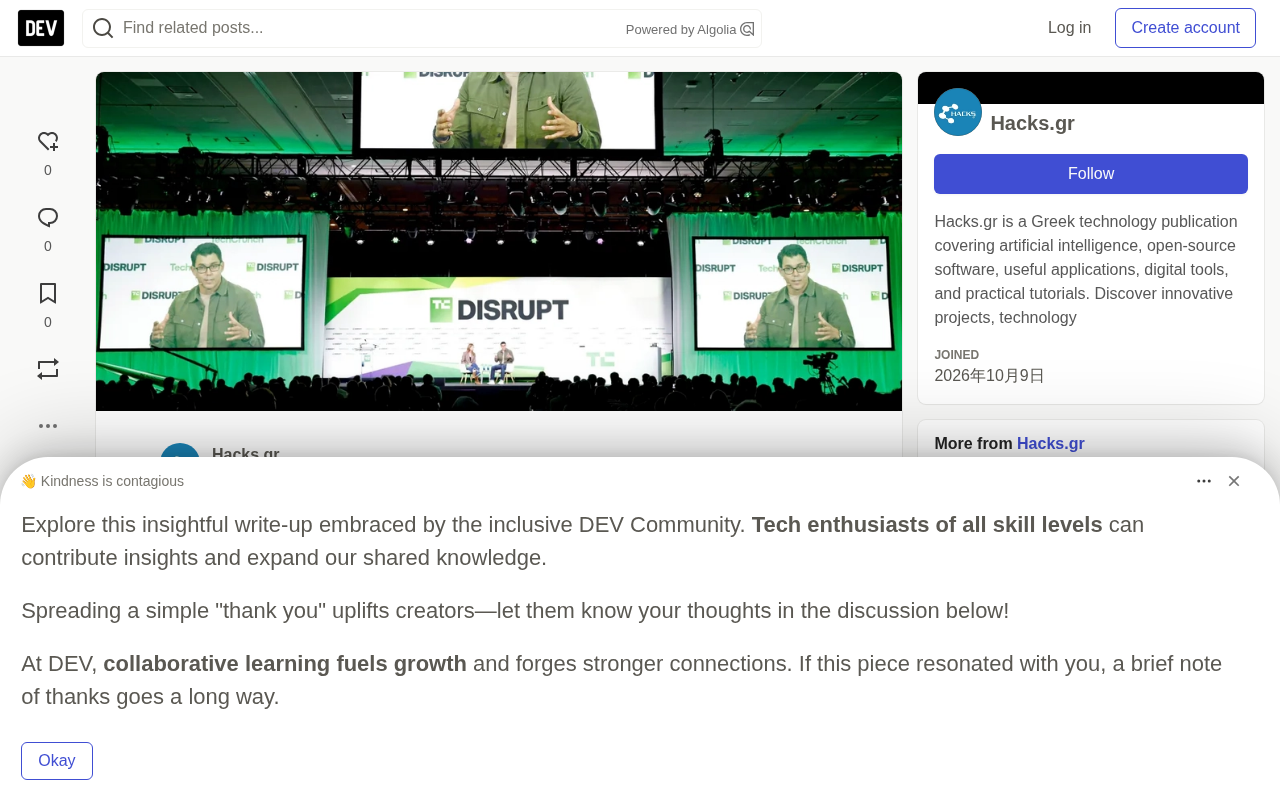
TechCrunch Disrupt 2026 entered its second day, with over 10,000 founders and developers gathering at the Moscone West venue in San Francisco. Compared to previous years, this year's agenda focuses more heavily on artificial intelligence, robotics, hardware innovation, and public safety, while the Startup Battlefield 200 competition has also reached a critical stage.
AI and Robotics Take Center Stage
Today's stage welcomed several heavyweight companies and investment firms, including Nvidia, Waabi, Benchmark, Flock Safety, and Recursive Intelligence. These names span the full spectrum from chips and autonomous driving to public safety AI.
Nvidia's presence comes as no surprise—it remains an unavoidable player in AI training and inference hardware. Waabi represents the technological frontier of the autonomous trucking segment, with its simulation-first approach being controversial in the industry yet repeatedly favored by capital. Benchmark, as a veteran venture capital firm, appearing here typically signals they are watching for investment opportunities in the next wave of infrastructure or application layers.
Flock Safety focuses on AI cameras and data analytics in the public safety sector, while Recursive Intelligence likely involves automated machine learning or recursive reasoning-related technologies. Judging from the speaker lineup, this year's Disrupt AI narrative is shifting from "model capabilities" to "deployment scenarios"—hardware, security, and logistics are all concrete grounds for deployment.
Waabi's simulation-first approach refers to this autonomous trucking company not relying on large-scale real-world road testing to train its driving systems, but instead building its training and validation pipeline around high-fidelity generative simulation environments (such as virtual cities, extreme weather, and rare accident scenarios).
Supporters of this approach argue that the cost and timeline of covering long-tail scenarios through real-world road testing are untenable, and that simulation can dramatically accelerate iteration and reduce safety risks. Skeptics worry that an insurmountable "gap" remains between simulation and reality, and that models may perform excellently in virtual environments but fail on real roads. Waabi was founded by Raquel Urtasun, former chief scientist at Uber ATG, and its technical thesis is precisely to use generative AI to build a simulation engine for the driving world.
Recursive Intelligence as a name points to research directions involving "recursive reasoning" or "recursive self-improvement"—that is, having models not just complete a single forward inference, but repeatedly invoke their own outputs for verification, correction, and re-reasoning, thereby improving reliability on tasks requiring multi-step reasoning such as mathematics, code, and planning.
A related dimension is automated machine learning (AutoML)—using AI to design and optimize the architecture and hyperparameters of AI models themselves. Regardless of which specific path it points to, such companies typically sit at the intersection of model capabilities and engineering efficiency, representing a frontier but also harder-to-validate commercial direction in the current AI infrastructure layer.
300+ Startups Exhibit, AI Matching Tools Boost Efficiency
The exhibition area features over 300 startups showcasing their products. One notable detail is that attendees can use AI-powered social tools to schedule meetings. These tools typically perform intelligent matching based on attendees' interest tags, company stages, and funding needs, reducing ineffective networking and allowing founders to spend time on conversations that are truly likely to lead to partnerships.
For early-stage entrepreneurs, the value of Disrupt lies not only in the main stage talks but also in these random yet high-density connections. The introduction of AI matching tools essentially reduces the "luck" component and increases the "strategy" component.
Startup Battlefield 200: Competing for $100K in Non-Dilutive Funding
The Startup Battlefield continues to advance, with participating teams from healthcare, life sciences, commerce, and security sectors. The eventual winner will receive $100,000 in non-dilutive funding—meaning no equity needs to be given up, which is a fairly friendly term for early-stage teams.
Looking at the distribution of tracks, healthcare and life sciences account for a considerable proportion, consistent with the热度 of AI in drug discovery and diagnostic assistance over the past few years. Commerce and security projects focus more on enterprise efficiency and risk management, reflecting that under the current macroeconomic environment, solutions that can directly deliver cost reduction, efficiency gains, or compliance value are more favored by judges.
Non-dilutive funding refers to a form of financing in which entrepreneurs receive capital without giving up company equity. Common sources include government grants (such as the SBIR/STTR programs in the United States), research funds, competition prizes, and certain revenue-sharing agreements.
For early-stage teams, the value of non-dilutive funding lies in: it does not dilute the ownership stakes of founders and early employees, does not introduce new board seats or investor demands, and does not force fundraising at a low valuation. The trade-offs are typically limited amounts, long application cycles, and attached usage restrictions or milestone requirements. Therefore, this type of funding is better suited as transitional ammunition before a seed round rather than a primary source of long-term growth.
The Intersection of Public Safety and Hardware Innovation
Today's discussions also featured a dedicated public safety topic. The participation of companies like Flock Safety indicates that AI applications in security are shifting from simple video surveillance to behavior analysis, license plate recognition, and cross-regional data collaboration. The privacy and ethical discussions these technologies raise are expected to be brought up during Q&A sessions as well.
On the hardware side, beyond robot bodies, sensors, edge computing modules, and specialized chips are also highlights this year. As large models become increasingly commoditized, differentiation and cost control at the hardware level will become new competitive barriers.
License plate recognition (LPR/ALPR) and cross-regional data collaboration represent the most controversial technology combination in public safety AI. A single camera's license plate recognition can only record vehicle information at a specific intersection at a specific moment, but when databases across multiple cities and multiple operators are connected, long-term vehicle travel trajectories can be reconstructed.
Supporters argue this helps track stolen vehicles, find missing persons, and solve cross-regional cases. Critics point out that this capability essentially constitutes mass continuous surveillance of the public, and once data is misused or leaked, the consequences are difficult to reverse. Several cities in the United States have already passed ordinances restricting or prohibiting government use of such systems, and related litigation and legislation continue to advance.
Trends Worth Watching
Judging from the second day's agenda, TechCrunch Disrupt 2026 sends several signals: AI is shifting from general capability demonstrations to deep vertical scenario cultivation; startup enthusiasm for hardware and robotics is rebounding; and non-dilutive funding models are becoming increasingly common in early-stage competitions. For those following tech startups, the upcoming Startup Battlefield finals and main stage fireside chats will be key moments for gaining first-hand information.
One-line Summary
Day 2 of TechCrunch Disrupt 2026 focuses on AI deployment, robotics, and public safety, with over 10,000 attendees gathering in San Francisco.
Paragraph Summary
Day 2 of TechCrunch Disrupt 2026 took place at Moscone West in San Francisco, with over 10,000 founders and developers participating. The agenda focused on AI, robotics, hardware innovation, and public safety, with companies including Nvidia, Waabi, Benchmark, Flock Safety, and Recursive Intelligence taking the stage. The exhibition area featured over 300 startups, and AI matching tools helped attendees schedule meetings efficiently. Startup Battlefield 200 continued its competition, with winners receiving $100,000 in non-dilutive funding, and participating projects concentrated in healthcare, life sciences, commerce, and security. Overall, AI is shifting from general capability demonstrations to vertical scenario deployment, hardware and robotics startup enthusiasm is rebounding, and non-dilutive funding is becoming increasingly common in early-stage competitions.
Related articles

Frontend to AI Agent Development: A Frontline Architect Explains Career Paths and Opportunities
A frontline AI architect explains the industry changes and practical paths for frontend developers transitioning to AI Agent development: why pure frontend jobs are disappearing, why Agent + full-stack has become mainstream in hiring, and three transformation routes—Agent development engineer, FDE, and remote contracting—along with corresponding learning strategies.

How to Choose an AI Agent Development Course: Five Pitfall-Avoidance Guidelines
A mechanical-engineering career changer's two-year pitfall-tested checklist for screening AI Agent development courses: complete delivery pipeline, resume-worthy projects, real development perspective, update frequency, and coaching feedback—with concrete judgment methods and pitfall-avoidance tips.

Coze AI Agent Building for Beginners: A Zero-Code AI Agent Development Guide
Coze, ByteDance's one-stop AI application development platform, supports zero-code drag-and-drop AI agent building. This article outlines Coze's core concepts, three advantages, differences between the domestic and international versions, and the distinction between agents and apps, helping beginners quickly get started with AI Agent development.