Tencent Hunyuan Hy-MT3 Open-Sourced: 102-Language Translation, 3B Activated Parameters Rival Flagship Closed-Source Models
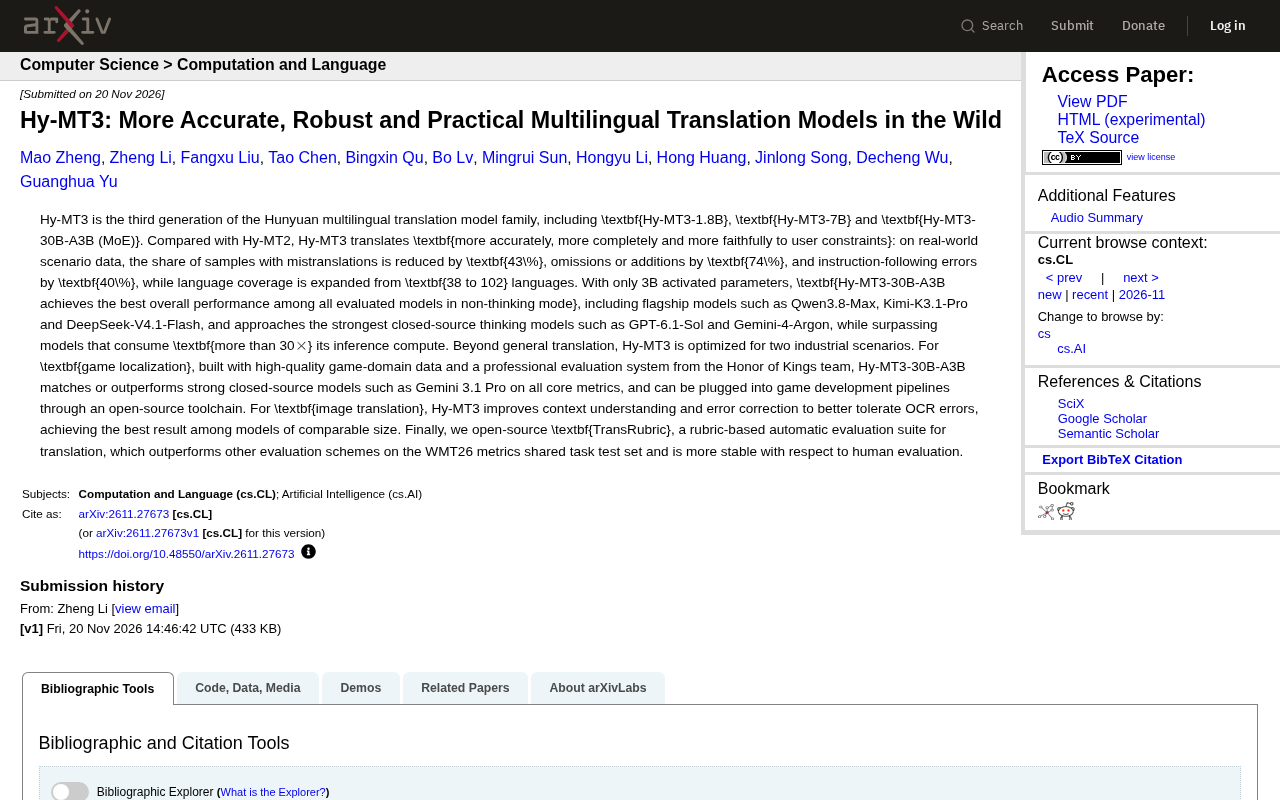
Tencent Hunyuan releases Hy-MT3 translation model covering 102 languages, benchmarking flagships with 3B activated parameters.
Tencent Hunyuan has released Hy-MT3, its third-generation multilingual translation model, in 1.8B, 7B, and 30B-A3B (MoE) sizes. It cuts mistranslations by 43%, omissions/additions by 74%, and instruction-following errors by 40% on real-world data, and expands coverage from 38 to 102 languages. The 30B-A3B variant activates only 3B parameters and is claimed to outperform flagship models like Qwen3.8-Max and approach top closed-source thinking models. It is optimized for game localization and image translation, and the team has open-sourced the TransRubric evaluation suite.
Title
Tencent Hunyuan Hy-MT3 Open-Sourced: 102-Language Translation, 3B Activated Parameters Rival Flagship Closed-Source Models
Meta Description
Tencent Hunyuan releases Hy-MT3 multilingual translation model: 43% fewer mistranslations, 74% fewer omissions/additions, language coverage expanded to 102, 30B-A3B rivals flagship closed-source models with 3B activated parameters, optimized for game localization and image translation, and open-sources the TransRubric evaluation suite.
Article Content
The Tencent Hunyuan team has released Hy-MT3, its third-generation multilingual translation model, in three sizes: 1.8B, 7B, and 30B-A3B (MoE). The core selling points of this generation are clear: substantially fewer translation errors on real-world scenario data, language coverage expanded from 38 to 102, and outperforming multiple flagship models in non-thinking mode with only 3B activated parameters.
Three Key Metrics for Translation Quality
Compared with the previous generation Hy-MT2, Hy-MT3 shows significant error rate reductions on real-world scenario data: mistranslated samples down 43%, omissions or additions down 74%, and instruction-following errors down 40%.
Among these numbers, the most noteworthy is the 74% reduction in omissions and additions. Translation models often produce missing content or add content of their own when handling long texts, complex formats, or constrained conditions—which is fatal for real-world deployment, since users can hardly verify sentence by sentence whether the translation is complete. A 74% improvement means the model has made substantive progress in completeness, not just "translating more smoothly."
A 40% reduction in instruction-following errors points to another pain point: whether the model can reliably follow user-provided glossaries, style requirements, and format constraints. This metric directly determines whether a translation model can enter production workflows.
3B Activated Parameters, Benchmarking Against Flagship Closed-Source Models
Hy-MT3-30B-A3B adopts a MoE architecture and activates only 3B parameters during inference. According to the official description, in non-thinking mode its overall performance is the best among all evaluated models, including flagship models such as Qwen3.8-Max, Kimi-K3.1-Pro, and DeepSeekAd-V4.1-Flash; it also approaches the strongest closed-source thinking models such as GPT-6.1-Sol and Gemini-4-Argon, and surpasses models that consume more than 30 times its inference compute.
It should be noted that the above comparison data comes from the official release and has not yet been independently reproduced by third parties.
This combination of "small activated parameters, high performance" is highly significant for high-frequency invocation scenarios like translation. In the cost model of translation APIs, inference compute is one of the main expenses; 3B activated parameters means the cost per request can be kept very low while maintaining quality close to flagship models.
MoE (Mixture of Experts) architecture's core idea is to split a large model into multiple "expert" subnetworks, with each token routed to only a few of these experts during inference, so that total parameter count and activated parameters per inference can be decoupled. The naming Hy-MT3-30B-A3B indicates total parameters of about 30B and about 3B activated per token.
The engineering significance of this design is that model capacity (which determines knowledge breadth and language coverage) is carried by total parameters, while inference cost (memory bandwidth, compute consumption) is mainly determined by activated parameters. For tasks like translation with controllable input/output length and extremely high invocation frequency, activated parameters directly determine the compute overhead per request, so 3B activation paired with 30B capacity is a trade-off between cost and quality. Note that the memory footprint of MoE models still approaches the total parameter count, so the hardware threshold for deployment does not decrease linearly with smaller activated parameters.
Game Localization: Co-Built with the Honor of Kings Team
Hy-MT3 has been specifically optimized for two industrial scenarios, the first being game localization. According to the official statement, this part used high-quality game-domain data and the professional evaluation system of the Honor of Kings team; Hy-MT3-30B-A3B matches or exceeds strong closed-source models such as Gemini 3.1 Pro on all core metrics, and can be integrated into game development pipelines via open-source toolchains.
The difficulty of game localization lies in terminology consistency, character tone, and cultural adaptation. General translation models often perform inconsistently in these dimensions, and integration into development pipelines means the model must output formats that can be directly consumed by engineering systems. The officially emphasized "pluggable" toolchain shows that they are not just releasing model weights but also solving engineering integration problems.
Image Translation: Tolerating OCR Errors
The second optimized scenario is image translation. Hy-MT3 improves context understanding and error correction capabilities, has better tolerance for OCR recognition errors, and achieves the best results among models of the same size.
The typical pipeline for image translation is OCR first, then translation, and OCR itself introduces typos, missing characters, and line-break errors. The traditional approach is to correct OCR results as much as possible before translation, but Hy-MT3's approach is to give the translation model its own fault tolerance, using context to infer the correct meaning. This is very practical in scenarios such as menus, street signs, and comics—where text recognition quality is often uneven.
OCR (Optical Character Recognition) is the process of detecting text regions in images and converting them into text, typically including three stages: text detection, character recognition, and layout/reading-order restoration. Each stage introduces noise: low resolution or artistic fonts cause recognition errors, complex layouts cause line breaks and order confusion, and handwriting or special fonts cause character confusion.
Traditional image translation uses a serial pipeline of "OCR → cleaning → translation," where errors are amplified at each stage and cleaning rules struggle to cover all scenarios. Making the translation model directly tolerate noisy OCR text essentially uses the language model's contextual priors to correct recognition errors—for example, inferring misrecognized characters based on semantics and collocations. This aligns with the idea of "using context to repair noisy input" in document-level machine translation, but places higher demands on the model's multilingual knowledge and robustness.
Open-Sourcing the TransRubric Evaluation Suite
In addition to the model itself, the team has also open-sourced TransRubric, an automatic translation evaluation suite based on scoring rubrics. It is officially claimed to outperform other evaluation schemes on the WMT26 metrics shared task test set and to be more stable than human evaluation.
Evaluating translation models has always been difficult: traditional metrics such as BLEU have limited correlation with human judgment, while human evaluation is costly and inconsistent. TransRubric adopts a rubric-based approach, attempting to find a better balance between automation and human judgment. For teams working on translation model research, the value of this suite may be no less than that of the model itself.
BLEU scores by measuring n-gram overlap between the translation and reference translations; its limitation is that it only measures surface lexical matching and is insensitive to synonymous substitutions, word-order adjustments, and semantically equivalent expressions, so its correlation with human judgment is limited. Subsequent metrics such as chrF and COMET improved on character-level matching and neural semantic similarity respectively, but most still rely on reference translations.
Rubric-based evaluation draws on the LLM-as-a-Judge paradigm: it gives the evaluation model a set of explicit dimensions and scoring criteria (such as accuracy, completeness, fluency, and terminology consistency) so that it outputs structured scores. This approach is closer to the human evaluation thought process and makes it easier to explain score deductions, but the cost is introducing the evaluation model's own preference bias and being highly sensitive to the design quality of the rubric. WMT's metrics shared task is precisely the evaluation project dedicated to comparing the consistency of various automatic evaluation metrics with human judgment.
The Practical Significance of This Generation
Judging from the release information, Hy-MT3 is not positioned as an all-round model pursuing general capabilities, but rather as one that goes deep into the vertical task of translation. 102-language coverage, customization for industrial scenarios, and accompanying evaluation tools—this combination points to real production deployment rather than leaderboard chasing.
For developers, the three sizes offer different deployment options: 1.8B suits on-device or low-resource environments, 7B is the mainstay for general deployment, and 30B-A3B, under the MoE architecture, trades lower inference cost for quality close to flagship models. What it can actually achieve still needs to wait for community hands-on testing before drawing conclusions.
One-line Summary
Tencent Hunyuan releases the Hy-MT3 multilingual translation model, covering 102 languages and benchmarking against flagship models with 3B activated parameters.
Paragraph Summary
The Tencent Hunyuan team has released Hy-MT3, its third-generation multilingual translation model, offering three sizes: 1.8B, 7B, and 30B-A3B (MoE). Compared with the previous generation, the model reduces mistranslated samples by 43%, omissions or additions by 74%, and instruction-following errors by 40% on real-world scenario data, while expanding language coverage from 38 to 102. The 30B-A3B variant uses a MoE architecture with only 3B activated parameters during inference; it is officially claimed to outperform flagship models such as Qwen3.8-Max, Kimi-K3.1-Pro, and DeepSeek-V4.1-Flash in non-thinking mode and to approach the strongest closed-source thinking models. The model is optimized for two industrial scenarios: game localization, for which data and evaluation systems were co-built with the Honor of Kings team, and image translation, which improves tolerance for OCR errors. The team has also open-sourced TransRubric, a rubric-based evaluation suite.
Related articles

David Fincher's New Film Accused of Being AI-Generated? The Truth Behind the Controversy
David Fincher's new film *The Further Misadventures of Cliff Booth* is accused of using AI, with a carriage shot in the trailer sparking controversy. Netflix's acquisition of Ben Affleck's AI company and Fincher's own openness to AI keep suspicions alive. This article sorts out the controversy and the views of all sides.

FCC Clears SpaceX's Space-Based AI Data Centers: A Debate Over Regulatory Boundaries
The FCC approved SpaceX's plan to deploy AI data centers in space but dismissed opponents' key concerns about scientific research impacts as beyond its regulatory authority. This article analyzes the regulatory boundary issues behind the decision, the deeper tensions of space-based AI infrastructure, and its implications for the industry.

Why Are Latinos Nearly Half of the U.S. Border Patrol?
Latinos hold nearly half of the U.S. Border Patrol and about 30% of ICE. Vox's Khalil Green explores their motivations, identity tensions, and why enforcement work ≠ MAGA.