Tencent Hunyuan HY3 In-Depth Review: How a Small Open-Source Model Punches Above Its Weight
Tencent's Hunyuan HY3: a compact open-source MoE model that rivals larger rivals in coding at a fraction of the cost.
Tencent's open-source reasoning model Hunyuan HY3 uses a MoE architecture with 295B total and 21B active parameters, released under Apache 2.0. With configurable reasoning effort, it rivals DeepSeek V4 Pro in coding and front-end tasks while costing up to 35x less, making it a compelling small-but-mighty open-source choice.
Tencent has officially released the Hunyuan HY3 reasoning model, a refined version following its earlier preview release. As another open-source achievement from a domestic AI lab, HY3 has quickly captured widespread attention in the open-source community thanks to its relatively compact size, highly competitive coding and front-end performance, and permissive Apache 2.0 license. Drawing on hands-on testing data from several overseas AI bloggers, this article offers an in-depth look at the model.
Model Architecture and Core Features
HY3 adopts a Mixture of Experts (MoE) architecture, with a total of 295 billion parameters, 21 billion active parameters, 192 experts, and a Top-8 routing mechanism.
About MoE architecture: Mixture of Experts (MoE) is an architectural design that splits a large neural network into multiple "expert" sub-networks. During inference, a router dynamically selects and activates only a few of these experts based on the input content, rather than running all parameters. This means a model's "total parameter count" and "active parameter count" are two entirely different concepts: HY3 has as many as 295 billion total parameters, but only 21 billion actually run during each inference pass, dramatically reducing computational overhead. The Top-8 routing mechanism means that each token activates only the 8 most relevant experts out of 192. This sparse activation strategy allows MoE models to store richer knowledge than dense models while maintaining lower inference latency and cost. Mainstream large models such as GPT-4, Mixtral, and DeepSeekAd all use similar architectures. This design allows the model to deliver practical capabilities rivaling much larger models while keeping inference costs low.
HY3 is primarily aimed at scenarios such as reasoning, agentic workflows, coding, and real-world production deployment. Its most notable feature is configurable reasoning effort — by default it runs in a fast "no deep thinking" mode, but it can also switch to low and high reasoning modes to flexibly handle coding, math, and multi-step tasks of varying complexity. Behind this "tiered reasoning" design lies the deep application of reinforcement learning techniques in large-model post-training in recent years. Through reinforcement learning variants such as GRPO and REINFORCE, the model learns to "defer reasoning" — performing multiple steps of self-reflection and error correction before answering. The rise of reasoning models like DeepSeek-R1 and o1 is exactly the product of this approach, and HY3's configurable reasoning tiers essentially reflect multi-modal reasoning behaviors trained under reinforcement learning strategies of varying intensity.
In terms of open-source licensing, HY3 is released under the Apache 2.0 license. Apache 2.0 is one of the most permissive licenses in the open-source software world, allowing users to freely use, modify, distribute, and commercialize the software, with the only requirement being the retention of copyright notices and license text. Compared with the "research-use-only" restrictions or custom licenses with commercial-use clauses adopted by some AI models, Apache 2.0 imposes almost no additional legal burden on enterprise users — companies can deploy HY3 directly into production environments, build commercial products, and even fine-tune and redistribute the model without applying for authorization from Tencent or paying royalties. As the commercialization path for open-source AI models becomes clearer, the choice of license often directly determines whether a model can be adopted at scale within the enterprise ecosystem. According to Tencent, despite HY3's significantly smaller size, its performance is strong enough to compete head-on with flagship models at the trillion-parameter scale.
Of course, the model also has clear shortcomings: its context window supports only 256K, which feels somewhat inadequate today as demand for long-text processing continues to grow. To compensate, HY3 introduces improved anti-hallucination techniques, more reliable tool-calling capabilities, and, building on the preview version, uses higher-quality post-training data along with substantially strengthened reinforcement learning strategies.
Coding Benchmarks: A Head-to-Head with DeepSeek
In the critical dimension of coding ability, HY3 delivers impressive results. On the SWE-Bench Multilingual test, HY3 scored 75.8, slightly behind DeepSeek V4 Pro's 76.2; but on the more challenging SWE-Bench Pro, HY3 surpassed DeepSeek V4 Pro with a score of 57.9 versus 55.4.
About the SWE-Bench benchmark: SWE-Bench is currently recognized in both academia and industry as one of the most authoritative benchmarks for coding ability, proposed by a team at Princeton University. It extracts real issues and their corresponding fix PRs from actual GitHub repositories, requiring models to locate problems directly within the codebase and generate valid patches. It evaluates end-to-end software engineering capability rather than mere code generation. SWE-Bench Multilingual is its multilingual extension, covering multiple programming languages beyond Python; SWE-Bench Pro further raises the bar in task difficulty and evaluation rigor, filtering out relatively simple problem sets. The score differences on these two subsets often reveal how a model's capabilities diverge between "easy problems" and "hard problems," making them an important reference for judging a coding model's true engineering ability.
HY3 has not yet dethroned GLM 5.2, the benchmark leader in the open-source space, but it can already trade blows with DeepSeek V4 Pro on coding and agentic benchmarks — and at a much smaller size. Tencent also reports that HY3 shows notable improvements in reasoning, long-context understanding, office productivity, financial analysis, front-end development, and game creation.
From a pricing perspective, HY3's cost-effectiveness is equally astonishing: when accessed via OpenRouter, input tokens cost just $0.14 per million and output tokens $0.58 per million. OpenRouter is an intermediary platform that aggregates the APIs of multiple AI models, allowing developers to call models from dozens of providers — including OpenAI, Anthropic, Google, and the open-source community — through a unified interface. For reference, Claude Opus 4's input pricing is about $15 per million tokens and GPT-4o about $2.5 per million tokens, making HY3 roughly 1/100 the cost of the former and 1/17 the cost of the latter. For enterprise scenarios requiring large-volume calls (such as code review pipelines or automated front-end generation), a cost difference of this magnitude is enough to fundamentally change a product's economic model. Compared with proprietary models that easily cost several dollars, this pricing is a steal.
Front-End and Game Creation Hands-On Testing
Multiple reviewers agree that front-end development is one of HY3's strongest areas. It skillfully leverages multiple third-party packages to build visually rich pages — from scroll-triggered animations to background animation packs, down to details like cursors and typography components — with an impressive level of polish.

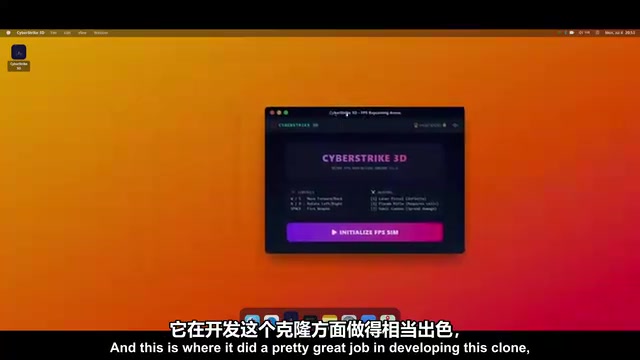
In one macOS webpage cloning test, HY3 generated a complete interface with independent SVG icons, created a 3D animation effect for the "CyberStrike 3D" game icon, and produced a playable FPS shooting mini-game. Although the top and bottom bar interactions had flaws and some app features were incomplete, the overall completeness is remarkable for an open-source model.
On SVG drawing tasks, HY3 also performed well — whether rendering a house scene with a firefly ambiance or a butterfly pattern with gradient wings and symmetrical structure, the model proactively added animation effects without being asked.

In a 3D Earth visualization comparison, HY3 competed alongside Opus 4.8 and Fable 5. Although Fable 5 achieved the greatest realism, HY3's single-pass Earth generation — including cloud layers and atmospheric details — was even visually more impressive than that of Opus 4.8.
Multi-Party Comparisons: The Dual Advantage of Speed and Cost
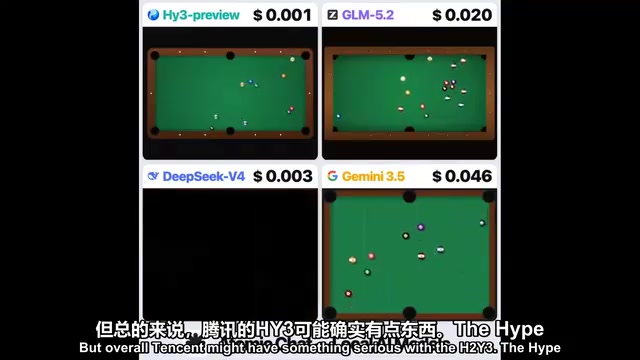
Several third-party reviews further validate HY3's competitiveness. Atomic Chat's comparison showed that in the task of building three self-contained HTML5 Canvas physics demos (a bowling simulation, air hockey, and a billiards break), HY3 consumed about 30,000 tokens at a cost of just a fraction of a cent; whereas Gemini 3.5 Flash generated 23,000 tokens but cost about 21 cents, and GLM 5.2 cost 7 cents.
Crucially, HY3's results across all three scenarios were essentially on par with Gemini 3.5 Flash — clean collision detection, believable motion trajectories, correct puck bounces, and proper billiard scattering — yet at about 35 times lower cost. Reviewers noted that GLM 5.2 remains strong in pure coding, but when a task requires "aesthetics, physical intuition, and simulation feel," HY3 comes out ahead. DeepSeek V4 was the most disappointing in this test, consuming the most tokens while producing the weakest results.
In another comparison, HY3 competed against Fable 5, Opus 4.8, and Sonnet 5 on three tasks: waves washing away a sandcastle, a factory assembly line, and an interactive 3D city built with Three.js. HY3 completed all tasks in about 14 minutes, noticeably faster than Fable 5 (18 minutes), Sonnet 5 (19 minutes), and Opus 4.8 (27 minutes). Reviewers praised it as "fast, clean, and surprisingly polished" — the sandcastle used a clever approximation, the factory logic had minor edge-case bugs, but the Three.js implementation of the 3D city reached frontier-level visual quality.
Conclusion: Small in Size, Big in Power
Taking all the hands-on testing into account, HY3 is not the "strongest open-source model" that crushes competitors across every metric, and it still lags behind proprietary flagships in the finesse of generation quality. But its true value lies in exceptional efficiency and cost-effectiveness — delivering clean code with a smaller footprint and lower cost, achieving practical performance far exceeding what its size and price would suggest.
For developers seeking an alternative to GLM 5.2, or teams that need to control costs in scenarios like front-end scaffolding and rapid prototyping iteration, Hunyuan HY3 is an option well worth serious consideration. The Apache 2.0 commercial license further lowers the barrier to entry. As open-source models continue to close in on the capability frontier of proprietary giants, "small but excellent" contenders like HY3 are quietly reshaping the competitive landscape of the open-source AI ecosystem.
Key Takeaways
Related articles
What Is Vibe Coding? The AI Programming Skill Every Developer Needs
What is Vibe Coding? Learn how AI programming is reshaping dev teams, why traditional programmers face displacement, and why Cursor & Claude Code matter.
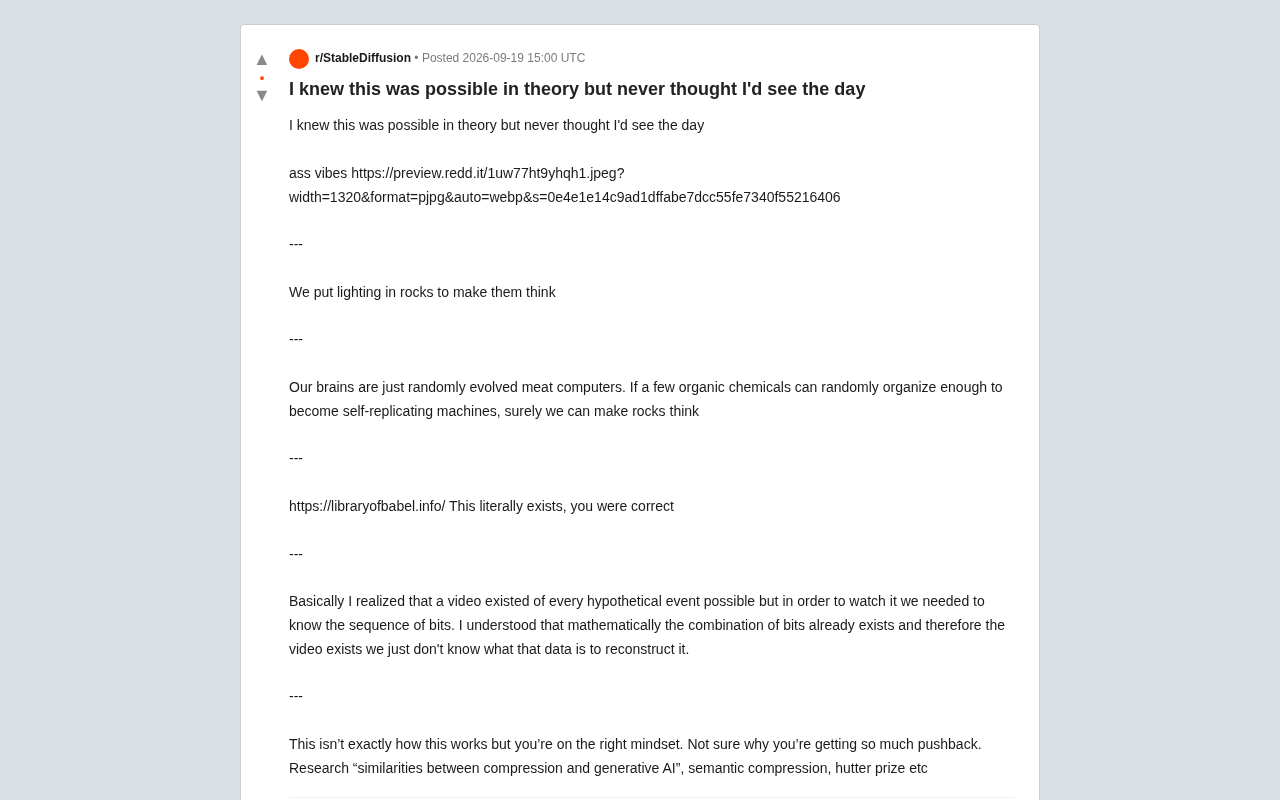
Making Rocks Think: A Philosophical Exploration of Generative AI and Information Compression
From a viral Reddit post to deep AI theory: why compression equals understanding, the Library of Babel thought experiment, semantic compression, and the Hutter Prize.

Irregular Warns: Four AI Lab Security Breaches Traced to the Same Root Cause
Irregular reveals four AI lab security breaches share a single root cause, exposing systemic risks from technology stack homogeneity across the AI industry.