Tencent Hunyuan Hy4 Fully Open-Sourced: 770B-Parameter Flagship Beats DeepSeek on Agent and Finance Benchmarks, But License Hides a Catch
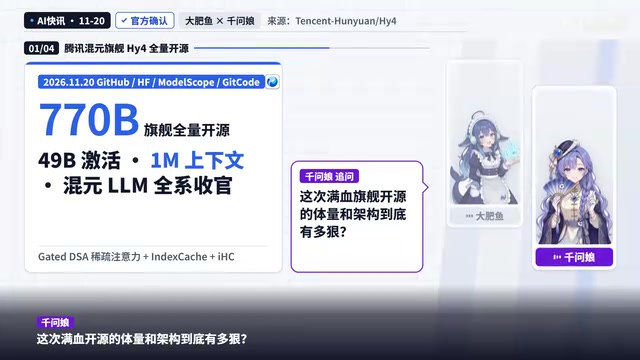
Tencent Hunyuan Hy4 fully open-sourced: 770B params, million-token context, tops benchmarks but has commercial revenue threshold
Tencent officially fully open-sourced flagship model Hunyuan Hy4, using sparse MoE with 770B total parameters, 49B activated per token, million-token context, and coefficient attention. It topped open-source leaderboards in real-world financial re-testing and research evaluations, surpassed DeepSeek on multiple Agent and finance benchmarks, and includes speculative decoding acceleration. Official releases provide instruction, quantized, and base versions, with a mixed-precision edge package compressing size to 215G. However, the article clarifies its license is not pure Apache 2.0 — commercial use has a $50M revenue threshold, personal use is unrestricted. Overall, Hy4 has solid specs and performs well professionally, but hardware requirements and license terms need evaluation before trying it.
Title
Tencent Hunyuan Hy4 Fully Open-Sourced: 770B-Parameter Flagship Beats DeepSeek on Agent and Finance Benchmarks, But License Hides a Catch
Meta Description
Tencent Hunyuan Hy4 flagship fully open-sourced: 770 billion parameters, million-token context, tops open-source leaderboards in finance and research evals, beats DeepSeekAd on some Agent and finance benchmarks. But the license isn't pure Apache — commercial use has a $50 million threshold, the quantized edge package is compressed to 215G, and personal use is unrestricted.
Article Content
Tencent's Hunyuan series has delivered a genuinely "full-power" release. According to a breakdown by a Bilibili creator in an AI news roundup, Tencent has officially fully open-sourced its flagship model Hy4 — 770 billion parameters, 49 billion activated per pass, million-token context — and introduced a "coefficient attention" mechanism for the first time. More importantly, it took the top open-source spot in real-world financial re-testing and research evaluations, beating DeepSeek on some Agent and finance benchmarks. However, this open-source release does not use the "permissive open-source, freely commercial" license that most news briefs have rumored — it hides a $50 million revenue threshold.
1. 770B Parameters + Million-Token Context: How Big Is This Open-Source Release
The core specs of Hy4 can be summed up in three numbers: 770 billion total parameters, 49 billion activated parameters, and a million-token context window. This is a classic sparse MoE architecture, meaning that although the model is enormous, each inference only activates a small subset of parameters — preserving capability while controlling compute consumption.
Million-token context is still a scarce capability among open-source models, and it directly determines whether a model can handle long documents, large codebases, or complex multi-turn Agent tasks. The Bilibili creator noted in the video that Hy4 "directly pays homage to coefficient attention" — "coefficient attention" here should refer to some coefficient-based improvement to the attention mechanism. Although the source material doesn't elaborate on the technical details, it's clear that this attention design is the key support for Hy4 maintaining performance in long-context scenarios.
In terms of scale, 770B total parameters is flagship-tier within the open-source camp, far exceeding most open-source models of the same generation. But large parameters also bring deployment challenges, which will be detailed later.
Sparse MoE (Mixture of Experts) architecture is currently the mainstream design approach for ultra-large-scale models. Unlike dense models that activate all parameters on every inference, MoE models contain multiple "expert" sub-networks internally, and each token is routed to only a few of them during inference — so "total parameters" and "activated parameters" are two different orders of magnitude. Hy4's 770 billion total parameters represent the model's overall capacity, while activating only 49 billion parameters per token determines the actual computational cost. The advantage of this design is obtaining capability close to a large-parameter dense model at a compute cost far smaller than the total parameter count. The trade-off is that VRAM usage is still calculated based on total parameters, and expert routing load balancing and communication overhead add extra engineering complexity. For the open-source community, MoE also means quantization and deployment strategies need special handling for the expert structure.
Million-token context window means the model can accept roughly 1 million tokens in a single pass. Roughly estimated in Chinese, this equates to hundreds of thousands of Chinese characters or thousands of pages of documents. The key difficulty of long-context capability isn't "fitting it in" but whether the model can maintain effective retrieval and reasoning over key information within ultra-long sequences — the industry commonly uses "needle-in-a-haystack" style tests to measure this. Attention computation scales quadratically with sequence length, so achieving million-token context typically requires combining sparse attention, chunked processing, positional encoding extrapolation, and similar techniques. The "coefficient attention" mentioned in the article falls into this category of improvements. For practical applications, long context directly affects the feasibility of long-document QA, large codebase understanding, multi-turn Agent memory, and similar scenarios.
2. Benchmark Reality: Agent and Finance Evaluations Top the Open-Source Leaderboard
Parameters are only paper strength — what really excites the community is the evaluation results. According to benchmark data cited by the Bilibili creator, Hy4 took first place among open-source models in both real-world financial re-testing and research evaluations, and surpassed DeepSeek on multiple Agent and finance benchmarks.

Finance-domain evaluations deserve particular attention. Real-world financial re-testing typically involves financial report comprehension, financial QA, numerical reasoning, and similar tasks, with extremely high accuracy requirements and little room for error. Hy4 topping such evaluations indicates that its instruction-following and reasoning capabilities in professional domains have reached a practical level. Research evaluations, meanwhile, focus more on complex reasoning and knowledge integration — together these two results sketch the image of an open-source flagship that is "usable in professional scenarios."
Another easily overlooked engineering highlight is speculative decoding acceleration. The Bilibili creator mentioned that Hy4 "comes with built-in speculative decoding acceleration, cutting latency/pressure dramatically" — "latency/pressure" here should refer to inference latency or VRAM pressure. Speculative decoding improves generation speed through a small-model draft plus large-model verification approach; for a model of 770B scale, this optimization directly affects real-world deployment usability.
It should be noted that the above benchmark data comes from the Bilibili creator's account, and the source material does not provide specific evaluation set names or comparison scores — readers should remain cautious when referencing them.
Speculative Decoding is an inference optimization technique that accelerates text generation without changing the model's output distribution. Its basic process: first, a small, fast "draft model" quickly generates several candidate tokens, then the target large model verifies these candidates in parallel in one pass; accepted tokens are kept directly, while rejected ones are resampled from the divergence point. Since the large model only needs one forward verification pass rather than per-token generation, overall throughput can be significantly improved, and theoretically the output matches the original model. For a model like Hy4 with 770B total parameters, inference latency and VRAM pressure are the biggest deployment bottlenecks; speculative decoding can improve response speed without sacrificing accuracy, making it a key supporting capability for engineering deployment.
3. Size Halved to 215G: Official Edge Package and Quantization Scheme
The most realistic question for 770B parameters is: can ordinary data centers and enthusiast users actually run it? Tencent's official answer is "here's a path that works."
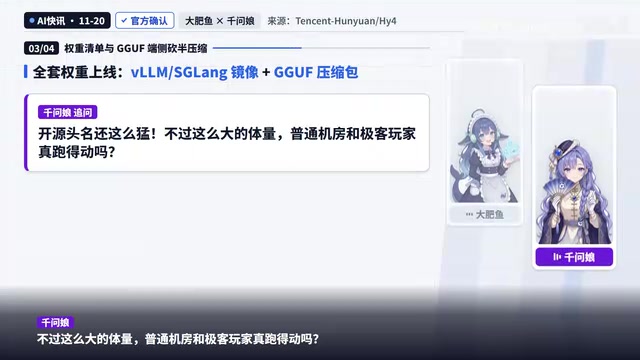
According to the Bilibili creator, the official release simultaneously provides instruction, quantized, and base models, along with a mixed-precision edge package that halves the size to 215G. This means a model that originally required large-scale clusters can run on smaller-scale hardware after quantization compression. 215G is still not light for high-end single machines or small workstations, but compared to the original 770B weight volume, it's already an order-of-magnitude reduction.
The instruction version is suitable for direct dialogue and Agent invocation, the quantized version targets resource-constrained scenarios, and the base version is left for teams that need continued pre-training or fine-tuning. The trio combination shows that Tencent's open-source release isn't just "dumping weights and calling it a day" — it considers the actual usage paths of different users. However, quantization inevitably brings accuracy loss, and whether the edge package's performance on complex reasoning tasks can approach the full-power version still needs community testing and verification.
4. The License Truth: Not Pure Apache — Where the $50 Million Threshold Hides
This is the most easily misread part of the entire news brief. The Bilibili creator explicitly warned: "News briefs across the internet got it wrong — it's not pure Apache."

According to the video, Hy4's open-source license is not the permissive Apache 2.0 but sets a threshold related to large-company commercial use: $50 million. Personal use is unrestricted, but if an enterprise commercializes by selling API interfaces and reaches this revenue threshold, it needs to pay attention to the license's additional constraints.
The impact scope of this clause is actually quite clear: for individual developers, researchers, and small-to-medium teams, daily use and experimentation are basically unaffected; but for cloud providers or AI API service providers with larger annual revenue, the license is no longer as simple as "freely commercial." The Bilibili creator's warning is direct — read the terms clearly before downloading, and don't be misled by the "permissive open-source" framing in news briefs.
This also reflects an industry trend: flagship open-source model licenses are moving from "completely open" toward "tiered constraints." The stronger the model capability, the more vendors tend to find a balance between openness and commercial protection. Hy4's choice is not an isolated case, but for developers accustomed to Apache licenses, it does require extra vigilance.
Apache 2.0 is one of the most commonly used permissive licenses in the open-source community, allowing users to freely use, modify, and distribute software, including for commercial purposes, without disclosing derivative code — only requiring retention of copyright and license notices. Many open-source models adopt this license, so the community often equates "Apache" with "freely commercial." But in recent years, some vendors have begun adopting custom "open-weight" licenses that allow download and personal use while setting revenue thresholds or additional authorization requirements for large-scale commercial use (such as providing API services). Such licenses are legally not OSI-defined open-source licenses but rather a tiered authorization model between fully open and closed source. Hy4's $50 million threshold is exactly a manifestation of this trend; before use, one must distinguish between "obtainable weights" and "freely commercial" as two different levels of rights.
5. Is It Worth Trying?
Overall, Hy4 is a full open-source release with solid specs and competitive benchmarks. 770B parameters, million-token context, topping open-source leaderboards in finance and research evaluations, and a companion quantized edge package — combined, these elements make it one of the few options in the current open-source camp that can match closed-source flagships in professional scenarios.
But two practical issues can't be avoided: first, the 215G quantized package still has hardware requirements, and ordinary users need to assess their own equipment; second, the license threshold means revenue conditions must be checked before commercial use. For individual developers and researchers, Hy4 is worth trying immediately; for enterprise users, it's recommended to have legal review the terms first before deciding whether to integrate it into production environments.
One-line Summary
Tencent Hunyuan Hy4 fully open-sourced: 770B parameters with million-token context, tops benchmarks but has revenue threshold for commercial use
Paragraph Summary
Tencent has officially fully open-sourced its flagship model Hunyuan Hy4, using a sparse MoE architecture with 770 billion total parameters, 49 billion activated per token, support for million-token context, and a "coefficient attention" mechanism. On evaluations, Hy4 topped open-source leaderboards in real-world financial re-testing and research evaluations, surpassed DeepSeek on multiple Agent and finance benchmarks, and comes with built-in speculative decoding acceleration to mitigate inference latency. On the engineering side, the official release simultaneously provides instruction, quantized, and base models, with a mixed-precision edge package compressing size to 215G. But the article specifically clarifies that its open-source license is not pure Apache 2.0 — commercial use has a $50 million revenue threshold, while personal use is unrestricted. Overall, Hy4 has solid specs and performs well in professional scenarios, but hardware requirements and license terms are two practical issues to evaluate before trying it.
Related articles
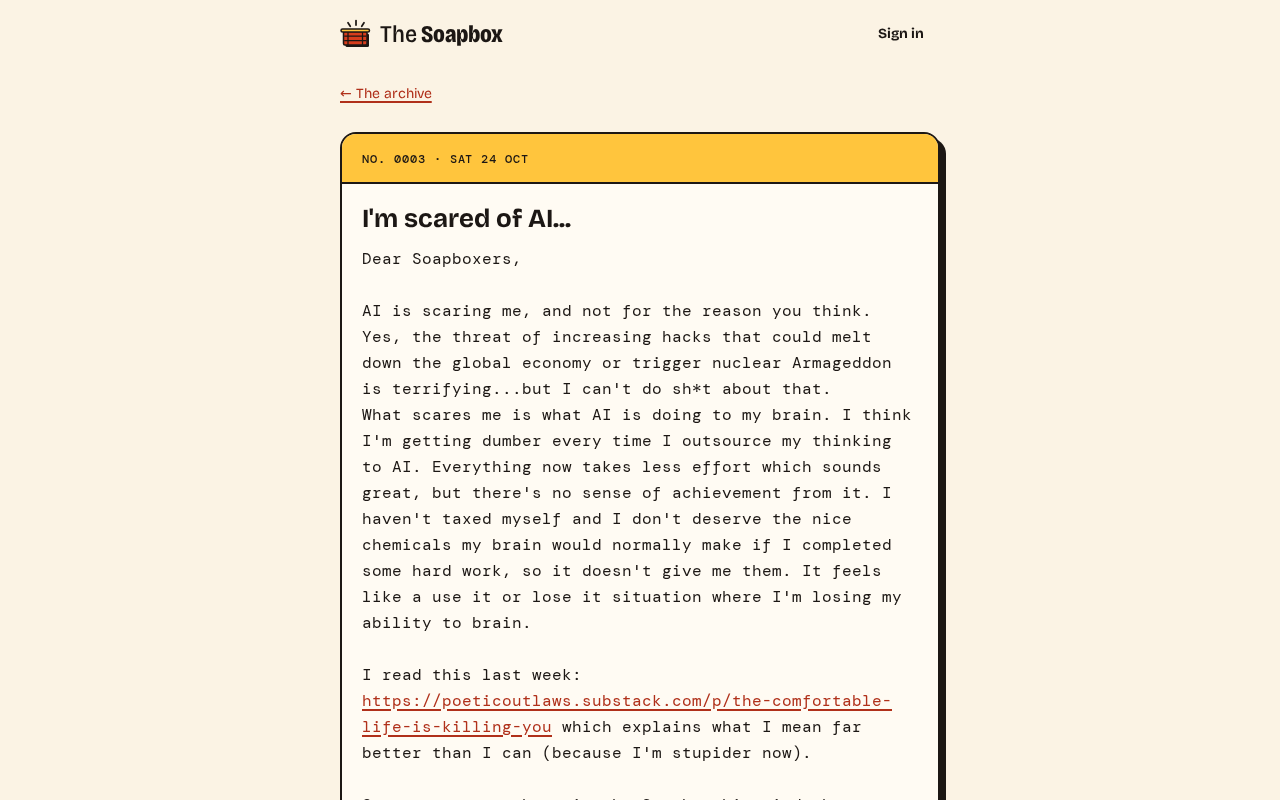
Fear of AI Is Spreading: A Technologist's Confession
A Hacker News post 'I'm Scared of AI' sparks debate with 212 points and 247 comments, showing AI anxiety spreading from the public into the tech community itself.

Unkernel: Compiling the Linux Kernel to WebAssembly
The Unkernel project compiles a real Linux kernel to WebAssembly, making it possible to run a complete kernel in the browser. This article covers its technical principles, challenges, and prospects.
New Claude Sonnet Model Tested: Performance Approaches Opus with Less Thinking
Anthropic quietly tests a new Sonnet model in Claude Code—performance approaches Opus 5.5 with far fewer thinking tokens, plus Codex transfer optimization, xAI's low-level rewrite, Google Antigravity updates, and the AI science understanding gap.