Tencent Hunyuan Joins the Open-Source Elite: Hallucination Rate Drops to 5.45%, DeepSeek Discusses Model Tiering at Wuzhen

Tencent Hunyuan 4 released, DeepSeek discusses open-source safety, ByteDance open-sources Agent model—open source and governance accelerate in tandem.
The article rounds up key AI news of the day. Tencent released Hunyuan 4, adding vision and computer operation for the first time, with hallucination rate dropping from 15.76% to 5.45% and open-sourcing planned, while admitting a gap with top closed-source models on frontier math. DeepSeek said at Wuzhen that open source may amplify security risks and is studying model tiering but remains committed to open source for AGI; CAICT and partners released an agent self-discipline convention the same day. ByteDance open-sourced an Agent foundation model in 35B and 122B sizes with training code and ~18,000 data samples. Other news includes leaked ChatGPT family subscriptions, India overtaking the US in weekly users, and Oracle cancelling a chip lease deal with Tencent.
Tencent's Hunyuan official release, DeepSeek discussing model tiering at the Wuzhen Summit, and ByteDance open-sourcing an Agent foundation model—on this day in AI, the twin themes of open source and safety were both pushed to the forefront.
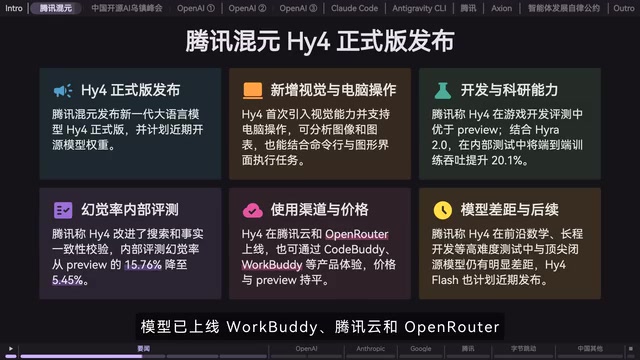
Tencent Hunyuan 4: Vision and Computer Operation Capabilities Debut
Tencent released the official version of its large language model Hunyuan 4, marking the first time the series includes visual understanding and computer operation capabilities. According to the official description, Hunyuan 4 can analyze complex charts, invoke tools, and handle professional software tasks by combining command-line and graphical interfaces, covering scenarios in development, finance, office work, and scientific research.
The most notable metric is the hallucination rate. Tencent's internal evaluation shows that Hunyuan 4's hallucination rate dropped from 15.76% in the preview version to 5.45%—a substantial reduction for an open-source model. Tencent also claims that Hunyuan 4 ranks first among open-source models in a retest of real-world financial tasks.
However, Tencent did not shy away from its shortcomings: on high-difficulty tests such as frontier mathematics and long-horizon development, Hunyuan 4 still has a clear gap compared with top closed-source models. This kind of statement is actually more informative than simply stacking benchmark rankings—it delineates the current capability boundaries of open-source models.
On the deployment front, Hunyuan 4 is now available on WorkBuddyAd, Tencent Cloud, and OpenRouter, with plans to open-source it soon. Hunyuan 4 Flash, which focuses on higher cost-effectiveness and faster inference speed, is also planned for release soon.
Hallucination rate is a key metric in large language model evaluation, referring to the frequency with which a model generates plausible-sounding but factually incorrect or unsupported content. Common evaluation methods include asking the model factual questions, summarizing long documents, or performing multi-step reasoning, then having humans or stronger models judge whether the output contains fabricated information. The lower the hallucination rate, the more reliable the model is in low-tolerance scenarios such as finance, healthcare, and law. However, evaluation sets and judgment criteria vary widely across vendors, so hallucination rate figures from different vendors are often not directly comparable. A more reasonable approach is to focus on relative changes between different versions from the same vendor.
DeepSeek Speaks at Wuzhen: Open Source Amplifies Security Risks, But We Stick With It
At the World Internet Conference Wuzhen Summit, a DeepSeekAd research engineer offered a rather candid assessment: open source may amplify some AI security risks, and the team is studying response measures such as model tiering.
On the other hand, DeepSeek made it clear that its commitment to open source is intended to accelerate the arrival of AGI. These two statements are not contradictory when taken together; they reflect the structural dilemma currently facing open-source model vendors—the more open the capabilities, the greater the surface for misuse; but closing off slows overall progress. Model tiering is essentially about finding an operable compromise between the two: different capability tiers correspond to different levels of openness and control requirements.
This approach echoes the industry self-regulation document released the same day. The China Academy of Information and Communications Technology, together with Tencent, Ant Group, Alibaba, Douyin, and other companies, released a self-discipline convention on agent development at the Wuzhen Summit, proposing eight self-regulatory measures covering agent trust systems, interconnection and interoperability, security protection, and user rights. The initiating units will take the lead in implementation and accept public oversight.
Model tiering generally refers to layered management of models based on capability, use-case risk, or degree of openness. Common practices include imposing stricter release reviews, access permissions, and usage constraints on the most capable models or those involving sensitive domains, while being relatively more permissive with less capable or highly general-purpose models. This approach shares similarities with the risk-tiering framework of the EU AI Act and the "progressive release" strategies of some vendors. The difficulty lies in how to quantify tiering standards, who determines them, and the fact that once open-source weights are released, they are hard to recall—tiering can only act on the pre-release admission stage.
OpenAI's Dual Moves: Family Subscription Leak and India Overtaking the US in Users
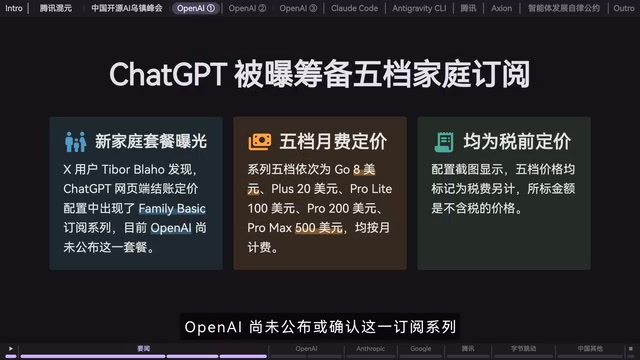
An X user discovered that ChatGPT's web checkout pricing configuration contains five tiers of Family Basic subscription plans, with monthly fees ranging from $8 to $500, all pre-tax. OpenAI has not announced or confirmed this subscription series, so this remains a configuration-level clue rather than an official release.
Another subscription-related piece of news: multiple users found that those who subscribe to ChatGPT Pro via Google Play can now claim API credits, with the entry point on the billing page. Some users report needing to refresh several times before it appears.
On user scale, OpenAI's India managing director said that India's ChatGPT weekly active users have surpassed those of the US and may even be the highest in the world, with user numbers doubling since January.
ByteDance Open-Sources Agent Foundation Model, Training Data Included
ByteDance released an open-source Agent foundation model (recorded in the source material as Axian 1.0), offering two sizes: 35B and 122B. The team says its training pipeline was completed with just two stages of supervised fine-tuning plus one stage of reinforcement learning, with multiple benchmark results comparable to leading commercial models. The training code and approximately 18,000 data samples were also made public.
Releasing training code and data together does more to advance community reproduction than open-sourcing weights alone. For the Agent direction, data mixing ratios and the reinforcement learning stage are often the real barriers.
Agent foundation models refer to models specifically optimized for agent tasks, with core capabilities including multi-step planning, tool invocation, environment interaction, and error recovery—differing from the training focus of general conversational models. Their training typically follows a "supervised fine-tuning + reinforcement learning" paradigm: first teaching the model basic behavioral patterns using expert trajectory data, then optimizing decision-making policies through reinforcement learning in verifiable task environments. When open-sourcing such models, the quality and mixing ratio of training data often determine reproduction results more than parameter count, so releasing data and code together is far more valuable to the community than publishing weights alone.
Toolchain and Industry: Anthropic Loosens Restrictions, AntiGravity Upgrades, Oracle Deal Cancelled
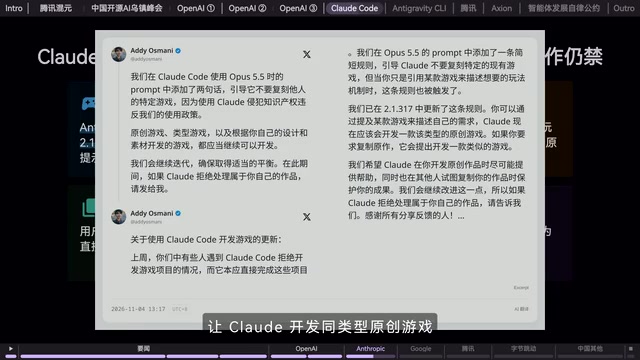
Anthropic adjusted game development restrictions in Claude 2.1.3 (recorded in the source material as CodeCode 2.1.3): users can describe the gameplay of an existing game and have Claude develop an original game of the same genre without being rejected; requests to replicate the original work will still be refused, and the official guidance only suggests developing games with a similar experience.
AntiGravity CLI released version 1.5.0, building MCP directly into the command-line editor so it can be used as your own agent. The sidebar Q&A feature BTW also supports reading files and invoking tools mid-conversation.
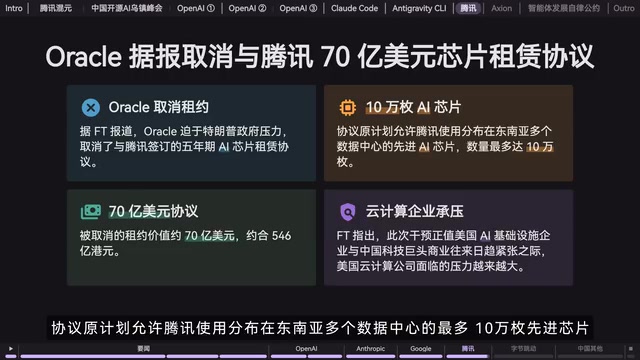
There is also a major industry rumor: according to reports, Oracle cancelled a $7 billion AI chip leasing agreement with Tencent under pressure from the Trump administration. The agreement would have allowed Tencent to use up to 100,000 advanced chips distributed across multiple data centers in Southeast Asia.
Open-Source Racing and Safety Governance Are Accelerating in Tandem
Looking at these stories together reveals a clear rhythm: Hunyuan 4 demonstrates improving productization capabilities of open-source models through a sharp drop in hallucination rate; ByteDance lowers the barrier to Agent reproduction by fully disclosing training code and data; and DeepSeek acknowledges the security costs of open source at Wuzhen while advancing model tiering. As the open-source camp accelerates its pursuit of capabilities, governance frameworks are also gradually being filled in through corporate self-regulation. For developers and enterprises, what truly needs to be evaluated going forward is not just benchmark rankings, but also the changes in usability and compliance costs brought about by the implementation of model tiering.
One-line Summary
Tencent Hunyuan 4 released, DeepSeek discusses open-source safety, ByteDance open-sources Agent model—open source and governance accelerate in tandem.
Paragraph Summary
The article rounds up several major AI developments from the day. Tencent released the official version of Hunyuan 4, adding visual understanding and computer operation capabilities for the first time, with internal evaluation showing the hallucination rate dropping from 15.76% to 5.45%, and plans to open-source it soon, while acknowledging a remaining gap with top closed-source models on tasks such as frontier mathematics. At the Wuzhen Summit, DeepSeek said open source may amplify some security risks and that it is studying model tiering, but remains committed to open source to accelerate AGI; the same day, CAICT and multiple companies released a self-discipline convention on agent development. ByteDance open-sourced an Agent foundation model in 35B and 122B sizes, releasing training code and about 18,000 data samples. Other news includes leaked ChatGPT family subscription configurations, India's weekly active users surpassing the US, and Oracle cancelling a chip leasing agreement with Tencent.
Related articles

Full AI Comic Drama Workflow with WorkBuddy: 8 Steps from Zero to Final Cut
A complete eight-step WorkBuddy workflow for making AI comic dramas: topic planning, script and storyboard, image assets, video generation, voiceover, editing, and publishing, plus WorkBuddy's expert-skill mechanism and tips for summoning experts one by one. Suitable for beginners.

Codex Practical Tutorial: From Installation to Multi-Agent Collaboration
Based on a Bilibili Codex practical tutorial, this article systematically covers installation and configuration, CLI interaction, slash commands, AGENTS.md architecture, the MCP protocol, multi-agent collaboration, and enterprise plugin development, helping developers understand engineering usage of AI Agents.

AI Agent Practical Guide: Building an Enterprise-Grade Agent from Scratch
A beginner-friendly guide to AI Agents: the difference from traditional programs, the perception-decision-action loop, technical evolution, the enterprise tech stack (LLM, tool calling, memory, RAG), and use cases.